Fatherless fathers and a long line of strong women

Have you ever thought about what traits you may have inherited from you dad and mum? The obvious answer is “of course”, we all have, whether we are interested in genealogy or not. But why not go further back and try to find out what our more distant forebears have passed down -or should have passed down- to us?

Take my father’s line, for instance: a long line of Italian forefathers who fought against poverty and bitter personal circumstances -not always unselfishly, I have to say. Going back in time up the “patrilineal line” (that is, the unbroken chain starting with my father, grandfather, great-grandfather, and so on) from whom my brother and I are descended, I come to a rather sad, yet revealing conclusion. My starting point is, obviously, my last male-line ancestor, a man I can scarcely imagine called Giuseppe Ameglio, who would have been born roughly at the end of the 18th century in what is now Northern Italy. As I have very few references about him, all I can say is that he lived in a small market town and that he lived long enough to see two of his children marry in the early 1840’s. So far so good. Things start to change, however, with when we come to the next generation.

Giuseppe’s son Gerolamo was born in 1815 and had several children with his wife Francesca. Sadly, as life expectancy at the time was much shorter than today, I can’t imagine Gerolamo living much longer after the birth of his son Vincenzo (my great-great-grandfather), who was born when Gerolamo was already a mature man of 44. Vincenzo’s plausible and probable lack of a father-figure may have contributed to his uneasiness around his own family, and would certainly explain why Vincenzo abandoned his young wife and unborn son when he was in his 30’s.

The taint of being fatherless did not dilute itself with Vincenzo. When his only son, Giacomo, became a widower many years later, he too didn’t seem to be excessively knowledgeable about how to bring up a young son, and therefore sent the four year-old boy (my grandfather Peter) from America to Italy, to be reared by the child’s stern grandmother. The kid remained in Italy until his father found a second wife, but by the time young Peter came back about ten years later, his father was all but a complete stranger to him. The relationship between father and son seems to have been strained, and would ultimately lead to a complete break after Peter returned from the war. Peter grew to become an attractive, carefree young man, and in line with his roguish character abandoned my pregnant grandmother in War-torn England in the mid-40’s. I’m not sure it’s up to me to forgive him, particularly at this stage in life, but I probably would be able to forgive him now I have reached the sad conclusion that he came, as I have recently realised, from a long-line of fatherless ancestors.

But if fatherlessness is the main characteristic I have inherited through my father’s line, I’d like to think that mental and moral strength is what may have been passed down my mother’s side.

My distant ancestor, Antonia, lived a long life and brought up ten children of her own with her husband at her side; their youngest daughter, Joaquina, was either strong or foolish enough to marry a man old enough to be her father (or grandfather even). Of course, she soon became a young widow, and thus had to face the unenviable task of bringing up six young children on her own. One of her daughters, Dolores, married when she was already pregnant, but was soon left to fend for herself when her husband abandoned her and the baby, to start a new life and family in Argentina (I am currently researching whether the second family was the product of a marriage, in which case he would have been a bigamist). The girl he left behind, Josefa was luckier than her mother, in that she seems to have found a good and faithful husband, but she too was left a widow at a young stage in life. Incidentally, her mother-in-law also seems to have been a strong woman, having lost both her parents and her first husband within a few days of each other, during the 1854 cholera epidemic). Josefa’s daughter, my great-grandmother Lola, also became a widow somewhat prematurely, but by then she could find comfort in her large and expanding brood of children and grandchildren. This large family would have given her much happiness and peace of mind in the winter of her days, I suspect. My grandmother too learned to lead a peaceful life despite losing her husband in her early 60’s, not to speak of my own mum, who has managed to battle cancer and overcome many griefs over the past few years with great courage and strength of character.

Which traits have I inherited, I wonder? Alas, this remains to be seen.

Posted in Argentina, Bigamy, Birth, Death, Divorce, Emigration, England, Galicia, Genealogy, Illegitimacy, Italy, Marriage, Spain, United States, War, Women | Leave a comment

O Father, Where Art Thou?

Gosh! Almost a month has gone by since I last posted on the old blog – and yet I have so many things to tell you all! I think I’ll start with the most recent -and exciting- piece of genealogical news: the unravelling of my great-great-great-grandfather’s story after he deserted his family in Spain and started a new life in Argentina.

Elkanah, the father of Samuel, is mentioned in the Bible as having had several wives.

Elkanah, the father of Samuel, is mentioned in the Bible as having had several wives.

You might not remember the case of Juan Blanco, which I wrote about just over a year ago (click here if you want to refresh your memory). Juan was one of my Spanish ancestors born towards the middle of the 19th century and by all accounts something of a rascal. All I ever knew about him was that he came from a family of very modest means (both his parents were poor agricultural labourers), and that after marrying young he and his wife had a daughter, Josefa, before he abandoned them both in order to start afresh (and start a new family, allegedly) in South America.

In 1887 Juan’s estranged daughter Josefa married a local called Manuel Romero, who later tracked his wife’s father in Argentina. Family legend has it that my great-great-grandfather Manuel actually went over at some point during his marriage and found out that Juan had a second family in Argentina. He had a good reason to travel to South America: I recently found a reference to Manuel in a slim volume about Galician emigrants (called gallegos) who went to Latin America in the 1800’s and 1900’s. He appears to have been the Banco de Comercio Hispano-Argentino‘s correspondent in Puerto del Son, where the family lived at the time. This all fits in perfectly with the family story I’ve been told about Manuel being a banker.

Juan Blanco was not at all pleased by the sight of his new son-in-law, who later informed his family that Juan had started a new family in Argentina. But that’s all we knew, until now.

A quick look on familysearch.org enabled me to track down a man called Juan Blanco, of about the right age, married and with a son, who had been recorded in the 1895 Argentinian census. However, Juan Blanco is a relatively common name in the Spanish-speaking world, and without an explicit reference to Juan’s exact birthplace or second surname (remember that Spaniards have two surnames, not one) it was almost impossible to confirm whether this was indeed my great-grandmother’s grandfather.

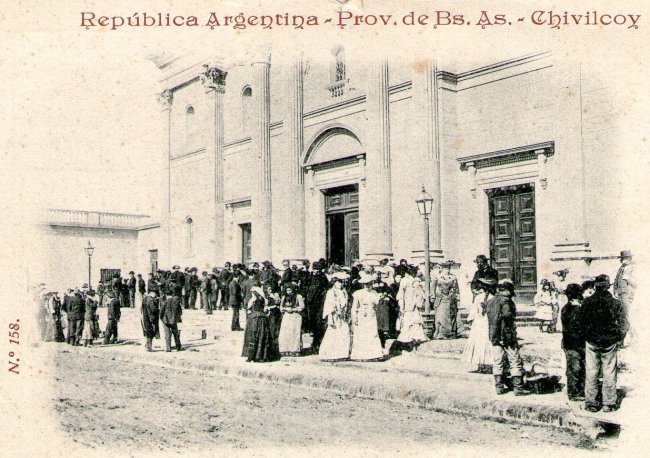
Chivilcoy, in the early 1900's.

Chivilcoy, in the early 1900’s.

Yesterday, a distant relative who lives in Uruguay and who, like me, was infected by the genealogy bug some years back, told me that the Spanish Consulate in Buenos Aires had written to inform him that they had found Juan’s death certificate, and that he died in 1914 in the Argentinian town of Chivilcoy. Bingo! That is exactly where the Juan recorded in the 1895 census actually lived.

I then had another look at the census return, this time knowing that it’s my Juan Blanco recorded on the form. I also managed to get a clearer image of what Juan’s life in Argentina must have been like. Although in Spanish documents he was described as a simple agricultural labourer, in the census he is down as an industrial, which I guess could mean anything. Given the fact that he seems to have lived in a fairly run down area of town (his neighbour is, would you believe it, a prostitute!), I suspect he may have been a simple shop-keeper, or ran a similar sort of business.

The big surprise for me is that he had a son, also called Juan, born around 1881, a year after his father allegedly married his mother, Constanza. If Juan Blanco (Sr.) actually married Constanza in 1880, he would have been a bigamist. I wonder how much Constanza knew about her husband, and what she made of his son-in-law’s visit a few years later… Time to start searching for a marriage certificate!

Posted in Argentina, Bigamy, Emigration, Genealogy, Marriage, Spain | 3 Comments

How did our ancestors celebrate Christmas?

The carols, the weather, the lights, the shopping for presents and the endless meals with the loved ones. Yes, Christmas is back!

It seems strange that, not too long ago, Christmas was seen in a very different light compared to what this festive season has become today. One could even say that Christmas is a “modern” festivity. Naturally, it depended on where your relatives lived and what faith they adhered to -unlike the world of today, where globalisation and growing agnosticism have made Christmas an international celebration.

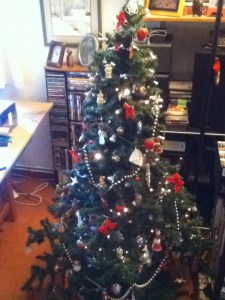
photo (19)

Our Christmas tree – photo by Dawsr.

Two hundred years ago, my English ancestors would have celebrated Christmas like anyone else (i.e., in a very “quiet” way). By the start of the 19th century, Christmas was not that important; in fact, many shops were kept open on 25th December because owners simply did not consider it a holiday -the first ever Christmas card was designed as late as 1843! But after Queen Victoria married Albert of Saxe-Coburg in 1840, many German traditions -such as the setting of a Tannenbaum or Christmas tree– were introduced to British society. In 1848 the Illustrated London News ran a sketch of the Queen, the Prince Consort and their small children standing around a fir-like tree which was decorated with glowing candles and small ornaments like sweets, gifts and fruit; this seemed trendy, and it simply caught on. Households were also elaborately decorated, not with evergreens and twigs -a Medieval custom-, but with paper, candles and other hand-made ornaments.

Another quintessentially British tradition at Christmas which began with the Victorians, that of pulling apart Christmas crackers, began when a confectioner called Tom Smith travelled to Paris. It was in the French capital that he first saw bon-bons (a type of sugared almonds wrapped in twists of glossy paper). Having substituted the sweets for paper hats and trinkets, Smith’s adaptation has turned crackers into a typically British Christmas element.

The exchanging of gifts was a tradition that already existed by the dawn of Victorian England, but it usually took place on New Year’s Eve; it gradually shifted towards 25th December as Christmas gained adepts every year. Gifts were initially hung from the newly-introduced Christmas tree, but as presents became larger and bulkier, they were soon placed under the tree itself.

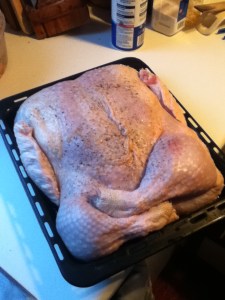
Our turkey, ready for the oven!

Our turkey, ready for the oven!

Eating turkey on Christmas day was also a Victorian invention; in fact, people ate goose or beef until then. Mince pies were eaten in December since Tudor times, but originally contained meat. Christmas carols were also exploited during the 19th century, only this time they tended to adapt old songs and lyrics to new tunes -which incidentally became a huge success. Christmas pudding, on the other hand, is a Medieval creation adapted -yet again- by the Victorians, and was initially intended to be made of 13 ingredients, representing Christ and the Twelve Apostles.

Naturally, those less favoured by their economic situation had fewer privileges than the rich, even at Christmas. But they still enjoyed the odd celebration or two, usually with the blessing of their employers. Servants had a lot to do in large country houses, where large dinners would take place to celebrate the Yuletide. I can imagine all my ancestors who were in service working terribly hard on a day like today. Thus, they were given the day after Christmas, 26th December, as their day off, and usually received small boxes containing gifts from their lord and master. The term boxing day may derive from this tradition, though its etymology remains disputed. For my English grandmother, Boxing Day must have been a rather significant date -after all, she too was in service for a while- and so she decided to get married on Boxing Day, 1939, with the Second World War already raging.

photo (18)

In Spain, the birth of Jesus Christ is still held as the main purpose of celebrating Christmas – photo by Dawsr.

On the other hand, my Spanish ancestors would have celebrated Christmas very differently from their English contemporaries. In traditionally-Catholic Spain, Christmas was seen as a very important holiday, as it celebrates the birth of Christ. A tradition carried on by many people even today was to attend mass at midnight on Christmas Eve, followed by another mass at dawn on Christmas day.

Food is also central during Christmas in Spain, but turkey has never been part of the Christmas menu. Instead, in coastal areas like Galicia people prefer to eat fish (such as cod and cauliflower) on Christmas Eve. Then, on Christmas day, capón (stuffed chicken) was served if the family’s economy allowed; otherwise plain chicken, which was considered a luxury in times of hardship, followed by a tray of marzipan and Spanish nougat (turrón) for dessert, was served.

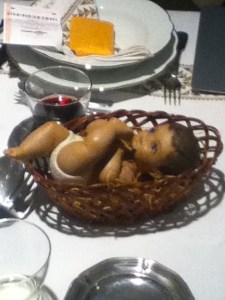
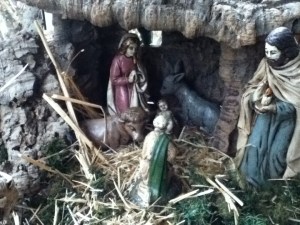
Our crib - photo by Dawsr.

Our crib – photo by Dawsr.

There was never a Christmas tree in sight a few years ago in Spain. Instead, people would set up a crib and sing carols celebrating the birth of Jesus. On Christmas Day, presents were never or rarely given; this was actually carried out on 6th January, after Twelfth Night, to celebrate the arrival of the Three Wise Men to Baby Jesus’s side. Children who misbehaved were warned that they would get coal instead of presents, which popularised the idea of selling a black, coal-like type of sweet (carbón). On 6th January, after lunch, families eat roscón, a large, doughnut-like dessert decorated with candied fruits and containing small toys or -even better- coins! So mind how you chew! The celebration over, the next task is to take down the Christmas decorations, including the crib… but that’s another story.

Wherever you are, and whichever way you celebrate Christmas, I hope you have a Merry Christmas!

Posted in Genealogy | Leave a comment

Adopting new attitudes towards adopting

Have you ever considered adopting a child? Whether the answer is yes or no, I’m sure that at some point in your life you’ve come across families with an adopted child or children. In fact, adoption is an alternative regulated in Britain considerably late in comparison with other countries like the United States. Before that time, adoptions were unregulated, unofficial and very often took little notice of the child’s interests and well-being.

These primitive adoption “procedures” involved very little paperwork -if any at all- and adoptive parents were free to alter the child’s identity (name, surname, official place of birth…) to better suit their purposes which led them to adopt the baby in the first place. This makes tracing the biological parentage of our adopted relatives much more complicated than if the adoption had taken place in more recent times. The inter-war period, with all its traumas and social changes, saw many women give up their children for adoption for new, terrifying reasons: single mothers were still too afraid to face society if people found out they had had a child out of wedlock; money was a problem for many large families in post-war Britain and elsewhere, so giving a child away for a certain amount of money may have seemed like a feasible exit to their financial difficulties.

However, many saw adoption as a threat to family stability, because it made the prospect of regulating a system whereby a single mother could give away her child “easily” seem highly immoral. Others found that adoption might pressurize women to give up their babies in an all too accessible way.

In previous years, adoptions were also used as a smoke screen to hide a clear case of illegitimacy. If the baby’s mother was, say, a teenager or a girl in her early 20’s, the baby could be passed as her much younger sibling without much difficulty (although how the grandmother-turned-mother managed to explain the lack of a pregnancy is beyond me). Considering social prejudices at the time and wishing to avoid the stigma of being a single mother would also make the choice of giving away a child as a rather fortunate “blessing” – although the results for the mother in most cases must have been traumatic.

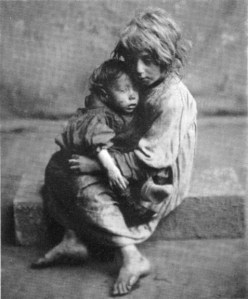
Poverty may well have been among your ancestors' reasons for giving a child up for adoption. Source: http://grayee.blogspot.com/2010/11/2010-christmas-carol.html

Poverty may well have been among your ancestors’ reasons for giving a child up for adoption. Source: http://grayee.blogspot.com/2010/11/2010-christmas-carol.html

Adoption procedures began to be regularised by the 1920’s, and peaked four decades later, the Second World War having practically destroyed all sorts of prejudices towards single mothers. By the late 60’s adoption numbers started declining, until these days most children given up for adopting come from an emotionally torn household or are otherwise physically or mentally impaired. Naturally, today the child’s interests are central, and other considerations like cultural differences (in cases where the baby is from a different country than that of the parents, for example) are taken into account. The profile of adoptive parents has also changed. In the 19th century, married couples were almost exclusively the only social group to adopt children. Then, between both World Wars, many single women (and some single men too) chose to adopt children. Today, potential parents can be found in all kinds of households, whether the prospective parents are single, married, heterosexual, gay, and so on.

My own “adoptive child story” centres around the figure of Auntie Ivy, my great-grandmother’s youngest “sister”. Unlike my grandmother and her siblings, who were all born in the county of Hereford, Ivy was born in Worthing (Sussex), a great distance from rural Herefordshire in those days and as far as I knew a place wholly unconnected with my family. We always knew Ivy had been adopted; some years ago I managed to contact one of her descendants and they told me about about how Ivy got to be taken in by my grandmother’s grandparents. It turns out Ivy’s father, a coachman, was killed when a fire broke loose in the stables where he worked in Worthing. A bit of census research showed me than Ivy had four elder siblings, none of whom were ever adopted -as far as I know. The census form also showed that Ivy’s mother, Elizabeth, came from Herefordshire. Was this a coincidence, or the key to solving the mystery of Ivy ending up in that part of the world? Indeed, after a few hours’ research I managed to piece together a new line of the family tree which explained a lot of things. Elizabeth, who had been widowed by the age of 31, was left to bring up five children aged between 12 and 1. Unable to cope, she sent baby Ivy to live with her first cousin Samuel, who was the son of Elizabeth’s aunt Ellen. After all, Samuel and his wife had lost two babies by then (one at birth, the other in infancy), so the arrival of little Ivy must have seemed like a fortuitous second chance for them.

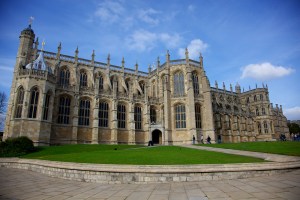
St George's Chapel, where adoptive Auntie Ivy's son is buried.

St George’s Chapel, where adoptive Auntie Ivy’s son is buried.

Therefore, Ivy and her adoptive siblings were really second cousins, and from what I hear, Ivy never went back to Worthing. In fact, she married in Shropshire in 1917 and enjoyed a long-lasting marriage which was blessed by the birth of three children. One of them, Maj. William Lancelot Arthur Nash, M.V.O., M.B.E., was in the Grenadier Guards and became Superintendent of Windsor Castle. He died in 1983 and was buried in Saint George’s Chapel, on the grounds of Windsor. as you can see, adoptions can be full of surprises and many reveal interesting facts about your closest relatives.

Posted in 1891 Census, Adoption, Birth, Death, England, Genealogy, Herefordshire, Money, Shropshire, United States, War, Women | 1 Comment

A Matriarch’s Ordeal

Now that the weekend has slowly ebbed away, I can positively say that I wasted it away completely. Well, not entirely, because I spent most of it double-checking some collateral lines in my family tree which I had neglected for quite some time. You see, a family tree is like a bonsai tree, like a house plant: if you ignore it, you’ll forget it, and before you know it it will have become dated, aged, old, a stranger, and sooner or later, it will be as dead as the motives which led you to keep it in the first place. So please, people, don’t neglect your ancestors – or your house plants!

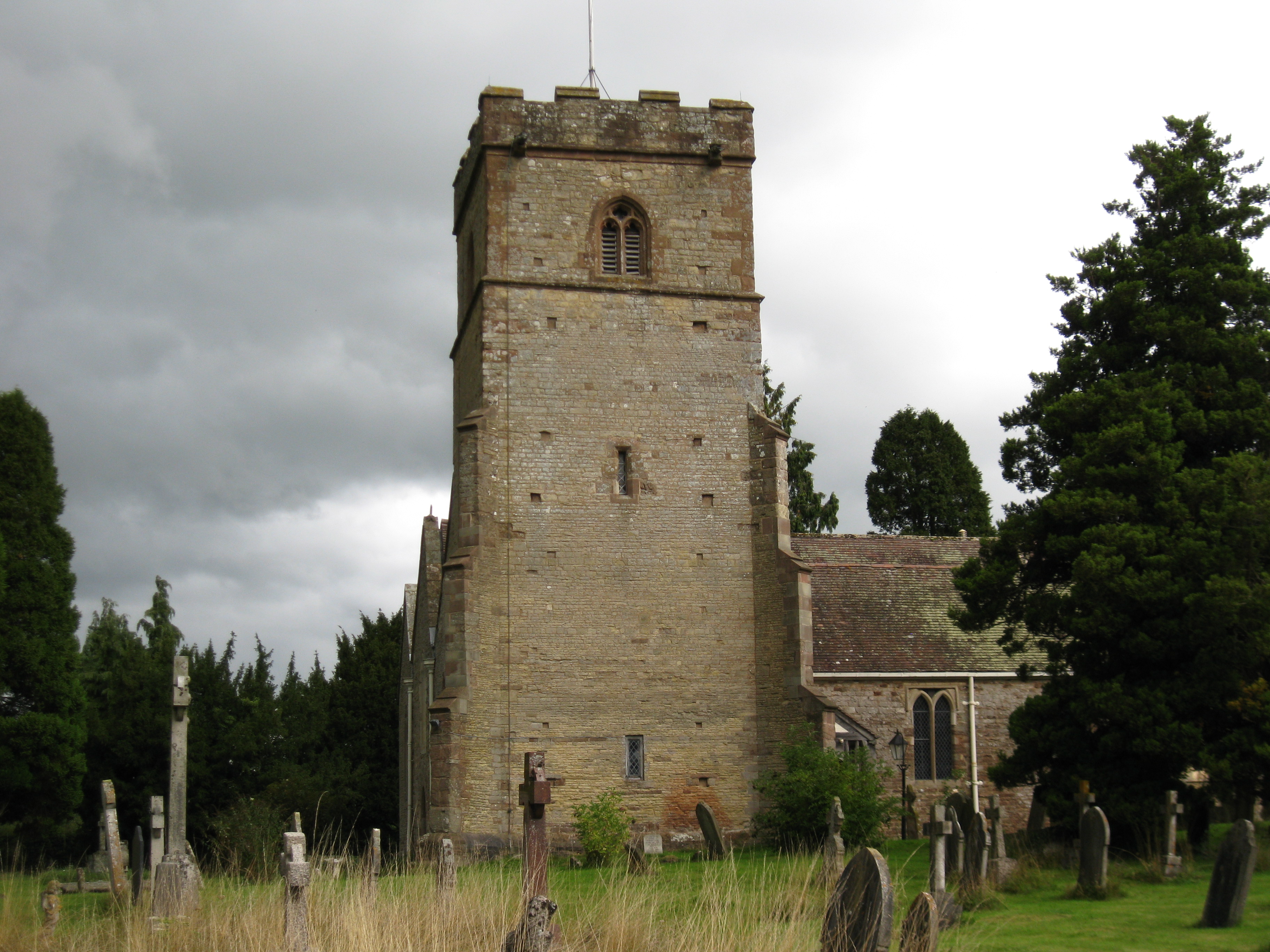
Colwall church, dedicated to St James the Great, 2010.

One of the many interesting things I have found over these last 48 hours is the story of Mary Willoughby, a very distant cousin related to me -I believe- through an 18th-century ancestor we both share. To be honest, I know very little about Mary herself. She was born in the Herefordshire village of Colwall in 1855, probably in spring or the summer, for her baptism took place in August of that same year. She had a younger sister, Sarah Anne, who died in infancy, and an elder sister, Martha, who by the 1870’s was enjoying (or enduring, who knows?) connubial life in nearby Staffordshire and churning out babies.

Mary herself soon ventured into matrimony, choosing as her companion a man almost a decade older than herself called Thomas Eacock. The Eacocks and the Willoughbys were close relations, as Thomas’s uncle John had married Mary’s aunt Elizabeth in 1840; this leads me to believe that someone in the family may have influenced Mary and Thomas to lure them into marriage.

Whatever the nature of the match, Mary soon became pregnant, and by 1884 had given birth to two sons , Harry and Gilbert, who were duly baptised in the local church of Saint James the Great. The next census, taken in 1891, revealed a drastic change in Mary’s personal circumstances. No longer the wife of Thomas Eacock, she is listed as the wife of a 70 year-old man named Adam Clarke, a butcher-turned-grocer from nearby Ledbury. Mary’s 9 year-old son Arthur is also living in the same household, while 6 year-old Gilbert is spending some time with his widowed maternal grandmother, Sarah Willoughby (née Smith). Despite their age difference (Adam was almost 30 years older than Mary), the couple also decided to start a family together, and by 1891 had welcomed two more babies into their household.

My next task was to try and find a marriage for Mary Eacock and Adam Clarke, whose wedding presumably would have taken place sometime between the death of Adam’s first wife (in 1887) and the birth of Adam’s first child from his marriage to Mary (1889). With such a narrow gap, it seemed odd that the marriage would be untraceable, and yet that is indeed the case. Considering the possibility that Mary’s second marriage may have gone unrecorded, I then thought of looking for her first husband’s death somewhere in the mid-to-late 1880’s. Again, I drew a blank.

I then decided to be a bit more open-minded about Mary’s story. Even at a time when social conventions were, to say the least, much more constrained than today, could her remarriage have taken place in some sort of unconventional way?

The1891 census again held some interesting clues. Not only had it revealed to me that Mary had started a new life by the side of old Adam Clarke, but it also showed that her first husband, Thomas Eacock, was still alive! Amazingly, Thomas and Mary’s marriage had broken down for some reason or another; the lack of existing records, as well as the improbable means that the couple would have had to cover the expenses for a divorce, make the idea of an official marital dissolution seem highly unlikely. There is a chance, I suppose, that the marriage was declared null and void for some reason, though the existence of two small boys discards any suggestion of sexual impotence on Thomas’s side.

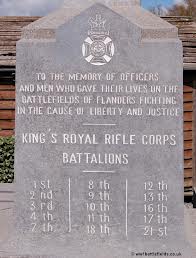
Memorial to the King’s Royal Rifle Corps. Mary Willoughby’s son Reginald Clarke belonged to the 18th Battalion. He was killed in Flanders in 1916.

Whatever their reasons for parting, Mary and Thomas continued to live in Colwall (separately) for a while. We know that by 1901 Mary and her new, second family (together with her sons from her first marriage) had moved north to Yorkshire. In the meantime, three more babies had completed her common-law marital bliss with Adam. Meanwhile, Thomas Eacock remained in Colwall; his personal story seems to have been less exciting than his former wife’s, for he remained a constant companion to his widowed mother until her death in 1894, and never having remarried, died in 1904.

Mary’s “husband” Adam Clarke died in 1909 after fathering five children with her (he was also the father of at least five children from his previous marriage, some of whom were older than their new step-mother!), but Mary lived on ten more years. The Great War was very cruel to her, for one source mentions she lost two sons during the war (one loss has been confirmed, the other I need to check). In honour of one of them, called Reginald, Mary wrote a moving poem which commended her son’s comradeship, dedicating it to “A kind and faithful son. A good brother. A true pall. Was loved by all who knew him” and ends the short eulogy with the touching phrase “But watch and wait for me, dear lad, to meet in Paradise”. Her wish was granted in 1919, when she died aged 64.


Posted in 1891 Census, 1901 Census, Bigamy, Colwall, Divorce, England, Genealogy, Killed In Action, Marriage, War, Women, Yorkshire | Leave a comment

Lest We Forget

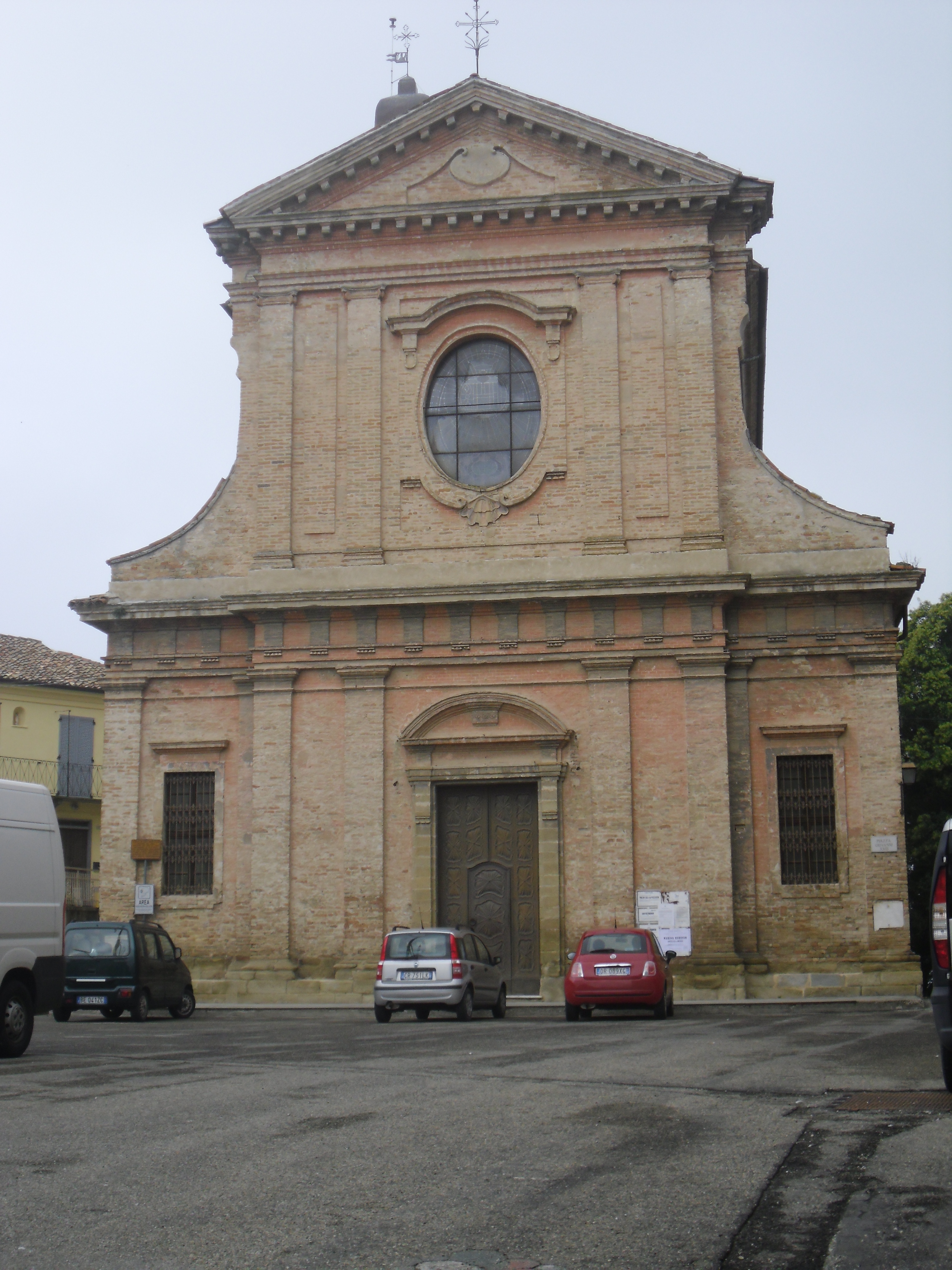
The local church of San Marziano, where my great-great-uncle was baptised in 1886.

One cannot face November 11th without thinking of the year 1918, when the guns in Europe went silent for what was thought would be the very last time. I doubt there is one among you who can seriously claim to have ancestors untouched by the terrible events which took place in Europe (and other parts of the world) between 1914 and 1918.

Today I thought I might try my luck and see if I could find some information about my great-grandmother’s brother Giacomo, mentioned in my previous post. The facts about Giacomo are very scarce and hardly tell me much about his life. The fact that he completely vanished from the face of the earth after 1910 makes him all the more interesting to research, I think.

Giacomo was born in the small Italian village of San Marzano Oliveto on 27th March 1886; he was christened in the local church of San Marziano the following day. He was his parents’ first child. His father, Pietro, was also born in San Marzano, but his mother Maria Maddalena (known as Amalia) came from nearby Nizza Monferrato, where she married Pietro in 1884 when she was just fifteen years old! The couple went on to have eleven other children (including three sets of twins), but unfortunately at least three (possibly five) died in infancy.

Giacomo’s family was not rich, and owned a simple chunk of land which must have given the family enough means to live on, but not much more. It is easy to imagine Giacomo’s ambitions pushing him to seek a better life elsewhere, which is precisely what he did.

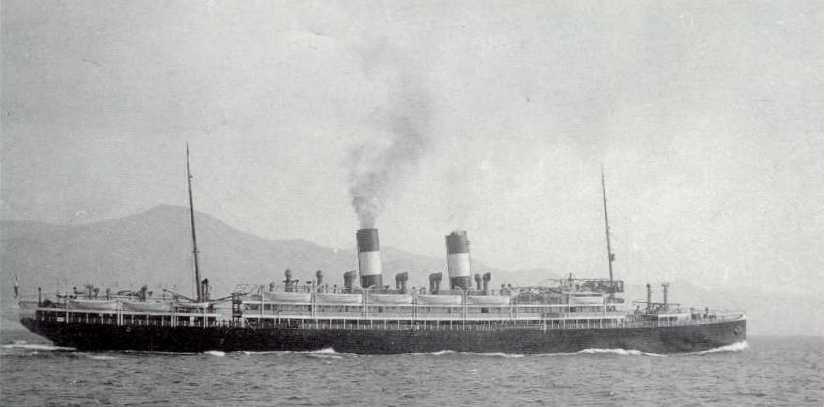
The SS Duca degli Abruzzi, which took Uncle Giacomo to New York from Genoa in 1909. He was only 23 years old at the time.

With the arrival of spring, 23 year-old Giacomo packed the few possessions he owned and made his way to the port of Genoa -in a time when trains would only have connected larger cities, I imagine he completed the trip in some sort of horse-drawn cart. On 28th April 1909 the Duca degli Abruzzi sailed from Genoa with several hundred passengers on board (mostly Italians leaving their land to start afresh in America), including my great-great-uncle. The double-screw steamer crossed the Atlantic at a maximum speed of 16 knots (the Titanic, which was already being built in Belfast at the time, had an average speed of 21 knots). The vessel arrived in the port of New York on 10th May 1909 after a stop-over at Ellis Island to check for sick passengers and Giacomo made his way to a friend’s house, Giuseppe Bussi, in New York City.

Brown-eyed Giacomo remained in New York for at least a full year. In 1910 the US Federal Census was taken, and it shows that in his first year in America, Giacomo had managed to find work in a hotel, where he worked as a “silverman” (presumably someone in charge of the hotel restaurant’s silver). At the time he was living with some friends, the Pesce family, on 9th Avenue. The address would later prove to be significant because that same year my great-grandfather moved to that same address, presumably met Giacomo (unless they knew each other from back home in Italy) and two years later married Giacomo’s sister, my great-grandmother Giovanna.

However, Giacomo’s trail goes cold after 1910. There is simply no further record that I can find of him in the New World after that date. There is a chance that any records of him (either later census entries, marriage/death records, etc.) have been misplaced or wrongly transcribed onto the Internet, which might explain why I can’t find a single further detail about him online.There is also a possibility that he went back to Italy, and if so, he may well have died during the Great War, the end of which we celebrate today. If that were so, his name may have been recorded somewhere, and indeed the War Memorial in his home-town mentions a man with Giacomo’s exact name and surname.

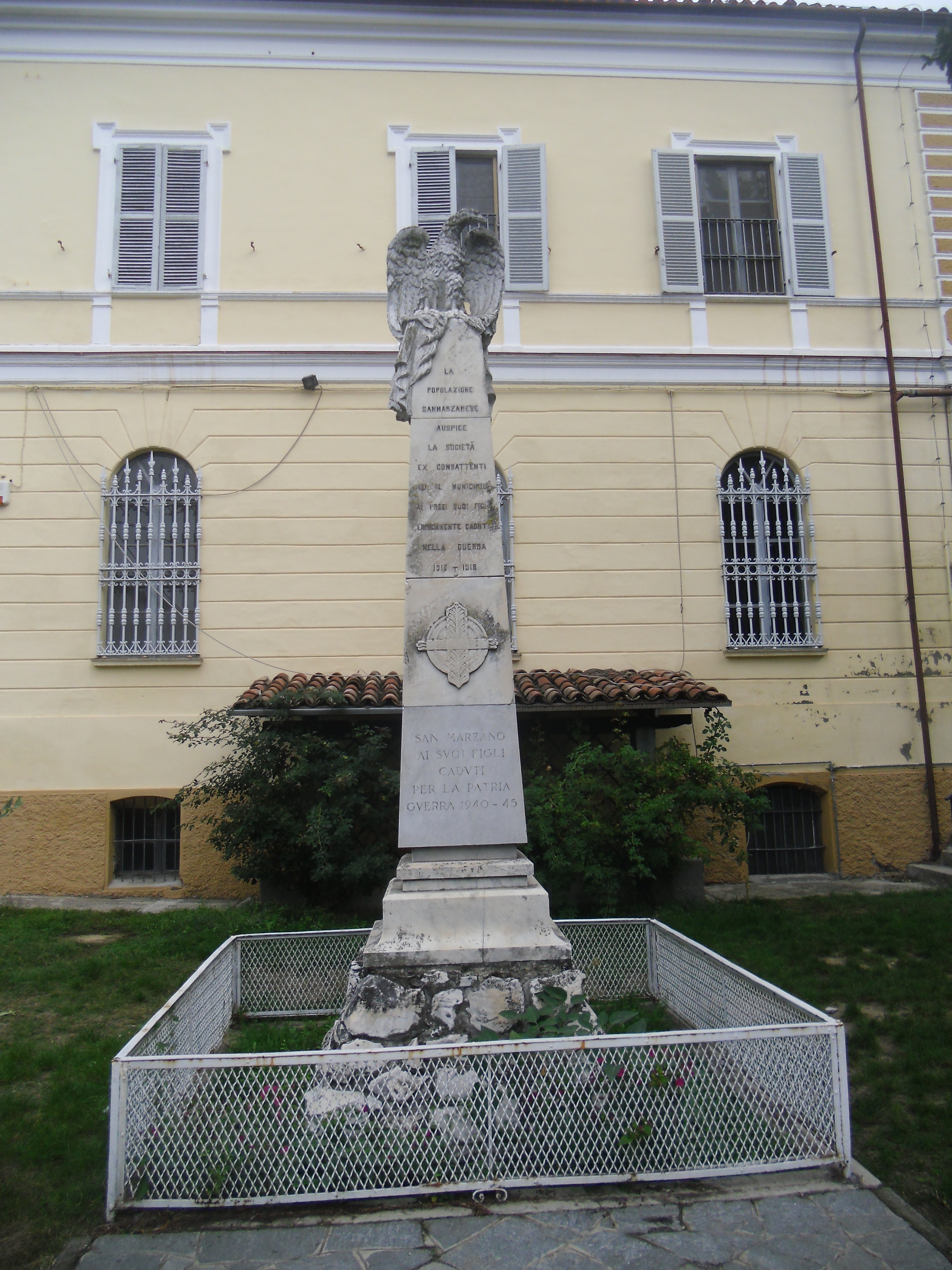
The misleading War Memorial in San Marzano Oliveto.

It took me a while to find a seemingly reliable source online which actually mentions -by name- Italian soldiers who were killed in action during WWI, or else succumbed to disease while in service for King and Country. If you follow this link you’ll find a section called “Cerca negli Albi”; click on it and you will see five numbers; each one comprises a short list of contents listing Italian regions alphabetically. As I am searching for a presumed soldier from  San Marzano Oliveto, which is located in the province of Asti, I click on Nr. 3 and then click on 15 (Piedmont AL-CN meaning Alessandria to Cuneo provinces). Then you will have to search for the soldier you are looking for by surname; click on “Mostra la pagina” when you find the link which would include the surname range (again, sorted in alphabetical order) and scroll up and down the opening page until you find the soldier in question. I managed to get to the page where my great-great-uncle Giacomo would have been recorded, and make two interesting discoveries: one, that my Giacomo is not the one listed on the War Memorial in his home-town, and two, that there were actually two Giacomos with the right surname who died during the Great War. However, neither is the son of Pietro, with one being the son of Francesco, the other the son of Giovanni; their birthdates, which are also included, confirms this much. Although there is no doubt in my mind that both soldiers were almost certainly related to me some way or other, they are certainly not my father’s great-uncle. A new dead end for me, though.

I search the records elsewhere and find that there is, curiously, a Giacomo who fits my relative’s description (name, surname, age & country of origin) living in England (Bloomsbury, of all places) in 1911; besides, he works as a pantryman in a restaurant, which sounds promising as I know for a fact my great-grandmother’s brother worked in a hotel. However, I meet a new dead end when I realise that not only is he living with three other brothers (none of whom match my recently-discovered relatives in Italy), but perhaps more damaging to my theory is the fact that this man was already living in Soho in 1901; I find it difficult to credit that he emigrated to England from Italy, then went back to Italy, emigrated to New York, worked there for a year and then made it to Bloomsbury to be recorded with these three unknown brothers in 1911.

The question remains, what happened to great-uncle Giacomo? If Flanders Fields did not claim his life, where did he end up? Can anyone out there shed any light on him? Please!

Posted in 1901 Census, 1910 US Census, 1911 Census, Birth, Death, Emigration, England, Genealogy, Italy, Killed In Action, Ships, United States, War | Leave a comment

Piecing together my Italian great-grandmother’s (huge) family

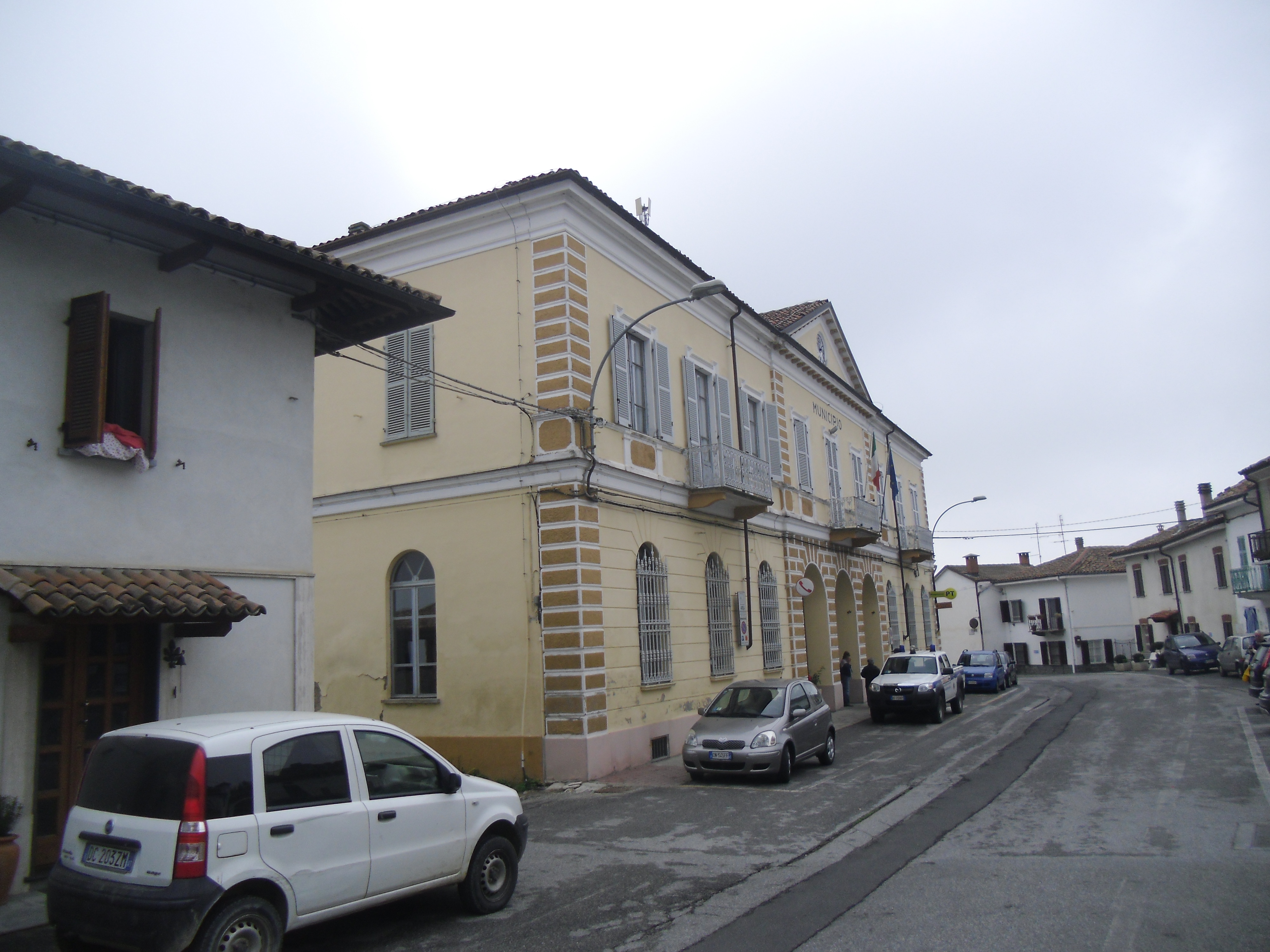
San Marzano Oliveto’s municipio.

Well, here I am, safe and sound, back in the real world for a change, and what a genealogical experience Italy has been!

This was of course the second time my father and I ventured forth  and north in search of our long forgotten (and unknown) Italian ancestors. Actually, whenever we prepare a trip of this sort, my dad always likes to nag me about how totally unrelated to genealogical research our trip will actually be. Naturally, I usually win the argument by taking him day in and day out to cemeteries, archives and registry offices. And thank God, or else we would have never found out what I am about to tell you.

We decided to stay at a three-star hotel in a small hill-top village called Alice Bel Colle, near the border between the provinces of Asti and Alessandria, in Piedmont, northern Italy. The place was rather more picturesque than quaint, and it lacked the resources of several modern conveniences like 24-h broadband connection, but or glass (OK, glasses) of whiskey and gin&tonic every night after dinner made our stay much more bearable.

On our first full day there we went, as arranged, to the municipio (town hall) of San Marzano Oliveto, the small village where my great-grandmother Giovanna had been born in 1895 and where she lived until the age of 17 it was then, at the end of 1912, that she decided to cross the Atlantic and start a new life  in New York. Three years later she married, and a year after that she had a baby son, my grandfather. Sadly, she died four years after that, aged 24, leaving my great-grandfather a young widower with an infant son to take care of.

The lady at the municipio was very interested in what we had to say about our family history, and proved to be immensely helpful. With my poor knowledge of the Italian language and a few smiles we were able to convince her to allow us to search for Giovanna’s birth certificate. As we knew the exact date, it did not take long to find her. We were also quite pleased to confirm that she had a twin sister (who was actually ten minutes older than her) and the document also allowed us to confirm the name of their parents and two grandfathers (grandmothers, for some reason, were not mentioned in either entry). Next we wanted to confirm whether an immigrant from the same part of Italy, with Giovanna’s surname and who emigrated to New York some years before she did was indeed her older brother. And indeed, we were right! In front of us was the birth certificate of brother Giacomo, my great-granny’s older brother, who in 1909 left Piedmont and decided to start afresh in America, only to vanish after the 1910 Federal Census was taken.

Noticing our interest, the lady at the town hall told us that the surname we were looking for was not very common in the village, but that there was a lady still alive who did have the same surname, and that we might try to contact her. After all, she only lived down the road!

At this stage I want to comment on a point we genealogists tend to forget. Indeed, our fascination for family history may not only lead us to uncovering our dead ancestors, but may also make us end up tracking down living cousins. However, many people are not as keen as we are, and may feel rather uncomfortable when strangers (even though closely related) turn up out of the blue. With that thought in mind, we decided not to pursue that course, and instead drove down to the cemetery, where we felt we would cause less havoc.

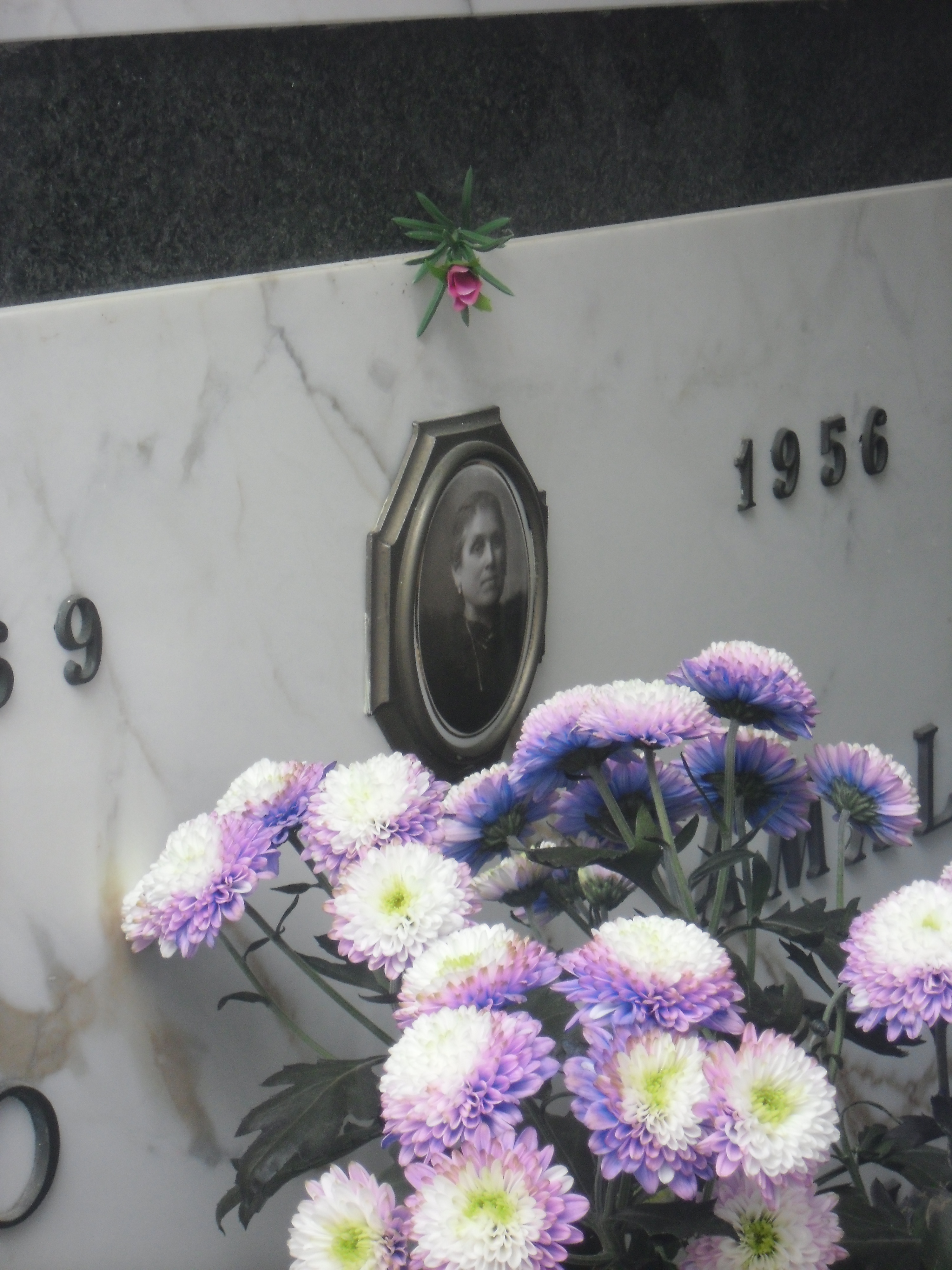
The tomb of my great-great-grandmother in San Marzano.

It was at our next port of call that we got the first of many hits during our stay. Buried side by side in the same family vault were the tombs of my great-great-grandfather Pietro and great-great-grandmother Amalia. Not only that, but each plot included a small cameo-shaped photo-portrait of each one! Crammed against the locked vault’s glass doors, my dad and I tried to get as close as possible to the photos in order to see what our ancestors looked like, and what my mysterious great-grandmother may have looked like… had she lived longer.

The inscription on the vault also gave us new clues: it stated their year of birth and death, 1859/1941 for one, 1869/1956 for the other. With that we realised that Pietro’s birth would only have been recorded in church records, his birth having taken place before Italian unification and the introduction of compulsory civil registration. However, his death would certainly have been recorded in the civil registry we had just visited, as indeed it was. Having died during the time of Fascist rule in Italy, Pietro’s entry in the death records included his race (“Aryan”). More importantly, the informant was a man called Armando, who was listed as the deceased’s son. Another son! The lady at the archive confirmed that the woman living down the road was positively Armando’s daughter, and that we should definitely look her up. Thus we drove down passed the cemetery again, and made our way to the house of our newly-found relative, Pierina (incidentally, we passed the war memorial to those who died in both World Wars; one of the names mentioned matched the information we had of Giovanna’s older brother – could this be the same Giacomo who had gone to America in 1909? Trying to find information about Italian soldiers who died in WWI is surely my next genealogical quest.) We didn’t manage to meet Pierina, our distant cousin (actually my grandfather’s first cousin) on that day, since she was out shopping and wouldn’t be back till later that afternoon, but when we rang later that evening she agreed, not without reserve, to receive us the next day. Thus we drove back to the house once again the following day and were greeted by this cousin whom we had never heard of (and vice versa). After explaining exactly how we were all related (which was somewhat confusing because I still hadn’t got everything straight in my head) we started looking at family photos. What a collection she had! Most of the snapshots were undated and unidentified so not even she knew who most of the sepia-coloured people were. But there was one particular photo which stood out among the rest: it was hanging on my cousin’s living-room wall, framed in a somewhat exaggeratedly ornate, faux-golden frame. It pictured a young woman looking steadily at the camera, and a man with a moustache, looking much more confident, standing next to her. The identity of the young woman was unknown to me, but the man was unmistakeably my great-grandfather Jack, whom I had seen in photos taken some 30 years after this particular portrait was taken. Could the young lady by his side be none other than my grandfather’s mother, the sweet Giovanna who had emigrated to America and died at only 24? A remark by my newly-discovered relative held the key to the mystery: “these are some relatives who emigrated to America, but I don’t know who they are” she said. I n my nervousness, I explained their identity, and we all gazed in amazement, my father being particularly touched at the first sight he has ever had of his own grandmother.

The rest of the visit passed smoothly and we even managed to leave with four pictures of Giovanna and her family, which our cousin kindly gave us.

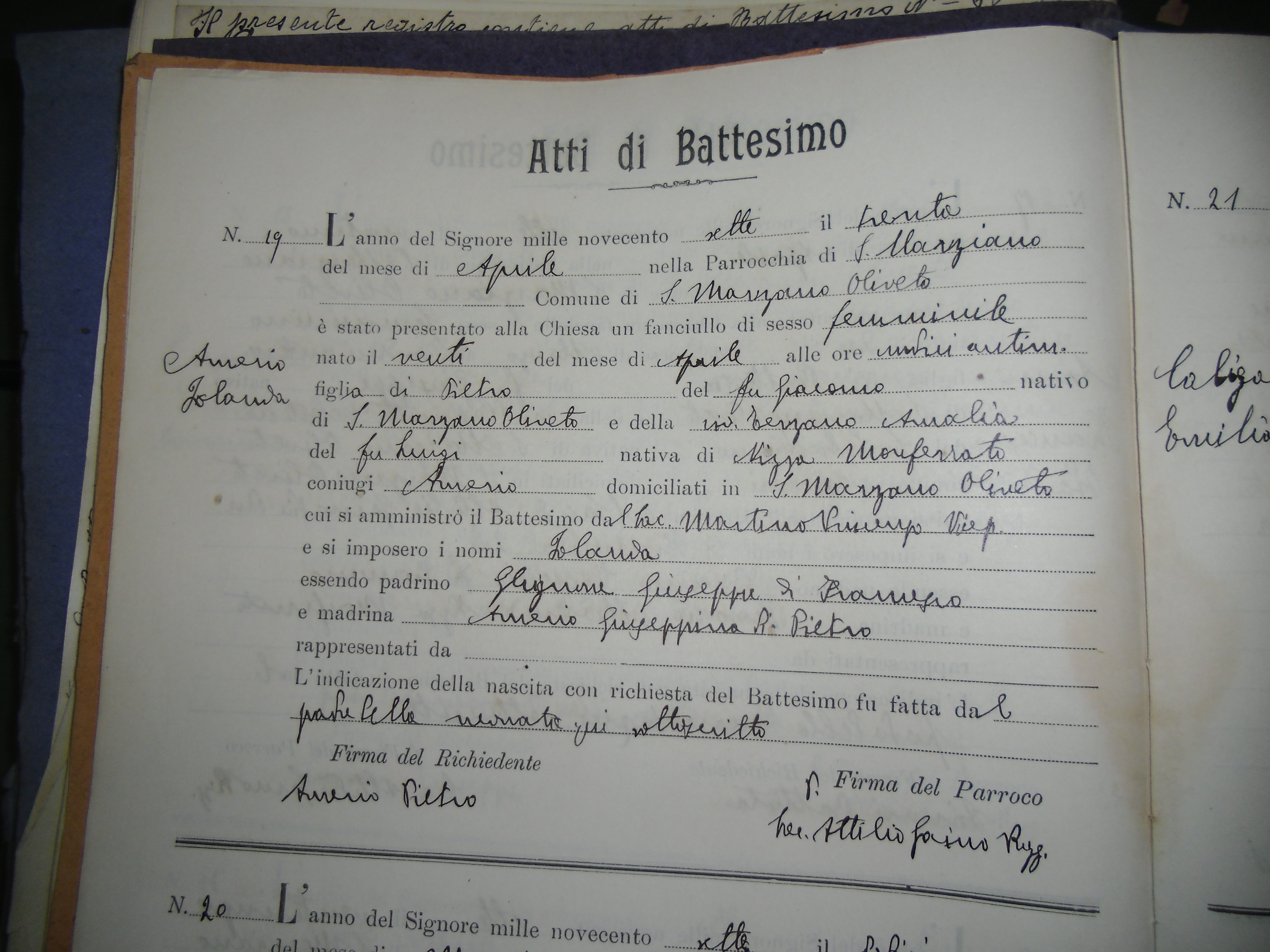
The baptism certificate of my great-grandmother’s youngest sister, who sadly died young like four of her eleven brothers and sisters.

Our next stop was the church archives, where I would be able to find out whether my great-grandmother Giovanna had any more siblings. The church records for that particular part of Italy are located in the bishopric archives in Acqui Terme; the archive itself is a cold, run-down sort of a place, but the staff were very kind and helpful, and even allowed us take pictures or make photocopies of any documents we wanted (for free!).

We successfully found my great-grandmother’s eldest brother, Giacomo, who as we know emigrated to America in 1909. Then came another baby brother, Luigi, born a year later, and of whom I have no further information (therefore I suspect he died early on in life). Then came Luigia, whose plot at the cemetery I had actually seen a few days before; poor Luigia died aged 44 leaving a young daughter aged only 1. Who’s next? Giuseppina, the only other sister I have “always” known about, who stayed in Italy, married and may have had descendants. Enter sister Cesarina “Rina”, whose letters and photos we saw only a few days ago at my cousin’s house. Hang on, what’s this? Rina had a twin brother! But wait a moment… My father and I quickly go over the siblings’ names and birth order: Giacomo, Luigi, Luigia, Giuseppina, now twins Rina and Cesare, plus my great-granny Giovanna and her twin sister Irma… and of course, baby brother Armando who also had a twin! We flick through the pages as carefully as our nerves can stand, and dig up Armando’s twin sister, plus another sister called Irma (so Irma number 1, Giovanna’s twin, must have died young) and a young baby sister called Jolanda., who may also have died young. Wow-wee! That’s twelve brothers and sister, and no less than three sets of twins!!! Go my great-great-grandparents Pietro and Amalia!

The view from the house where my great-grandmother was born, and where she left to start a new life in America exactly 100 years ago.

On our last full day in Italy, we decided to meet up with our cousin Pierina and tell her all about our newly-found relatives. Sadly, being the only child of the youngest brother, she had very sketchy information about her father’s family, but at least we were able to prove our findings and to show her that our visit was sincerely consecrated to digging up long lost relatives, not to disturb the living ones. She asked us if she could have a copy of the photo she had given us a few days before, which we did, and we gave her a plant as a souvenir of our visit. I don’t know if we will ever see her again. I think she wasn’t all that keen on family history, but without her we would never have found out many of the things I have just told you about, let alone seen a picture of my great-grandmother. Now the circle is complete, and my father and I returned home, having survived each other’s company for a whole week, with a terrific sense of peace, historical sense of place, and most importantly, closure.

Posted in 1910 US Census, Birth, Death, Emigration, Genealogy, Italy, Killed In Action, United States, War | 4 Comments

Tips on how to trace your Galician genealogy

If you have ancestors who, like mine, came from the region of Galicia (NW Spain), then please read on. Here are a few facts and tips about how you can start tracing the family history of the gallegos in your family, regardless of where you live.

Civil Registration in Spain

First, you must bear in mind that Civil Registration in Spain only came into existence at a national level in 1871; this meant that all births (provided that the baby survived the first 24 hours), marriages and deaths which took place on Spanish soil had to be recorded in the local town’s Civil Registry (Registro Civil), which is usually located in or very close to the municipality’s local council. Every municipality in Spain has its own Registro Civil, which will therefore include the births, marriages and deaths which occurred in the parishes under its jurisdiction. Thus, if you are searching for a Birth/Marriage/Death (BMD)  certificate which took place after 1871, you will necessarily need to know where (city, town or village) the event actually took place. If you know the parish but are unsure to which municipality it belongs, a quick search on Google or Wikipedia will almost certainly prove useful, as small parishes rarely have anything like historical societies or museums dedicated to local history.
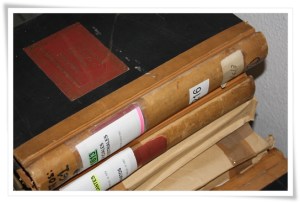
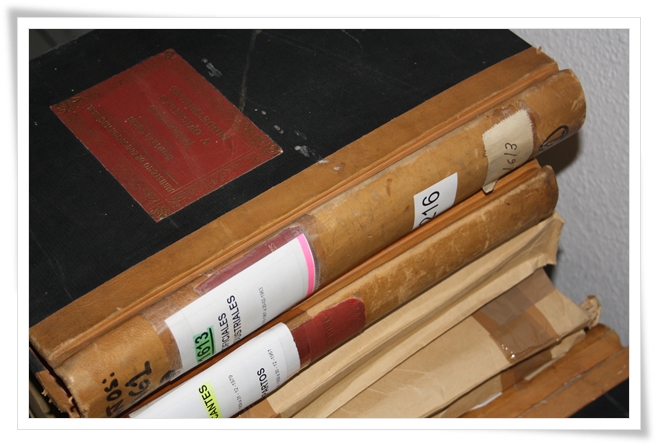
Civil Registry volumes.

Knowing the date of a BMD is also very important, but not always absolutely necessary when ordering a certificate. This is particularly true if you are ordering a certificate from a small-to-medium-sized town. If you are ordering certificates from a large city like Madrid, Barcelona or Valencia, you may well have to inform the registry not only of the exact date, but also of the city district where the event took place. If you don’t know a person’s birthdate or birthplace, but you know when they married or passed away, ordering the marriage/death certificate might provide useful clues, as marriage and death certificates usually include the person’s age (or the exact date of birth) as well as the person’s place of birth. How to order a certificate from the Civil Registry in Spain? You can order Spanish certificates personally by going directly to the local registry office, or online. Unlike England and Wales, there is no single repository of BMD certificates in Spain, nor are there any national or online indexes which allow the general public to scour lists to find one particular certificate.

If you need a certificate but can’t order it personally from the office where the document is being held, then visit the Spanish Ministry of Justice webpage (available in English) on www.mjusticia.gob.es. By clicking on the “Trámites y gestiones personales” menu at the centre of the page, and then scrolling down to the “Familia” section, you will be able to choose the type of certificate you wish to order. By following a few simple steps, you will reach a page which you will basically have to fill in with the person’s details, plus your name and contact details so the authorities can send the document to you within a space of a few days. Make sure you choose the literal version, which is basically a photocopy of the original document; you can always get a translation of the document. A plurilingüe (multilingual) copy will contain far less details about the person or people in question, and will therefore be less useful from a genealogical point of view. If you don’t know the exact date of the event (BMD), try to at least enter an approximate date, or else just enter the year and leave the day and month blank (for example: 01/01/194); if you don’t know the book (tomo) or the page (página) where the certificate would be, just enter three zeros. There are very few restrictions as to whose BMD certificate you can actually order, but you might find yourself facing publicity restrictions when ordering certificates of people who are still alive. Sometimes, you may also have some trouble ordering the birth cert of someone who is not related to you or doesn’t share the same surname(s) as you; you may also be required to explain why you have ordered the birth certificate of a celebrity, or a politician. In certain exceptional cases where the person was born illegitimate, or got a divorce, you might be asked by the registry office to prove your family link to the person whose certificate you are ordering. But despite these hurdles, on the whole ordering certificates in Spain is quite easy, aside from being free and usually genealogically very useful, so give it a try!

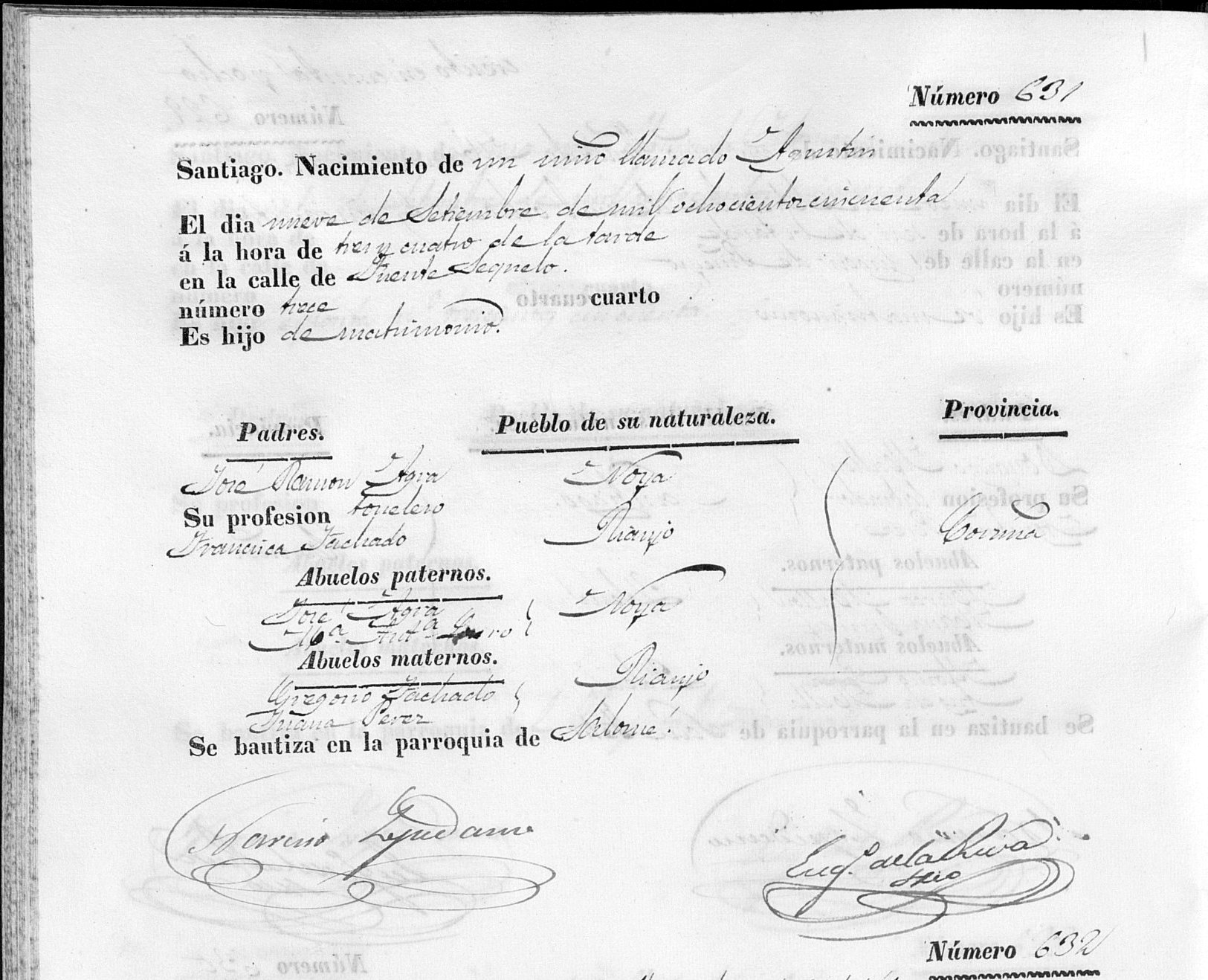
Registro de Nacidos, Casados y Difuntos
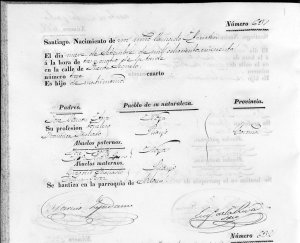
The birth certificate of a distant relative of mine, from the Santiago Registro de Nacidos, Casados y Difuntos.

But let’s stick to Galicia. Did your gallego ancestors give birth, marry or die in the last 140-odd years? If so, then you know you have a sporting chance of ordering their certificates from the local Registro Civil. However, you’re in for a treat if your ancestors came from Santiago de Compostela, the Galician capital city. The Registro de nacidos, casados y difuntos (Registry of births, marriages and deaths) was created in Santiago as early as 1842 and would remain in existence for a further three decades, when it was merged and replaced by the creation of compulsory civil registration in 1871, during the brief reign of Amadeus I. This means that those of you with ancestors from Santiago will probably be able to track your forefathers back at least one or two generations more than most other gallegos. In order to check whether your family’s records are available online, you can look for the scanned copy of the actual certificates by accessing the webpage of the Universidad de Santiago de Compostela (USC) Archives (http://www.usc.es/arquivo/arquivo/presentacion.htm). The webpage is in Galician, but is also partly available in English. Bear in mind that the USC’s Archives go far beyond primitive civil registration; you can also find legal documents such as wills, public notary declarations, family trees, university files and many Church papers which go back well beyond the 15th century in some cases. Be warned that the USC’s Archives can only be viewed online with certain navigators, such as Internet Explorer.

Church Records in Spain

But let’s go back those vital records which existed before the introduction of civil registration. Up until 1871, it was up to the Catholic church to record christenings (which usually took place within hours of the birth), marriages and funerals (which according to Spanish custom, usually take place within a day or two after the death). Baptism records dating as far back as the second half of the 18th century will generally offer very useful information, such as the names of both parents and grandparents, and where they all came from or where they lived; occasionally the record might also include their profession, and who the child’s godparents were, often stating if they were actually related to the baby, and how. These type of records will also include the mother’s and grandmothers’ maiden names – remember that women in Spain do not drop their maiden name upon marriage, which means that, in this sense at least, it is a lot easier to trace your female ancestors in Spain. Marriage entries will equally mention each partner’s age, place of origin, status before marriage, profession, parents’ names and the latter’s place of origin; if the prospective spouses were somehow related, the marriage entry will probably include a reference to the Papal dispensation which enabled the local priest to perform the ceremony, the couple having been given official permission by the Church to marry, regardless of their blood connection. Finally, funeral entries will generally state the date on which the death took place, the deceased person’s status, and sometimes might also include the name of their children and (occasionally) the cause of death. If the person who died was married, the record will probably mention his or her spouse’s name; if, on the contrary, the person was single (soltero/soltera, or in older documents, célibe) or died in childhood, the record will very probably mention who the parents were as well. Dead babies and infants often lack a first name on the funeral record even if they had already been given a name when they had been christened; instead of a name, you will sometimes find the word párvulo (infant) written where the name should be. Pay special attention to marginal notes and the cause of death, as they can prove to be very revealing clues to your investigation.

Finding where church records are kept can be rather tricky, as many documents in Spain (usually those which are over a century old) have been taken to the diocesan archives, which are usually found in larger cities where the Archbishopric’s seat is located. Thus, you may find that the church records for the parishes of the city of La Coruña are actually located in Santiago de Compostela, La Coruña city being within the jurisdiction of the diocese of Santiago. If in doubt, you might want to get through to the local priest and explain why you are looking for the church books; he may well be helpful and send you a free copy of the entry you are looking for (as long as he still has access to the books) or else provide you with the contact details of the Diocesan Archives (Archivos Diocesanos) where the documents are being stored and preserved (and which you can normally access for free). Taking notes directly from the original document is theoretically available to anyone, whilst obtaining official copies of these documents is usually subjected to a fee, so make sure you select your documents properly.
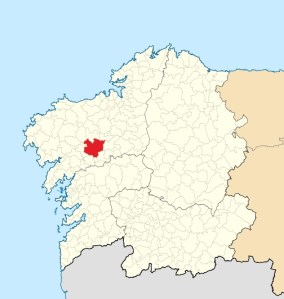
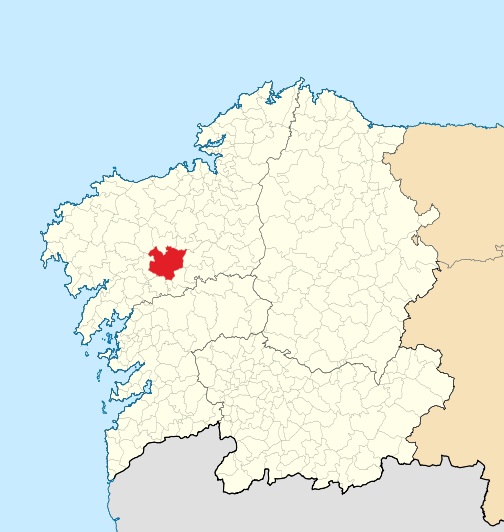
Map of Galicia, with the division of the four provinces and all their municipalities. The capital city, Santiago, is highlighted in red.

The region of Galicia is divided into four provinces (officially called A Coruña, Lugo, Ourense and Pontevedra). The political capital is Santiago de Compostela, although Vigo is the largest city, followed closely by the city of A Coruña. The political divisions of Galicia, however, do not correspond with the region’s ecclesiastical division into archdioceses, of which there are five: Santiago, Lugo, Mondoñedo, Ourense and Tuy-Vigo. Each one has its own Archivos Diocesanos, which essentially means that each one is independent from the rest and will therefore operate in a very different way from the others. From my own personal experience, the archives in Santiago are very well kept (although access to certain old documents is limited because of conservation issues) and they have very capable and friendly staff working there too; you might need a small pocket dictionary however, as they are unlikely to speak much English. Up to now the staff in the archives of Tuy-Vigo have been very unhelpful -though I have yet to visit the archives personally, and the archives in Mondoñedo were run up to a couple of years ago at least by an ageing priest, which made investigating and browsing records rather difficult.

Other sources

If you want to go beyond vital records, there are many other sources  in Galicia and online which will fill you in on the lives of your ancestors. Online you will find easy access to passenger lists and emigration records on FamilySearch and Ancestry, among others. FamilySearch also includes some, albeit very few, online church records from Galicia, which can be useful if you are unable to travel to the diocesan archives. However, the information online will include the very basic details about a person and his/her parents, so you can forget all about learning about godparents, grandparents and causes of death if you’re limited to surfing the net.

You might also want to look up local history societies (contacting the local council –ayuntamiento- might be a good starting point) for additional information about the places where your ancestors lived and worked. Unfortunately, tracing a will or any other type of legal document can also prove rather tricky, but it is certainly not impossible. Many legal documents are preserved in the regional college of public notaries (Ilustre Colegio de Notarios de…), or else in University archives (Archivo Universitario de…). You might want to try contacting local organisations and online forums (such as http://foros.xenealoxia.org/)  for guidance and advice on your particular quest; many societies in Spain have made their repositories available online, which is aa good starting point. Although mostly in Spanish and/or Galician, you will easily find many webpages dedicated to the history of Galicia and Galician genealogy. You just need to start looking. So what are you waiting for?

Here are some useful links which I have used many times:
Spanish Ministry of Justice
Diocesan Archives of Santiago de Compostela
Diocesan division of Spain (including a detailed map of the ecclesiastical division of Galicia)
University of Santiago de Compostela Archives
Lugo Diocese Webpage
Tuy-Vigo Diocese Webpage
Family Search (useful for church and emigration records)
Galician Emigration Arquives
Spanish Archives Portal (PARES)
Rememori.com (obituary search engine)
ABC newspaper archive (useful for looking up obituaries and marriage announcements which took place after 1903)
La Vanguardia newspapers archive (ditto, since 1881)
Xenealoxia.org Forums
Complete list of Spanish Dioceses (including contact details)

Of course, these are just tips and the very basics of Galician genealogy. If you want more information about your Galician/Spanish ancestry, or you don’t know where to start, your quest, you can always drop me a line and I’ll see what I can do for you. Genealogist solidarity, right?

Posted in Birth, Death, Divorce, Emigration, Galicia, Genealogy, Illegitimacy, Marriage, Santiago de Compostela, Spain | 28 Comments

Hardcore Genealogy

Our ancestry on a major scale.

This morning I was pleased to find that a fellow wordpress blogger had clicked the “like” button on two of my recent posts. As a general rule I always think it’s polite to at least check the blog of those people who have clicked on mine and have taken the time to read and like my posts. Call it blogger solidarity.

I was very pleased to read the following post by Stephen Lewis, which I highly recommend. It’s a very long article but very illustrative and entertaining, although it will certainly require a good dose of concentration on your part. Believe me though, it is worth reading. In a fairly simple and straightforward way, the author explains the very basics of direct ancestry and how the pyramid-shaped pattern of our family tree necessarily has to be more theoretical than practical, given the limited amount of human beings we can actually claim descent from. Enjoy!

http://thewildpeak.wordpress.com/2012/03/04/how-many-ancestors-do-you-have/

Posted in Genealogy | Leave a comment

A family of stonemasons

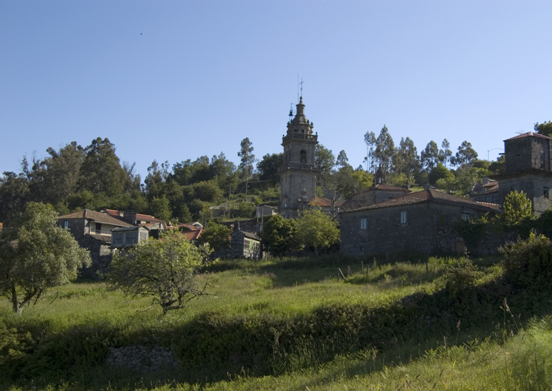
The parish of Aguasantas, in Cotobade, where my Cerviño ancestors came from.

I don’t know about you, but at least in my case there aren’t many trades or professions which have been passed down the family generation alter generation. For some undisclosed reason, when the time came to choose a profession, most of my ancestors chose a career which was very often totally unrelated to their parents’ jobs. Among my forefathers I can count an innkeeper, a tailor, a grocer, a lawyer, a tax-collector, a public notary, a butcher, a farmer, an aristocrat’s secretary, a couple of teachers, a few maids and quite a few carpenters.

My 2x great-grandfather’s family would, of course, be the exception to the rule. José Benito Cerviñ o(1851-1924) was a stonemason throughout his life. In fact, he did rather well for himself, being the first of his family to leave his small provincial village in Cotobade and moved to the bustling, industrial port city of Vigo, in NW Spain. His marriage produced ten children, seven of whom survived into adulthood. Most of his six daughters became an integral part of the local bourgeois society, and made good matches by marrying wealthy merchants who had just made their small fortunes in America. How different their lives would have been had José Benito not done so well in the stone-cutting business!

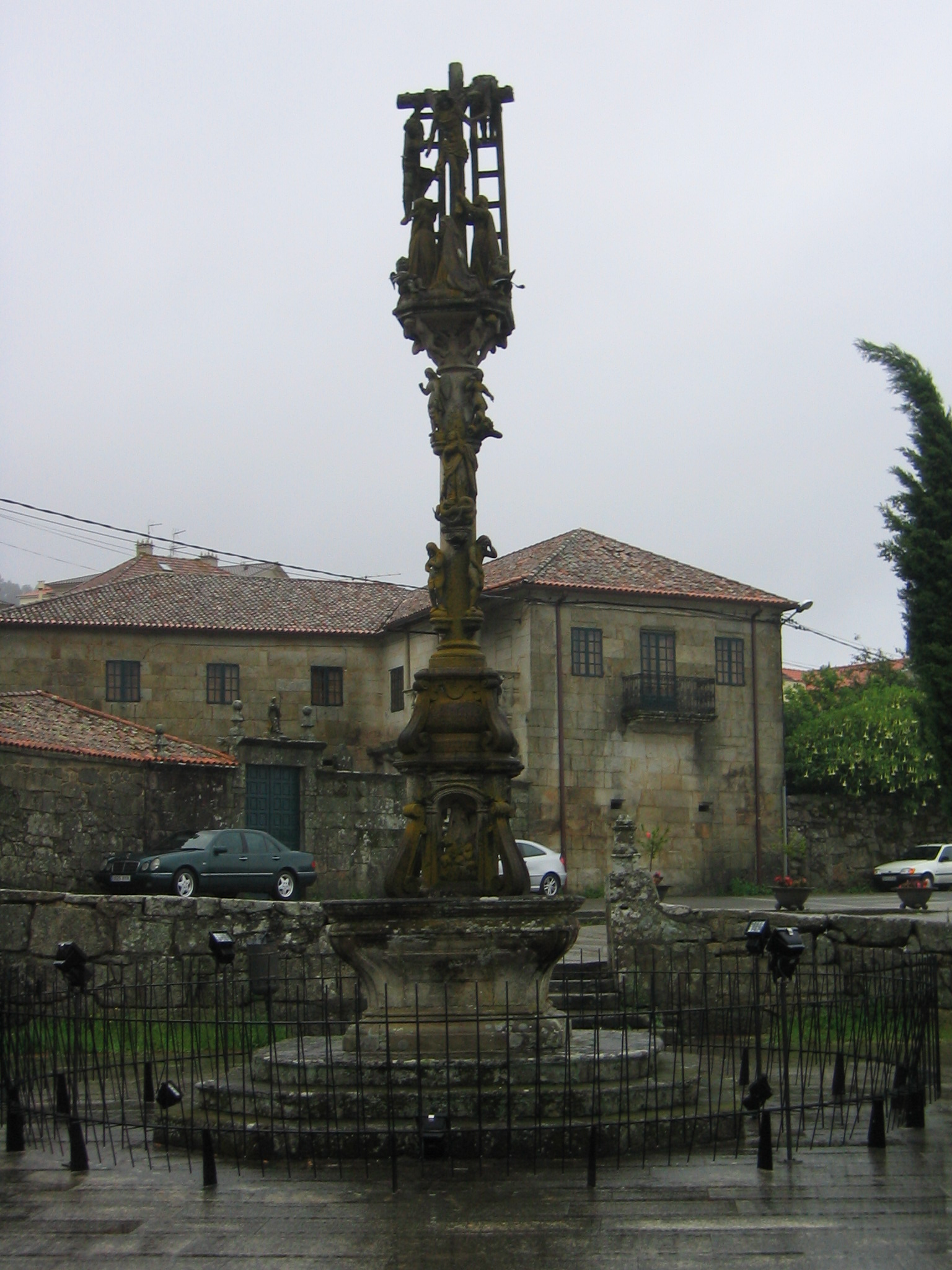
The Cruceiro de Hio, sculpted out of a single block of stone by my distant relative José Cerviño García in the early 1870’s.

But my ancestor was not alone in becoming a stonemason. His father was, rather exceptionally, a school teacher, but many of his other relatives became stonemasons too. One of them met a particularly tragic end: his name was Antonio Cerviño and, like José Benito, who was born on the year of Antonio’s death, he became a stonemason from an early age. However, his life was cut short when he came down with a fever and died in March 1851 at the age of 15. Some sort of family rift had obviously taken place between him and his parents, because neither they nor the young man’s grandparents attended the funeral service, “the deceased having fallen into such disgrace”. What that disgrace was I honestly cannot say, as there are very few sources which could produce any further information about Antonio’s end.

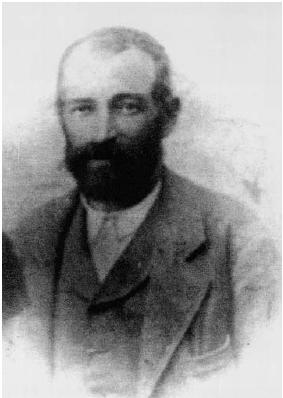
My great-great-grandfather’s second cousin, José Cerviño García, the greatest of all the stonemasons in Galician history.

Another, somewhat happier story about a stone cutter in my family refers to the life of José Benito’s second cousin, José Cerviño, who became one of the most famous stone-cutters in the whole region of Galicia. His works took him to the region’s capital, Santiago de Compostela, and beyond; his best piece, the Cruceiro de Hio, can still be admired today. But even he did not escape tragedy too; his first wife died in her 40’s leaving him to raise their four infant children; his second marriage produced a further three children, although one died in infancy. José himself died, in miserable circumstances, blind and forgotten by the world, in 1922. The Cruceiro de Hio is, incidentally, a large decorated stone cross depicting Biblical scenes, located opposite the small local church in Hio (Cangas do Morrazo) and towers several metres above the ground. What makes this cruceiro even more fascinating is the fact that it was cut out of a single block of stone. Not bad, I say.

The list of stonemasons and stonecutters in my family goes on and on: José’s father Manuel was also a mason, as were several of his cousins and nephews. As far as I know, there are no masons left in my family, or many of my relatives left in Cotobade for that matter, but that’s how History goes I’m afraid. If I have trouble finding a job come the following winter, I might consider becoming a mason. Ha! Fat chance!

Posted in Death, Galicia, Genealogy, Santiago de Compostela, Spain, Work | 6 Comments