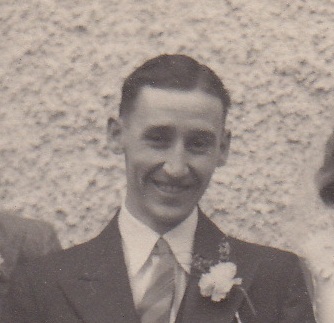
Harry Bertram Caines (1893-1916)

Harry Bertram Caines was born in mid-1893, the son of Albert Caines, a brewer, and his wife Elizabeth, of Hill View Terrace, Upper Wyche. The Caines family were of modest means, and of the eleven Caines children, six had died before 1911.

By 1911 Harry was earning a living as a poultry merchant; at the time he lived near the Wyche with his sister Jessie, her daughter Ivy and her husband, John Stephen Freeman, who also happened to be killed in the war.

At the beginning of the war Harry joined up and became a Private in the 1st Battalion of the Herefordshire Regiment. He served in the Dardanelles.

On 27th November 1915 the Malvern News reported that Harry “was wounded at Gallipoli on 5/9/15 whilst attached to the Machine Gun Corps. A bullet passed through his helmet into his shoulder. He was brought to hospital in Malta, where he went on military police duty. His father and two uncles were in the army and a cousin [actually his brother-in-law], Bdr J Freeman, RFA had already served at the front for 14 months by November 1915.”

After recuperating, 23 year-old Harry was sent back to the front. Sadly he was killed in action in Egypt on 4th August 1916. His brother-in-law died the year after, but his father Albert survived the war and returned home.

Sources:

http://www.malvernremembers.co.uk/HPCaines_HB.html

Posted in Colwall, Colwall Soldiers, Commonwealth War Graves Commission, Death, England, Genealogy, Herefordshire, World War I | Leave a comment

Almond John Bratt (1891-1917

Almond John Bratt was born in Colwall in early 1891, one of twelve children born to Thomas William Bratt and his wife Margaret. The Bratts, who lived in Lyttelton, Colwall were a working-class family, and in his youth John worked as a domestic gardener.

After the outbreak of war, John joined the 7th Battalion, Herefordshire Regiment, which was later attached into the King’s Shropshire Light Infantry, 7th Battalion. He was later promoted to the rank of Sergeant.

26 year-old John Bratt was killed in Flanders on 26th September 1917. His name is engraved on the Tyne Cot Memorial.

Posted in Colwall, Colwall Soldiers, Commonwealth War Graves Commission, Death, England, War, World War I | Leave a comment

Walter Booton (1882-1915)

Walter Booton was born in Rock, Worcestershire, in the spring of 1882. He was one of four children born to Thomas Booton, of Cleobury Mortimer, and his wife Elizabeth (née Oliver). Walter’s father worked as an agricultural labourer, a profession which Walter also dedicated his life to upon reaching adulthood.

In 1908 Walter married Susan Amelia Wallis; a year later, on 18 August 1909, their son Cyril Thomas Booton was born. Then, in 1910, Susan passed away at the young age of 27.

After the death of his wife, Walter invited his sister-in-law Mary Louisa Wallis to live with him and little Cyril at their house in Far Forest, Rock. On 18 July 1911 Walter and Mary Louisa were married in Far Forest, but this second union produced no children.

After the war broke out, Walter joined 4th battalion of the Worcestershire Regiment as a private. On 21st March 1915 Walter’s Battalion sailed from Avonmouth on the SS River Clyde, bound for Gallipolli via Egypt. He landed at Cape Helles, in modern-day Turkey, on 25th April 1915.

On 6th August 1915, the day Walter Booton was killed, his battalion suffered heavy losses. During the first week of August there was heavy fighting in the area, and the 4th Battalion suffered heavy casualties totalling 15 Officers and 752 men. As the War Diary for that period was lost in the action, there is no complete list of all the casualties. The attack took place in the vicinity of Krithia Road, their principal objective being the enemy defences around Krithia Vineyard. For that very day the 4th Battalion history states: “All night the Headquarters personnel worked in “No Man’s Land,” bringing in wounded and searching for survivors. One subaltern crawled forward to within thirty yards of the enemy’s trench and located two of their machine-guns; but there was no sign that any of our men were still holding out in the enemy’s trench, or that any were still alive save the helpless wounded in the open. By dawn a large number of the wounded (about 300 men) had been brought in”.

Walter Booton’s name is inscribed in the Helles Memorial in Sedd el Bahr, Turkey.

Little is known about Walter’s family back at home. His second wife may have remarried years later, while his son Cyril died in Malvern in 1986.

Sources:

http://www.worcestershireregiment.com/forum/viewtopic.php?f=2&t=1922

http://www.1914-1918.net/worcester.htm

http://1914-1918.invisionzone.com/forums/index.php?showtopic=168060

Posted in Colwall, Colwall Soldiers, Commonwealth War Graves Commission, England, Genealogy, Killed In Action, War, Worcestershire, World War I | Leave a comment

Barking up the wrong family tree

Genealogy can be described, at best, as a never-ending learning curve. Your not only make wondrous new discoveries all the time, but you also never stop learning from your own mistakes. Assumptions can sometimes make you bark up the wrong family tree (literally!) and lead you to a dead end. Today was one of those days where I just had to hit my head against a wall for not having been more cautious.

A few years ago I discovered a fantastic page on Rootsweb which stored transcriptions for the church records of the parish of Colwall, where my grandmother’s paternal family came from. It was a goldmine. Decade after decade of baptisms, marriages and burials all nicely rolled up into one tidy little website which some anonymous soul had taken the trouble to transcribe for me. Thank you, whoever you are.

Tracking ancestors on a website is often much more accessible than leafing through a few old volumes of church registers. After all, you just press “Control+F” and type in the surname you’re looking for. Bingo. Allen here, Allen there. It soon became clear that my Allen ancestors had lived in Colwall for well over 200 years. Nice! But beware, you might also be missing out on the marginal notes which somebody forgot to include in the transcription – let alone become the unknowing victim of third parties who have mistakenly mistranscribed your ancestral record! Yes, nothing beats leafing through books I’m afraid.

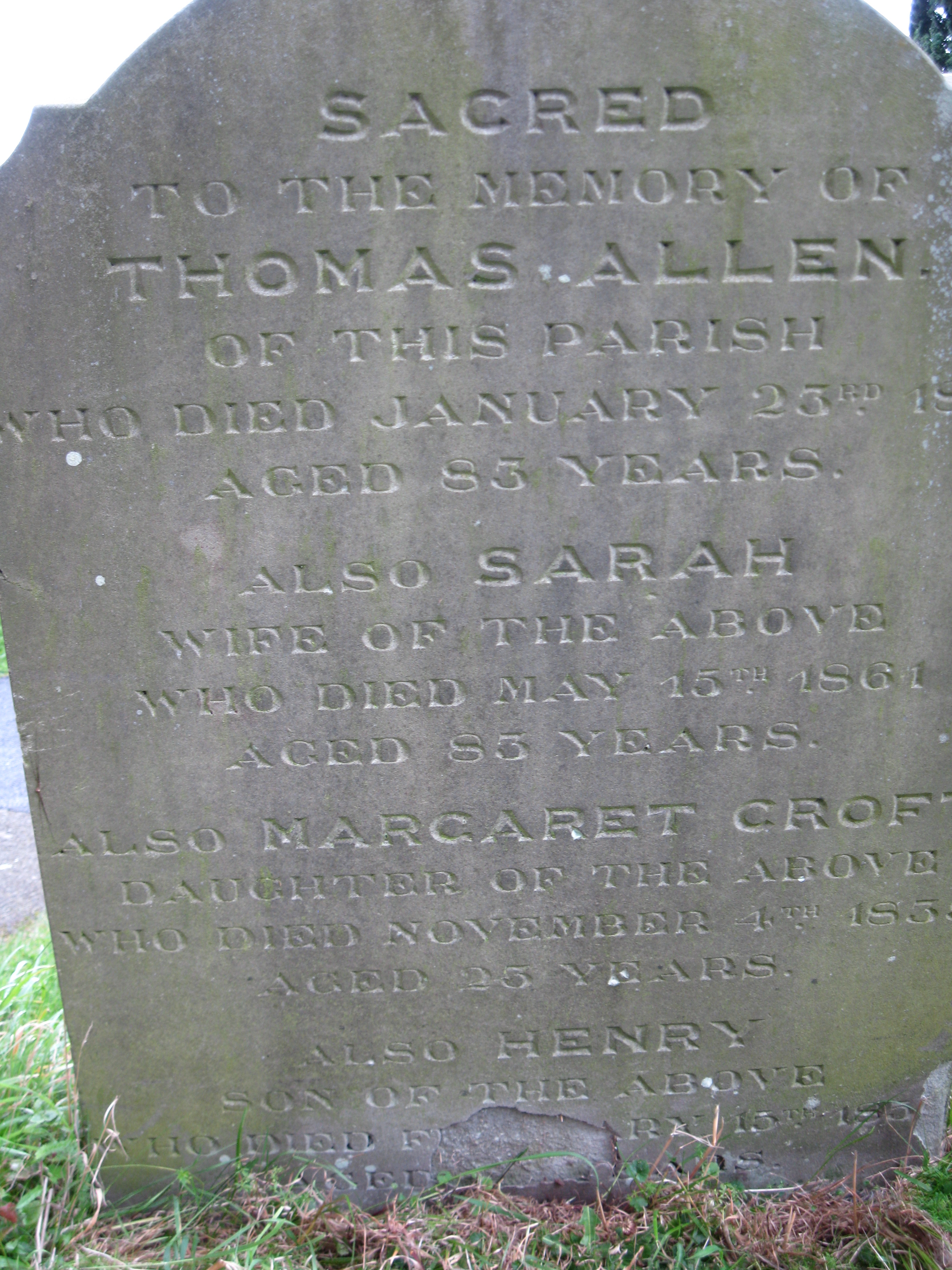
Piecing together the facts was easy with a little external help from sites such as Ancestry.co.uk and the kind assistance of fellow members of Rootschat. My line could easily be traced back to Thomas Allen and his wife Sarah, who died towards the middle of the 19th century when both were in their eighties. It was beyond them that things started getting a little tricky, as I discovered today to my dismay.

Family plot: The grave of Thomas Allen, his wife and two of their children.  (Copyright of The Genealogy Corner)

Family plot: The grave of Thomas Allen, his wife and two of their children. (Copyright of The Genealogy Corner)

My findings had led me to believe Thomas Allen was (and, as far as I know, will always be) the son of William Allen and his wife Elizabeth. Now, establishing who this couple were may end up being a little harder to prove that I expected. There is a marriage for a William Allen and a Elizabeth Symonds in Colwall in 1751. The dates ties in nicely with the fact that my ancestor Thomas had an elder brother called Richard who was born a year later; in fact, William and Elizabeth had a further six children, apart from Thomas himself. So… may I therefore assume that William and Elizabeth were indeed Thomas’s parents? Question number 1.

Question number 2. If Elizabeth Symonds was indeed my ancestor, then she may well have been born in Colwall, as it was often the custom for couples to marry in the bride’s place of origin. It seems probable that her parents were Robert Symonds and his wife Elizabeth (talk about choosing exotic names for your children!), but two facts make me uneasy about this assumption: first, the fact that Elizabeth was baptised in 1739 (had she been a baby at the time, this would mean she would have been a girl of merely 12 years when she married my ancestor William Allen in 1751; I know this was before Lord Hardwicke’s Marriage Act of 1754, but still I would not wish to rely on what seems to me a convenient solution for an otherwise seemingly extraordinary marriage). Even more damming to my theory is the fact (and this is a fact) that Robert Symonds, my purported ancestor, made his will a few decades later, a will which I hasten to add was probated in 1780 and which mentions his daughter Elizabeth Symonds (not Elizabeth Allen, as she would have been by then) as one of his heirs; not w whiff or Elizabeth Allen anywhere. No, it seems I have been barking up the wrong tree, and it’s back to where we started with the Symonds family.

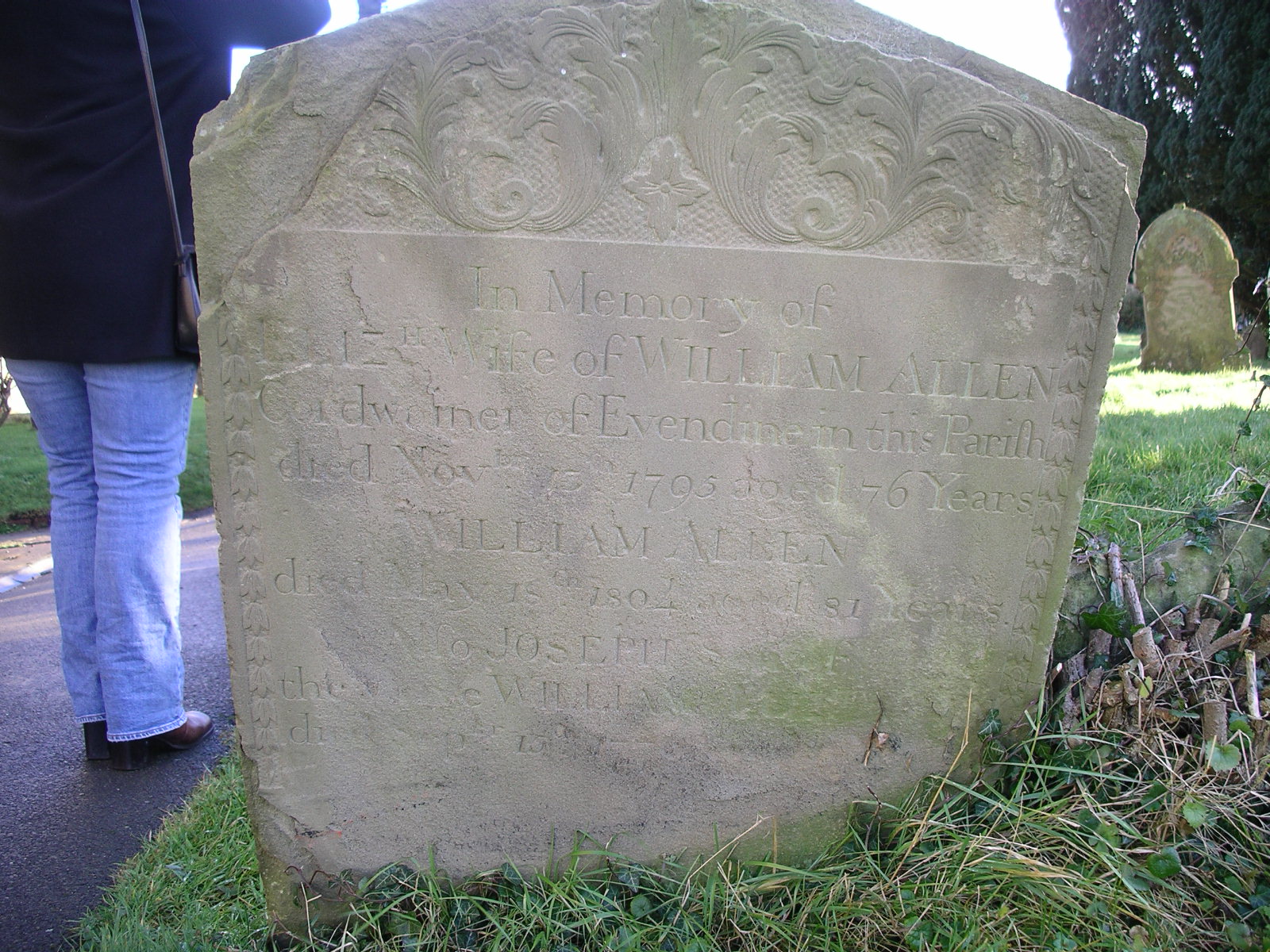
The grave of William Allen and his wife Elizabeth. Their age and date of death offer many clues when tracking down a plausible birth year - and discarding other possibilities! (Copyright of The Genealogy Corner)

The grave of William Allen and his wife Elizabeth. Their age and date of death offer many clues when tracking down a plausible birth year – and discarding other possibilities! (Copyright of The Genealogy Corner)

Question number 3. So what about the Allen side? Well, fortunately the grave of my ancestor William Allen (and his wife Elizabeth, née Symonds) still exists. It is located in Colwall churchyard and the writing is still fairly legible. It reads that Elizabeth passed away in 1795 aged 76 – thus she was most certainly not the daughter of Robert Symonds who had been born in 1739. Maybe my Elizabeth was Robert’s sister? Food for thought… According to the same headstone, William Allen died in May 1804 aged 81, meaning he would have been born in 1722-1723 (depending on whether he had already turned 81 the year he died, and provided the information on the grave is accurate). The Rootsweb site containing the church transcriptions does not feature baptisms before 1723, but FamilySearch does include two possible candidates: William Allen, bapt. 12 July 1722, son of Richard and Margaret Allen, and William Allen, bapt. 26 May 1720, son of Joseph and Elizabeth.

As I do not have access to the physical books, which are kept at Hereford Records Office (presently closed to the public) and must therefore rely on transcriptions, it’s time to make more assumptions. Assuming that my William Allen, who married Elizabeth Symonds, was born in Colwall; assuming that the headstone in Colwall churchyard is spot on and that William Allen did die having reached the age of 81 in 1804, of these two candidates above the first baby seems to me the likeliest possibility. If William Allen was born shortly before his baptism in July 1722, he would have been very near his 82nd birthday in 1804 when he passed away. For the moment, things tie in nicely. Oh, but look at me, I’m assuming things again. Will I ever learn?

To give this theory even more credibility, or at least slightly more backing, I have managed to track down two wills from the mid-18th century which offer several clues that reinforce the Allen connection to Colwall. In one of them, dated May 1745, John Allen, a yeoman from Evendine (close to Colwall) left his land to his “brother Richard Allen and his wife Margaret”, i.e. my William’s purported parents. I wonder if anyone out there is reading this and can offer me any help proving or disproving this theory? Help!!!

Of course, I am weary of these assumptions, which again have led me to a very convenient spot. Now I find myself scouring the pages of 18th century wills which are pocked with names of relatives I knew nothing about. I don’t suppose the learning curve will ever stop – do you?


Posted in Colwall, Death, England, Genealogy, Herefordshire, Property | Leave a comment

Penrith Sutton Beauchamp (1893-1917)

Penrith Sutton Beauchamp was born in Colwall, Herefordshire in early 1893, the fifth of the seven children born to Frederick William Beauchamp and his wife Minnie Blanche (née Dixon); he was christened at St James “the Great” Church on 24th February 1893. Penrith’s father died when the boy was only four years old. The Beauchamps were a middle-class family.

While his brothers Forrest and Arthur emigrated to Canada and British Guiana respectively, Penrith remained behind in The Cottage, Colwall with his mother and younger sisters.

Upon the outbreak of war, Penrith joined the 9th Battalion, Worcestershire Regiment, reaching the rank of second-lieutenant. Like Penrith, the majority of the original personnel of the 9th Battalion had been raised in Worcestershire, though many enlisted in the nearby city of Birmingham.

In June 1915 the difficulties in the Gallipoli peninsula resulted in the British Higher Command requiring reinforcements to be sent if the Mediterranean Expeditionary Force was to win through to its goal: Constantinople.  Accordingly, five fresh Divisions were sent out as reinforcements from England to Gallipoli, one of them being the 13th Division, which included the 9th Battalion of the Regiment. This would have included Penrith Beauchamp himself.

In December 1916 Penrith and his Battalion were sent to Mesopotamia, where the Worcestershire Regiment was once again engaged in fighting against the Ottoman army. Facing disease, the lack of water and extreme weather conditions, fighting in that part of the world became particularly brutal.

Less than two months after arriving in Mesopotamia, 24 year-old Penrith Beauchamp was killed on 25th January 1917 during the disastrous Battle of Kut al Amara. His remains were interred in the Amara War Cemetery, on the left bank on the Tigris river. Following the surrender of the garrison on 29 April 1916, the survivors of the siege were marched to imprisonment at Aleppo, in modern-day Syria.

Penrith’s brother Forrest, who also saw active service during WWI, was killed in action in France a year later 1918.

Penrith Beauchamp never married, and had no known children, but his elder brother Arthur gave the name Penrith to one of his own sons, Kenneth Henry Penrith Beauchamp. This second Penrith Beauchamp also distinguished himself in another world war, having joined the RAF in 1938 and being awarded the Distinguished Flying Cross (1940), Distinguished Service Order (1942) and Bar to Distinguished Service Order (1945), for the action he saw in Germany.

Source:

http://en.wikipedia.org/wiki/Siege_of_Kut

http://www.cwgc.org/find-a-cemetery/cemetery/69100/AMARA%20WAR%20CEMETERY

http://www.cwgc.org/find-war-dead/casualty/627426/BEAUCHAMP,%20PENRITH%20SUTTON

http://www.cieldegloire.com/002_raf_beauchamp_k_h_p.php

Posted in Colwall, Colwall Soldiers, Commonwealth War Graves Commission, Genealogy, Killed In Action, War, Worcestershire, World War I | 3 Comments

Forrest Beauchamp (1883-1918)

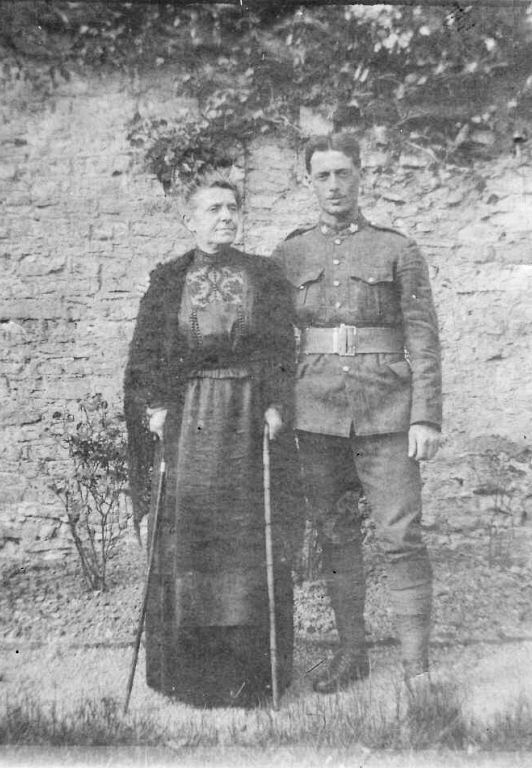
Photo of Forrest Beauchamp – Forrest Beauchamp and his mother (circa June 1916) taken at Foxleigh, Saskatchewan. Copyright/source: http://www.veterans.gc.ca

Photo of Forrest Beauchamp and his mother (circa June 1916) taken at Foxleigh, Saskatchewan. Copyright/source: http://www.veterans.gc.ca

Forrest Miles Beauchamp was born on 19th October 1883 in Cotham, Gloucestershire, the eldest son of Frederick William Beauchamp and his wife, Minnie Blanche (née Dixon). Forrest had three brothers (Frederick Gordon, Arthur Kenneth and Penrith Sutton Beauchamp) and three sisters (Gladys Eveline, Dorothy Margaret and Grace Winifred Beauchamp).

In his youth Forrest lived with his family in Keynsham, Somerset, but later moved to Worcester. Between 1885 and 1900 he worked as a clerk for the Great Western Railway Company. By 1901 he and his family were living in Malvern Link, but around 1906 he moved to Regina (Manitoba), where he worked as a farmer.

In June 1916, two years after the outbreak of war, Forrest enlisted as a private in the Canadian infantry, with the serial number 255173, 46th Battalion. A year later, news reached him that his younger brother, Penrith, had been killed in action in Mesopotamia.

He was stationed in Dury, France, where he was shot and killed by enemy fire immediately after reaching the Battalion’s objective. He was 35 years old. His remains were buried in the Dury Crucifix British Cemetery.

Sources:

http://www.ancestry.co.uk/

http://www.cwgc.org/

http://www.freebmd.org.uk/

http://www.veterans.gc.ca/eng/remembrance/memorials/canadian-virtual-war-memorial/detail/254037

Posted in 1901 Census, Canada, Colwall, Colwall Soldiers, Commonwealth War Graves Commission, Emigration, England, War | 5 Comments

Percy Barrett (1886-1914)

Percival Sydney Barrett was born in Gorse Hill, Swindon in or around 1886, the youngest son of George and Naomi Barrett’s seven children. When he was about 5, Perival’s mother died. His father, who worked on the railway, remained a widower.

On 25th January 1909, in the parish church of Colwall, Percival Barrett married Emily Louisa Winters, the daughter of George and Mary Winters, of Purlieu Lane, The Wyche, Colwall.

A year after their marriage, Percival and Emily had a son, also called Percival. A year later, when the census was taken, Emily and her infant son were recorded as living with her parents, George and Mary Winters, in Purlieu Lane. Meanwhile, her husband Percy Barrett was working as a miner in the Welsh town of Pontypridd together with his 18 year-old brother-in-law Alfred Winters. Both were lodged in the house of a Mr Charles Biggs. In 1913 Percy and Emily had a daughter, who was baptised Naomi in honour of Percival’s late mother.

The outbreak of war in the summer of 1914 encouraged Percy, and possibly his brother-in-law Alfred, to enlist. Mining was at the time an extremely dangerous and often deadly profession, so ironically the battlefield may have seemed to them as something of an adventure as well as a safer way of earning money. Percy joined the Wiltshire Regiment, 1st Battalion, as a private (service number 6460), and on 14th October 1914 he landed in Rouen.

Percy was killed in action on 31st October 1914, only two weeks after arriving in France. His wife Emily remained a widow for two years; in 1916 she married John A. Banner, and that same year gave birth to a daughter, Phyllis.

Sources:

http://www.cwgc.org/find-war-dead/casualty/823795/BARRETT,%20PERCIVAL%20SYDNEY

http://home.ancestry.co.uk/

Posted in Colwall, Colwall Soldiers, Commonwealth War Graves Commission, Genealogy, War | Leave a comment

Raymond Barnett (1895-1917)

Raymond Whitmore Barnett was born in Colwall in late 1895, the son of James Henry Barnett, a roadman and labourer, and his wife Annie (née Jolly). Raymond was baptised in the local church of Saint James “the Great” on 20th October 1895.

Both of Raymond’s parents were long-time residents of Colwall, although his mother originally came from Birmingham. Aside from Raymond, James and Annie Barnett also had nine other children, although three had already died by the time the 1911 census was taken.

The Barnetts were a working-class family. In his teenage years, Raymond earned his living as a bricklayer, while his brother George worked in a mineral water factory (probably bottling Malvern water); another brother, Walter, worked on a farm.

After the outbreak of war in August 1914, Raymond joined the Herefordshire Regiment (1/1st Battalion), service number 235244, as a Lance Corporal. Raymond’s battalion had been formed that same month, only days after war had been declared. By 1915 Raymond and his unit had been posted to different areas in the UK. On 16 July 1915 the battalion boarded the SS Euripides at Devonport and the ship made its way to Suvla Bay on Gallipoli, in present-day Turkey. The landing, which commenced on 6 August, was intended to support a breakout from the Australian and New Zealand Army Corps (ANZAC) sector a few miles south, a fact which was mentioned in dispatches. The campaign, however, was a failure, and the battalion was eventually evacuated to Egypt at the end of the year.

In mid-1916, with the war still raging, Raymond probably sought a few days’ leave and travelled back to England, where he hastily married Daisy Sharpe in Nottingham. The couple probably spent very little time together, as Raymond was compelled to go back to the front. There is no evidence to suggest that they ever had any children together.

At the time, Raymond Barnett’s battalion was still stationed in the Middle East, where it would remain for the latter part of the war. Raymond would therefore have seen action in what was known as the Egyptian theatre.

On 26th March 1917, 21 year-old Raymond was mortally wounded during what became known as the First Battle of Gaza, which ended the following day. He died shortly after, and his remains were buried in the Jerusalem Memorial in Israel, where another 3,298 soldiers are interred.

His young wife, Daisy, remained a widow for about a year. In early 1918 she became the wife of a Henry Brown, and settled with him at 30, Caroline Street, Pea’s Hill Road, Nottingham.

Sources:

http://www.cwgc.org/find-a-cemetery/cemetery/142016/JERUSALEM%20MEMORIAL

http://www.ancestry.co.uk/

http://www.1914-1918.net/hereford.htm

Posted in 1911 Census, Colwall, Colwall Soldiers, Commonwealth War Graves Commission, Death, England, Herefordshire, War | Leave a comment

Brave Colwallian Soldiers

The Colwall War Memorial was erected in the aftermath of the First World War to honour the memory of the Colwallian men who fought and died during the First World War (1914-1918).

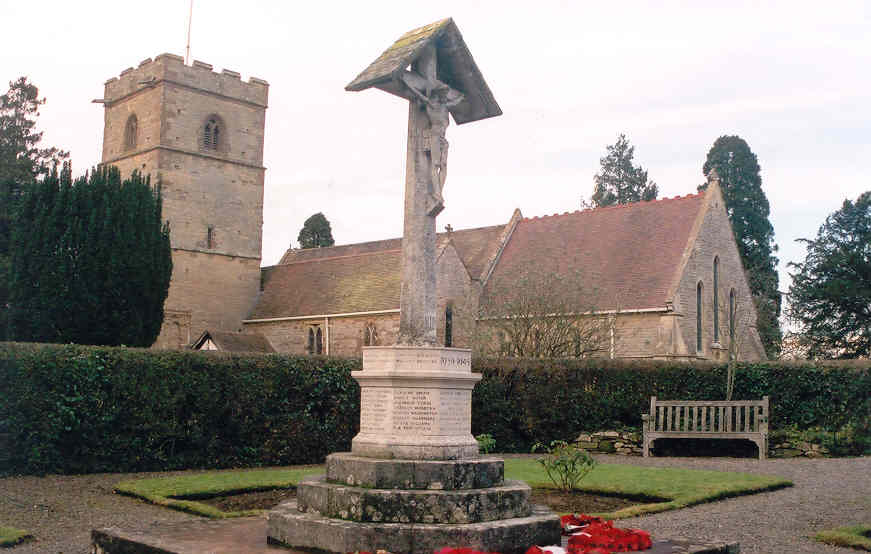
The Colwall War Memorial, outside Colwall church. Photo copyright colwallchurch.org.

The Colwall War Memorial, outside Colwall church. Photo copyright colwallchurch.org.

The Memorial makes no distinction between those soldiers who were born and lived in Colwall (Herefordshire) or those who simply spent a part of their generally young lives in the village.

The Memorial, a simple crucifix on an octagonal stepped base, is located just outside the churchyard at Saint James’s. A latter addition honours the memory of Colwallian soldiers killed in the Second World War (1939-1945).

The War Memorial lists a total of forty-nine Colwallian soldiers who lost their lives while on duty during the Great War. However, for unknown reasons, the names of at least six other soldiers who were also linked to Colwall in some way have been left out.

Nevertheless, in recognition for their bravery, effort and sacrifice, their lives are included in the work I will publish in the upcoming months. The names of those not mentioned in the war memorial are marked accordingly. They are also marked with an asterisk in the below transcription:

RAYMOND BARNETT
PERCY BARRETT
FORREST BEAUCHAMP
PENRITH BEAUCHAMP
WALTER BOOTON
JOHN BRATT
HARRY CAINES
ERIC CARTWRIGHT
RONALD CARTWRIGHT
EUSTACE CHANCE
ARCHIBALD CLARKE
GUSTAVUS CUSTANCE
REGINALD FARLEY
JOHN FREEMAN
THOMAS GARDINER
ALBERT EDWARD GILKS*
CHARLES GREEN
HENRY GREENING
W.H. GREENWAY*
WILLIE GOODWIN
FREDERICK HANDY
NOEL HARRIS
ANSELL ARTHUR HART*
CHRIS HITCHINGS
EDWARD HOLLAND
A.U. HOLMAN
WILLIAM INNES
FREDERICK JAMES
WALTER JOSEPH LANGFORD*
ALBERT LOCK
HUBERT MADDOX
ERNEST MARTIN
JOHN PERCY MARTIN*
DONALD MOSS
JOHN ORR-EWING
ALBERT OLIVER
PERCY PEDLINGHAM
UNIECKE PERY-POWELL
WILFRED PHILLIPS
FREDERICK POWELL
SAMUEL PUGH
FRANK RAWLINGS
ALBERT ROBBINS
WILLIAM SELLY
AMOS SMITH
ARTHUR SMITH
RAYMOND SMITH
ERNEST SUTER
REGINALD TUDGE
JAMES WEBLEY*
CHARLES WHARTON
ROBERT WASHINGTON
ERNEST WHATMORE
VICTOR WILLIAMS
E.A. TOM WILLIS

To read about each one of these brave Colwallian soldiers, click the category “Colwall soldiers” bellow to see the links to each biography.

Source: http://colwallchurch.org/churchyard/war_memorial/history.html

Posted in Colwall, Colwall Soldiers, Commonwealth War Graves Commission, Death, England, Herefordshire, Killed In Action, War | Leave a comment

The Smith family I am (not) descended from

History can often be ironic with its unexpected and unusual twists and turns. But sometimes we carry those ironies with us for ever. Having been brought up in Spain, I always lived among my peers conspicuously for having an undeniably foreign (that is to say English) surname: Smith. Can there be a more symbolic, alien and typically Anglo-Saxon last name in the non-Anglo-Saxon world than Smith? Don’t get me wrong: I’ve ever felt ashamed of having a foreign-sounding name -quite the contrary-, though in all honesty, I always felt rather uneasy about having a surname that was not quite my own. I’ll explain what I mean.
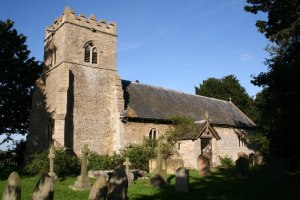
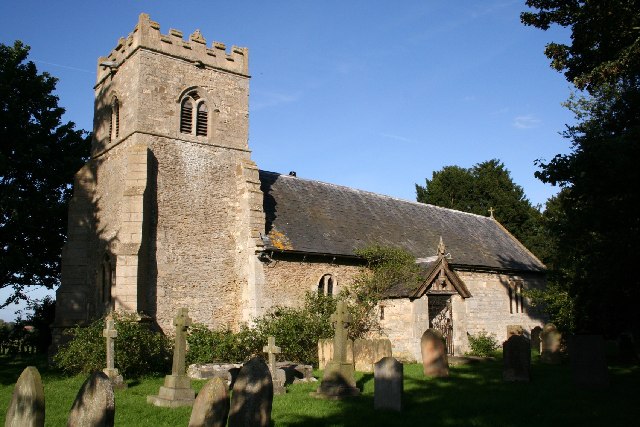
Thurlby church in Lincolnshire.

Thurlby church in Lincolnshire.

The whole story of the Smith family starts with an eleven-month old baby called Joseph Smith and his first appearance on the English census in 1851. A glimpse at this document reveals little Joseph was, at the time, the only child born to his parents, Mary and Edward Smith, the latter an agricultural labourer by profession. The Smiths had been living in Thurlby, a hamlet of Bilsby, in Lincolnshire, probably for many generations, and it seems baby Joseph was the first one to break the mold by making the leap north to neighbouring Yorkshire. By 1861, the then ten year-old Joseph and his five younger siblings who had been born in the meantime were living with their widowed mother and widowed maternal grandfather, Thomas Epton, in Bilsby.

By 1871, the year of his marriage, Joseph Smith had moved and begun working as a servant in Alford, Lincolnshire, in the household of Dr Edward Richardson, a veterinary surgeon. Shortly after the census was taken, Joseph married a local Alford girl called Sarah Hornby, with whom he enjoyed their shared conubial bliss and were blessed with the births of numerous children. The difference in age between their children meant that by the time the youngest were born, the eldest were already old enough to become parents themselves. Among the former children we can count Arthur Smith, who was born in the spring of 1891 in Otley, Yorkshire. It was in Otley that young Arthur grew up among modest surroundings, supported by his father’s furniture shop. It is very likely that Arthur’s first professional experience was acquired there, as was that of his elder brother Elias, who by 1901 worked as their father’s assistant.

Life in Yorkshire evidently could not or did not fulfil Arthur’s expectations, and before the decade was out Arthur had decided to emigrate to Canada, as so many other Englishmen of his time did. War was already looming over the horizon in Britain, and Canada being a largely unexploited and virgin nation, Arthur knew life would be better if he left England for good.

Arthur Smith settled in Shellbrook, Saskatchewan, a small town that had been founded in the late 19th century, roughly at the same time Arthur was born. In 1894 the first post office was opened in Shellbrook, and soon many British and Scandinavian immigrants arrived and settled in the area. According to Wikipedia, in 1910, the Canadian Northern Railway reached Shellbrook from Prince Albert for the first time, and the community blossomed as a service centre for the surrounding agricultural region. Arthur Smith worked as an office clerk, a profession he may have learnt at his father’s shop in the North of England, but little more is known of his professional career in Canada.
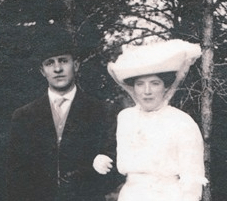
Arthur and Ellen Smith, around the time of their marriage in Canada.

Arthur and Ellen Smith, around the time of their marriage in Canada.

Life seemed what it should be in Canada. Arthur soon met and married a young, pretty English woman called Evelyn Eleanor James, whom everyone called Ellen. The couple probably married in or around 1914, the same year World War I broke out in Europe. Canada entered the war almost as soon as Britain had declared war on Imperial Germany, and 600,000 men and women enlisted as nurses, soldiers and chaplains. Arthur Smith was one of them, as he joined the army in 1916.

Arthur’s wife Ellen gave birth to her first-born James Arthur Smith in 1915; the boy’s two Christian names evidently honouring his father name as well as his mother’s surname. While Arthur was posted at the front, Ellen, who was again pregnant, and her baby boy moved back to her native England to live with relatives in the Herefordshire market town of Ledbury. It was in Ledbury that Ellen learnt of Arthur’s death in late June 1917, just months after the birth of their second son, Donald Hornby Smith. Arthur was killed in action near Mont St Eloi, near Calais. He was just 26 years old.
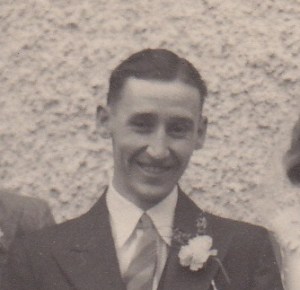
James Arthur Smith on his wedding day. His life would be cut short by consumption less than four years later.

James Arthur Smith on his wedding day. His life would be cut short by consumption less than four years later. His surname, however, would live on.

Back in Ledbury, Ellen raised both her children in her zealous Catholic faith. She chose not to remarry, and died almost five decades later aged 76. James Arthur Smith, Ellen’s firstborn, would have ad no recollection of his father. He went on to work at the Gloster Aircraft Company (GAC) at their factory in Brockworth/Hucclecote, and shortly after the outbreak of WWII, he married my grandmother Betty. The couple rented a house in Brockworth, Gloucestershire, on a newly-built housing estate. They had two children, and life appeared to be typically suburban lower middle class amidst the ongoing war. On one occasion a local rag reported German bombers attacking the factory and fighters shooting up the Shurdington road, while whist drives to raise money for the Red Cross were taking place. Everything seemed idyllic on the surface -James Arthur owned a Morgan tourer car- though it seems theirs was not a happy marriage. Years later, when questioned why she had never remarried, Betty replied “I was married once – never again!”.

In any event, in 1943 James Arthur died of tuberculosis, leaving 25 year-old Betty to bring up her children. As luck would have it, a year later Betty became pregnant by an American GI who soon thereafter made his way it back to America. When his birth was registered, that baby (my father) had to be given my grandmother’s married name, Smith, since that was, after all, her legal name. Thus my father, and by extention my brother and I, ended up with a surname that is, as you can see, not totally ours.

Posted in Genealogy | Leave a comment