The story of Charles Henry Vickress

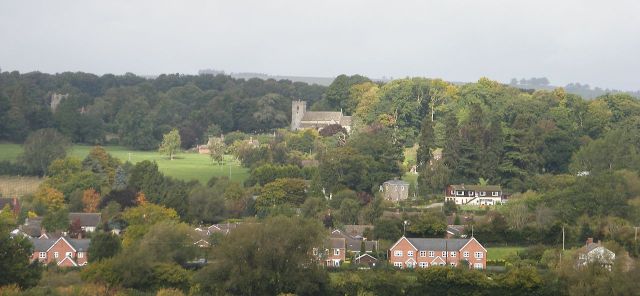
Lyonshall, in Herefordshire, where Charles Henry was born. The church where he was christened can be seen at the top of the hill.

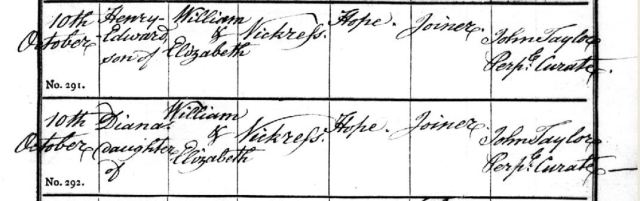
During the summer of 1870, my great-great-great-great-grandparents Frederick and Ann Vickress welcomed their tenth (and last) child, a son whom they had baptised on 21 August in the local church of Lyonshall (Herefordshire), where Frederick worked as a humble carpenter and joiner.

The arrival of Charles Henry, as the little boy was christened, was undoubtedly a happy occasion. Five years earlier, Ann had given birth to a boy who only lived 49 days. Eight children, five girls and three boys, had preceded him in the Vickresses’ nursery, of whom three also died young.

The household was surely dominated by little Charles Henry’s elder siblings; his parents were after all quite old (by the time the census was taken a year later, Frederick was 56 and Ann was 47), and the elder girls would marry before long. The family was by then composed of 8 month-old Charles Henry, his parents, his sister Diana (a 19 year-old farm servant) and his two brothers William and Thomas, who were attending school. My own great-great-great-grandmother (his sister Elizabeth) was a general servant in Huyton and Roby, Lancashire and may not even have known her youngest brother during his first few months of life.

The Vickress family lived relatively peacefully for several more years in Lyonshall. However, by 1881 they had moved to nearby Pembridge, where many of Ann Vickress’s relatives, the Tippins family, lived. As Charles Henry grew up, his elder brothers began working the land while their father continued his business in carpentry. The little boy most probably indulged in fun and games with the neighbours’ children, like the Leakes and the Hughes families.

On 2 April 1891, Charles Henry’s father Frederick died aged 76 of an “abscess of the prostate gland” (perhaps a sign of cancer). Only three days later the 1891 census was taken, and so Ann Vickress was described as a widow for the first time ever. She was kept company by her two youngest sons, Thomas Frederick (a hatter who had married a few years before and was by then living in Rainow, Cheshire) and Charles Henry (an agricultural labourer, still living at home). It would be years before Charles Henry left the family home – he was still with his mother in 1901 when the next census was taken.

By then Charles Henry had changed jobs, moving from an agricultural to a mason’s labourer. Only a year later he married Elizabeth Postians (or Postings) at the local church in Pembridge. Elizabeth was about five years older than Charles Henry, and although the marriage seems to have been blessed with the birth of a daughter in 1904, the couple appears to have drifted appart: in 1911 Charles Henry, by now a builder’s labourer, was lodging in Caerphilly (Glamorgan) at 14 Bradford Street, the house of 70 year-old widowed Rebecca Knight and her family, the Broughtons, some of whom worked in the local colliery. It was probably through them, or thanks to them, that Charles Henry managed to secure a position as a miner, while his wife remained in Pembridge (living near her mother-in-law) with her little daughter Daisy Elizabeth by her side.

By about the time Charles Henry turned 44 in 1914, the country had plunged into a war. In view of his age, Charles Henry would have been only slightly older than the required age to be called up. Interestingly, while many men saw the war as an opportunity to escape the dangers and drudgery of working down the mines, Charles Henry seems to have taken the opposite view, and with mining considered an essential part of the war-work (with coal in great need), he would not have been pressed to go to the front. Charles Henry therefore remained in Wales, working as a mine banksman, not just far from his own family but also from the young men who had gone to fight.

By August 1915 the war had been raging for a year, and Charles Henry may well have wondered if he would be conscripted before long. Tragically, his question would never be answered, as on 28 August he was violently struck on the shoulders and body by a descending pit-cage at the Navigation Colliery in Crumlin, where he worked. The unfortunate man suffered for seven agonising hours, but eventually succumbed to his injuries.

News of his death surely reached his wife and daughter before long. Elizabeth does not appear to have remarried, and she passed away in 1945, at the end of another global war. Their daughter Daisy Elizabeth went on to marry a Michael Sutton, but the couple don’t seem to have had children, thus bringing Charles Henry’s line to an end.

Charles Henry was, however, honoured by his elder (and probably closest) brother Thomas Frederick, who had moved to Cheshire when Charles Henry was still living at home. Thomas Frederick named his youngest son Charles Henry; the younger Charles Henry emigrated to Australia with his parents and sisters in the early 1900’s and would in fact go on to join the Australian army, seeing military action during WWI and receiving a medal for his services. It seems that where one Charles Henry failed to take an active part, the other shone with distinction.

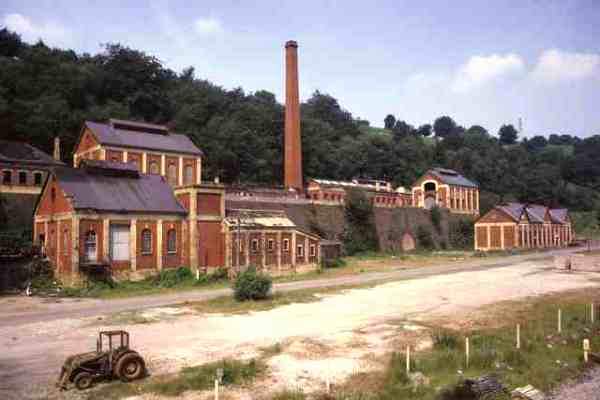
Crumlin’s Navigation Colliery, where Charles Henry Vickress met a tragic end.

Posted in 1871 Census, 1881 Census, 1891 Census, 1901 Census, 1911 Census, Australia, Birth, Cheshire, Death, Emigration, England, Genealogy, Herefordshire, Lyonshall, Pembridge, Wales, World War I | Leave a comment

Why don’t Spanish death certificates include a cause of death?

If you have ever had to order a death certificate from a Spanish registry office, you may have noticed that the cause of death is crossed out, or simply does not exist. To many of us, the absence of a cause of death on a death certificate makes no sense whatsoever. You may or may not agree with doing away with what genealogists consider a vital part of their genealogy research, but today we will try to figure out why Spanish death certificates no longer include this crucial piece of information.

The modern Spanish Civil Registry system was created in 1870 during the reign of King Amadeo I, who imported the idea of a non-ecclesiastical registration of deaths from his native Italy; the law came into effect on 1 January 1871, and began by only recording births, marriages and deaths (not including stillbirths or children who died within the first 24h after birth). Nowadays, the Civil Registry covers a wider range of events, as it also records stillbirths, tutelages and legal representations.

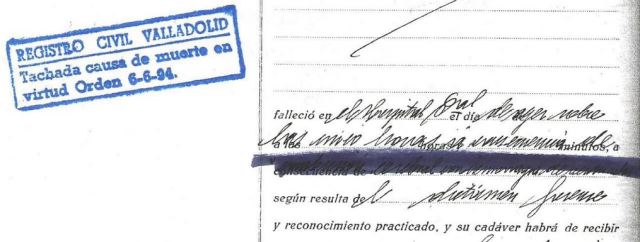
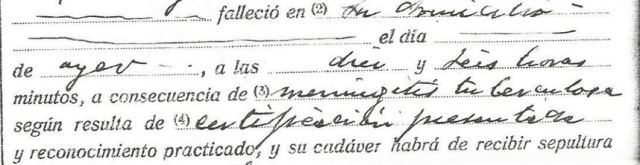
This death certificate, from 1935, shows the cause of death stricken out and the Order reference beside it. The cause of death is still partially legible.

At first, like in most other civil registration forms like the English, French or Italian systems, Spanish death certificates did include a cause of death. This was mentioned either in a handwritten form or in the practical an easy-to-fill-out printed forms which became commonplace at the end of 1800’s.

This death certificate, dated from 1936 but issued in the 21st century, has not had the cause of death crossed out.

Everything changed in the 20th century, however, when the Ministry of Justice considered that the cause of death was “alien to the registration institution” – in other words, it was outside the scope of the Civil Registry’s purpose, as a cause of death does not contribute to the Registry’s goal of certifying someone’s death, which should otherwise continue to include a person’s identity (name, surname, parentage, date of birth, etc.).

For this very reason, the Order of the Spanish Ministry of Justice of 6th June 1994 decreed that, from then on, no death certificates would include a cause of death (which is included, however, in medical reports issued upon a person’s death but which are not kept at the Civil Registry office).

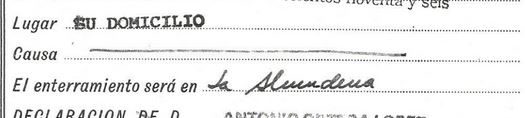
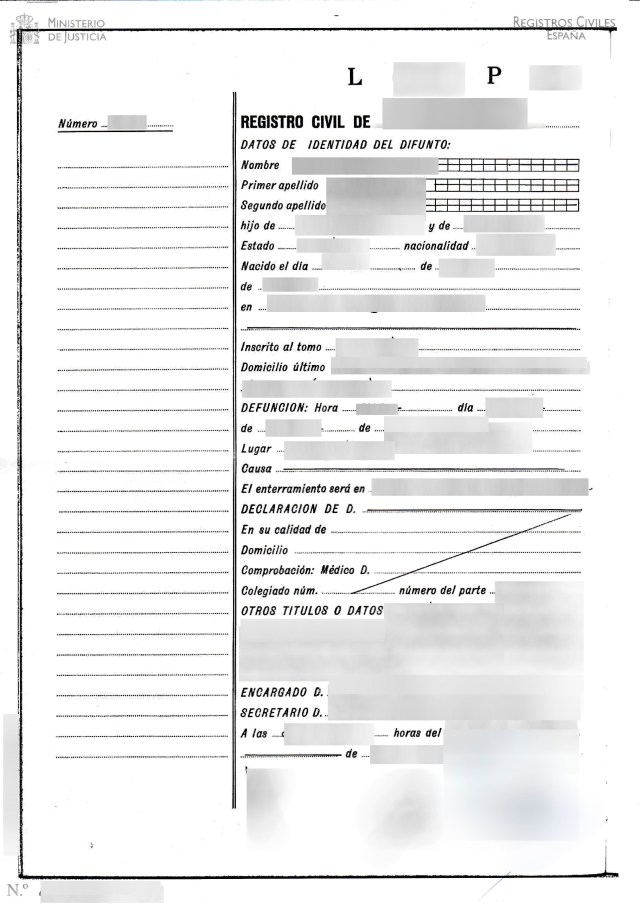
This death certificate, from 1996, does not include a cause of death but still includes the space where it would have been stated.

By virtue of this very Order, modern-day certificates simply do not include a cause of death. Deaths which were registered prior to 1994 would naturally include a cause of death, but Civil Registry officers are now expected to cross out the cause of death. Luckily, not everyone follows this rule, and we may still be lucky enough to find a cause of death stated in a pre-1994 certificate.  Sadly, this is not always the case, but depending on the civil servant’s efficiency, we may still be able to make out the writing underneath the ink, as shown on the first image above.

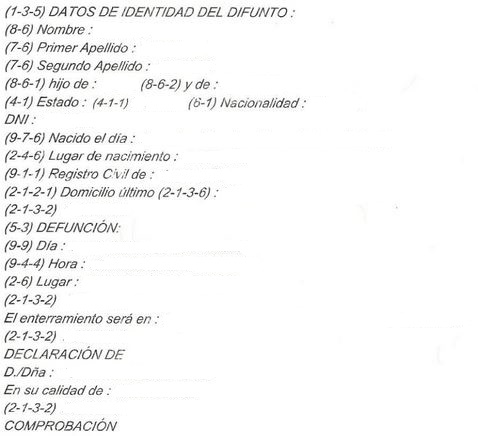
This blank death certificate, issued in 2004, no longer includes a space for the cause of death.

So, how can you find out what your Spanish ancestors died of if the cause is not mentioned on their death certificate? Well, it won’t always be easy, but I can think of several ways and methods that you can look for clues (and ensure that future generations can easily track the cause of death of their forefathers, whether it’s for medical reasons or out of general interest):

  • Burial records: many burial records in Spain, particularly during the 19th and early 20th century, feature the cause of death.
  • Family history and previous genealogical research: check stored information passed on orally or in writing by members of your family who knew your ancestors.
  • Medical or clinical records: although difficult to access (they would probably be stored in local hospitals or clinics), these may be of invaluable help. It is likely that only direct descendants will have access to such records.
  • Birth records: sometimes a marginal annotation on the birth record mentioning the person in question passed away may include the actual cause of death.
  • Newspaper clippings: there was a time when newspapers would publish daily announcements of deaths recorded in the local registry office, and mentioned the person’s name, age and cause of death.
  • Obituaries: very often a cause of death is given on obituaries. Phrases like “after a long illness” may imply a wasting disease like cancer or tuberculosis. If the person was killed in a war, a newspaper obituary would most likely make a reference to the circumstances.

If you want to apply for a death certificate in Spain, you can do so by ordering a copy via the Ministry of Justice website. Certificates are free, but the date and place of death (town or city) need to be included in the request. For more information I advise you read my article on how to order a Spanish death certificate.

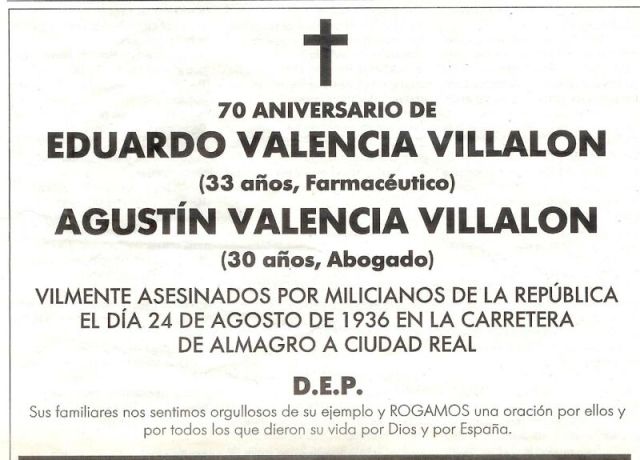
This modern-day obituary remembers the deaths of two brothers who were murdered shortly after the outbreak of the Spanish Civil War.

Posted in Civil Registration, Death, Spain | Leave a comment

My Living DNA experience

Those of you who followed my blog in April will remember how I was singled out at Who Do You Think You Are? Live by Living DNA’s Marketing Director Hannah Morden– I suppose constant tweeting, not to mention purchasing 12 DNA kits on the spot – sort of made me stand out…

Anyway, thanks to that rather serendipitous encounter, I took a test with Living DNA, the results of which would ordinarily have taken between around 8-12 weeks to arrive. This week, after just over an amazing six weeks’ wait, I got my results!

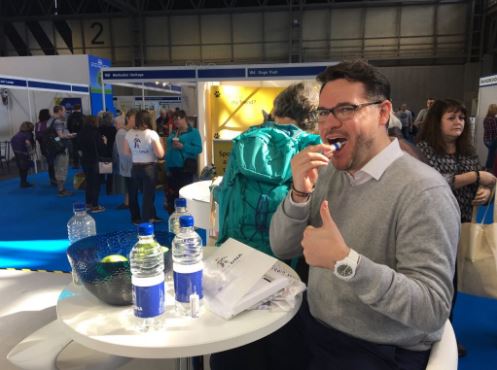
Swabbing and giving a grateful smile to Living DNA for our serendipitous encounter at the same time is not easy, I can tell you!

Now, you will probably remember that so far the only company I have tested with is Ancestry.co.uk. The results I received a year ago showed what I (more or less) already knew, or at least half suspected – that I am a big fat European mongrel. A chunk of British ancestry here, a splash of Spanish (“Iberian”) blood there, and a sprinkling of Italian (“Italy/Greece”) genes all concocted with traits of other, smaller ethnic groups appear to have made me what I am today. So how would my Ancestry results compare with those of Living DNA?

Well, I certainly hope that no one out there is getting tattoos with their ethnic group percentages, because we must remember that any estimations we get are just that, mere estimations, and are actually only based on whichever company’s existing database. In other words, your results may and will vary depending on the company you test with, and will also change with the passing of time, as more and more users test.

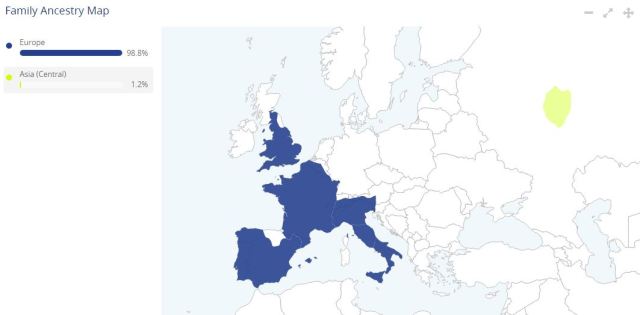
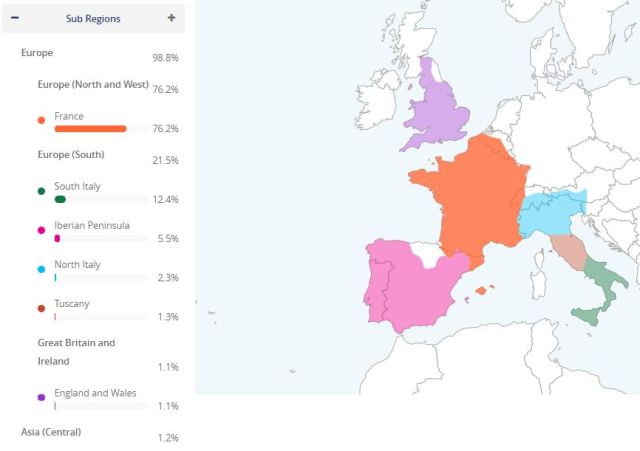
So, how did I fare with Living DNA? Well, for someone whose recent (300 years or so) ancestry is vaguely 40% Spanish, 25% British (in my case mainly West Midland English with a pinch of Welsh) and about 30% Italian, I was amazed to find a large chunk of purported French DNA (over 70%!). But then again, France is a large country, with a lot of mixed peoples, and my Italian ancestors did come from northern Italy, not that far from the French border. Then again, this may well be because the markers contained within my DNA are for the time being too different from the markers that Living DNA’s lab currently use – thus they compare somewhat differently from my other Ancestry DNA results.

At first glance, my autosomal DNA results did not look very detailed…

My Spanish side was also represented in my Living DNA results, although strangely it only merited 5.5% – again, my family comes from a very specific region on the north-western coast, and the migration of peoples may well have mixed up my ethnic Spanish “purity”. And, as mentioned, the markers from that particular area may not yet have been sufficiently developed by Living DNA’s lab.

…but alas, here were my detailed autosomal DNA results!

Alas, enter Great Britain. Only 1.5 %? My English grandmother, whose whole ancestry back to the 1750’s is firmly English – but for one distant Welsh female ancestor- would definitely be shocked. And even more surprising is that there is no sign of Irish DNA, which according to Ancestry is present in my veins, though I can’t exactly explain how. Maybe Ancestry means to say “Celtic”, which would explain the Welsh side…?

All this may seem confusing. In fact it is, but I am not too concerned: the markers that Ancestry, Living DNA and the other DNA testing companies use are different; the labs they use are different, and as far as I can tell, their definition of ethnic groups is also different. I am sure that with the passing of time my results both on Living DNA and any other company I may decide to test with will continue to evolve and become similar (if not identical) to each other.

But that’s not all – for me, getting my autosomal DNA results was not the main reason for testing with Living DNA. You will understand my joy when I also received my Haplogroup subclades for my Y-DNA (direct paternal line) and Mt-DNA (direct female line) – Living DNA test 20,000 markers for their Y-DNA test, and 4,500 snips for the Mt-DNA test. Now, you may know by now that my dad’s direct paternal line comes from NW Italy, an area which was in fact at one point ruled by Sardinia. It all seemed to fit perfectly when I realised that my Haplogroup is quite common not just in the Western Balkans (what? I’m Bosnian/Croatian now?) but also in Sardinia!

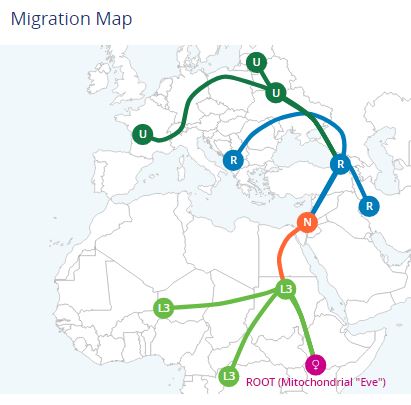
The path presumably followed by my maternal ancestors from Eve to my Mum.

My mother’s Mt-DNA signature was equally fascinating – and puzzling. She got a Haplogroup which turns out to be more common among northern Scandinavian peoples – in other words, a far cry from my NW Spanish ancestors…

Once I had time to digest my results and try to ponder the questions that were all of a sudden popping into my head, I wrote down the pros and cons of this testing, and decided to get some answers from Living DNA themselves. Here are some pointers which will hopefully help you clarify some of the questions you might have:

  • Living DNA’s single test available offers autosomal, Y-DNA (for males only) and Mt-DNA results. Considering the cost (129€ plus delivery), it is very good value.
  • Unlike other DNA testing companies, they cover the whole world, which means you can receive your DNA kit pretty much wherever you live.
  • Living DNA is, as far as I know, the only company of its kind based in Europe and which consequently complies with EU legislation.
  • Their website has a sleek, modern look to it, although finding your way around is not always 100% evident because of the features they include – but this is a minor detail in my opinion.
  • Living DNA’s level of detail is pretty much unprecedented, as it allows breaking down ethnic groups into much smaller subgroups. The UK is the country with the largest group of ethnic sub-groups, but I understand other regions are in the pipeline to become more detailed in the months to come.
  • Downloading one’s raw DNA file will also soon become possible, and they are working to make this feature compatible with sites such as GEDmatch which will helpfully allow users to compare their results with thousands of others.
  • As a genealogist, the biggest flaw I found with Living DNA’s current set-up was the lack of a DNA comparison feature. For me, being able to compare my autosomal DNA results with those of other users is crucial as I am more interested in knowing if I have any close genetic relatives, as opposed to finding out if I’m a quarter French. Happily I just heard DNA comparison will be available as early as next July, so that will hopefully be a problem taken care of. If this feature is added, Living DNA will definitely become the most cost-effective of all available DNA tests.
  • One detail which I think can be improved on their website is the accessibility to one’s autosomal results. It took me a while to figure out that by clicking on the “plus” sign I could actually see my results in greater detail. But again, a minor detail which should nevertheless be made more accessible, in my opinion.
  • I also understand that there will soon be an additional feature which will allow data to be managed by a “key owner”, in other words, your data can be managed by a relative after your death.
  • Living DNA’s current database is not as large as other companies’, but they are growing exponentially every month. I have already made it clear to Living DNA that I would be happy to volunteer some friends and relatives whose grandparents were born within an 80km radius of each other – thus allowing the company to increase their markers database and allow everyone’s results to appear in greater detail.

Living DNA has the benefit of being a fairly small, innovative and new company with all the good qualities of a family-run business. I find they are keen to listen to users and are happy to get suggestions, which is why I am ready to give them a vote of confidence. I certainly look forward to many great things from Living DNA in the near future!

Disclaimer: All views expressed here are my own personal opinions. I do not work for Living DNA or any other DNA-testing company, or any company operating within the field of genealogy or genetics.


Posted in DNA, England, Galicia, Genealogy, Genetic Genealogy, Italy, LivingDNA, Who Do You Think You Are? | 2 Comments

Using DNA to find the common ancestor

If you have ever taken an autosomal DNA test with any company, be it Ancestry, 23andMe, FamilyTreeDNA, Living DNA, etc., you will have seen that your results will appear on the company’s database along with a (generally long) list of others users who match your own DNA. Now, I am not a genetic genealogy expert, and all I have learnt (and I am still learning) generally comes from experience and from reading articles & papers, online professional videos and specialised magazines. This said, genetic genealogy is not difficult to apply to your “traditional” genealogy research – if you know how to apply it. Here’s a good example of what I mean:

Some months ago I was contacted by someone in America called Kathryn (not her real name), who appeared among my DNA matches as an (estimated) 4th-6th cousin. That means that Kathryn is, theoretically and at the very closest, a great-great-great-grandchild of my great-great-great-grandparents. Of course, the calculation is based solely on the amount of the DNA that we have in common, which necessarily begs the question “Why do we share this amount of DNA, and not more, or less?”. As I’m sure you know, we inherit 50% of our DNA from our father, and the other 50% from our mother. However, our more distant ancestors’ DNA, starting with our grandparents, is inherited randomly via our parents. In other words, we may get 50% from dad and 50% from mum, but that does not mean that we get 25% of DNA from each grandparent: in fact, as a rule, we don’t. We might, for instance, get 35% of DNA from our paternal grandfather, but just 15% of DNA from our paternal grandmother. That’s the randomness of DNA for you! The below diagram explains the random inheritance pattern of DNA more simplistically.

As I have managed to track down the name and origin of most of my great-great-great-grandparents, I thought that my genetic coincidence with Kathryn was too good to ignore. The first step was, naturally, to ask Kathryn where her immediate ancestors came from. Like me, she has Italian blood, but her ancestors apparently came from Southern Italy, while my Italian forefathers were from a small area sandwiched between the hills of Northern Italy. Not a likely scenario for our presumed nearest common ancestor to have come from. We therefore turned our attention to her father’s family, and this time we seemed to strike gold, as her paternal line has a connection with Galicia, the north-western part of Spain where practically all of my mother’s ancestors lived as far back as the 1600’s.

The next step was to cross-check if our suspicious about a geographical connection were right, and so I had my mother tested so I could compare her results with Kathryn’s. Not only did they share a match, but they also seemed to be more closely related, as Kathryn shared more centimorgans with my mother than with me. We were definitely on the right track.

I then asked Kathryn to share with me some of her recent family history which might help me to unearth a common name which I could follow up. She said her paternal grandfather had been born in Spain in the early 1900’s, and that she had once seen his parents’ names on his birth certificate, which she has since lost. However, there seemed to be some inconsistencies and loose ends with her story when it came to the identity of her grandfather’s father. She said he belonged to a middle-class family who started a transport business which later developed into a bus company. She also said her great-grandfather had died young (she had even seen his grave in Galicia on a visit some years back), and that his widow, who was of lower birth, had been turned away by her in-laws and had left Spain for America, leaving her son to be brought up for foster parents.

With the names she was able to provide me, I searched online newspaper archives to see if I could find any reference to either Kathryn’s grandfather or his parents, and luckily I found an obituary for a man who died in 1915 whose name matched that which Kathryn had provided. I immediately sent for the man’s Spanish death certificate, but when I received the document I made a very curious discovery: the man, called Manuel, was unmarried, so there was no reference to a wife, nor to any children. I again cross-checked with Ann to see if the story she had told me may have been wrong, but she was sure we had the right man. It wasn’t difficult to track him down in the Spanish census at the turn of the century, and this helped me to prove that Kathryn’s story about a family-run bus company was absolutely spot on. Luckily, both of Manuel’s parents were listed, as was their respective place of birth: the father was born in the Castilian province of León, the mother in Madrid. So it was clear that the family did not have any immediate genetic ties with Galicia, the area w were focusing on.

My attention then shifted to the mother of Manuel’s child, Josefa, whose full name was not very clear to us. I searched high and low for a birth certificate for their illegitimate son, to no avail. Unfortunately Kathryn’s efforts to retrieve the document she had seen years before were not yielding any results either. It was only then that we decided to try a different source, and we applied to the church archive for a baptism certificate. Their response was positive, in that they had found a corrected baptism certificate, issued in the 1970’s (in other words, some seven decades after the child had been born) where his parents’ names were mentioned. The document not only confirmed the father’s identity (it was, incidentally, the man called Manuel whom we had previously been looking for), but it also served to confirm the mother’s full name: Josefa Adega López (the last two being her two surnames, as is the Spanish custom).

Armed with a full name, I decided to track Josefa down in the census; her son’s baptism certificate confirmed she came from Ferrol, the same city as some of my ancestors, and so I decided to look her up. I was somewhat dismayed by the fact that she too seemed to be illegitimate, as I was able to find her living with her elder sister and their single mother in the 1887 census, when Josefa would have been about five years old.

The fact that Josefa was illegitimate naturally opened the possibility of never actually finding out who her real father was. But before committing myself to searching aimlessly for a purported father, I asked my grandfather’s only surviving sister to take an autosomal DNA test too. The reason for this was that she was my theoretical link to Kathryn’s family, but as of yet I had not proven this much other than by testing my mother. The results confirmed that my great-aunt and Kathryn were indeed fairly closely related (still within a 4th-6th cousin relationship), and although I still was not 100% sure of how we are connected, at least we knew our link came via my maternal grandfather’s family.

Unfortunately my application for Josefa Adega López’s birth certificate has been unsuccessful: she was either recorded under a different name, in a different location, or she was not registered at all. Church records in the area are noticeably hard to come by, and so for the time being I have little to go on via Kathryn’s family line.

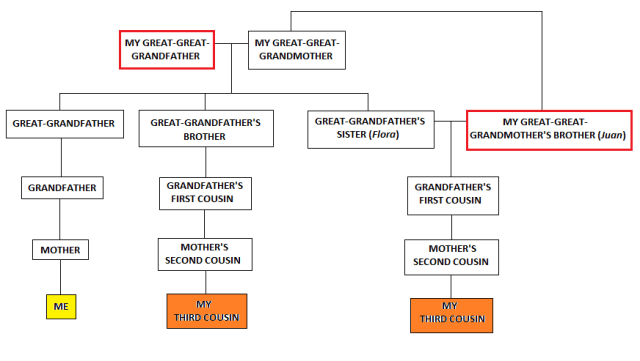
Although I do not think I will be able to confirm the link between our two families (not, that is, until there is sufficient documentary evidence to prove it – and, as this is a case of an illegitimate child, I am not raising my hopes too high), I decided once again to go down the genetic path. (There’s a family tree chart at the end of the article which will help you follow the story as I explain it.)

As Josefa was born in 1882, I laid out who of my family could have actually “done the deed”, and I found a rather curious set of options: my own great-grandfather was born in 1879, and so he would have been too young to father a daughter at the time. His elder brother were also too young to become fathers in their own right, BUT their father (my great-great-grandfather) could easily have fathered Josefa out of wedlock. I just hope for my great-great-grandmother’s sake that he didn’t!

The other option, which is tantalisingly suggestive, is my great-great-grandmother’s only brother, Juan. As Juan was born in 1836, he would have been 46 at the time of Josefa’s birth, so he could well have been her biological father. He was, at the time, still single, and he may well have had an affair with Josefa’s mother. However, in about 1890 he decided the time had come for him to marry. His choice of bride was none other than his own niece Flora, by whom he would go on to have two children.

Now, my grandfather’s family is not very extensive, and I know very few relatives on that side whom I could ask for a DNA sample. One of them, curiously, is a descendant of that uncle-niece marriage, and so I have decided to ask her to have a DNA test. I may also ask another cousin who is descended from another brother of Flora’s. If Flora’s descendant’s DNA results show a much higher DNA proportion with Kathryn than with me (Flora’s descendant, after all, would be related to Kathryn not only via Flora herself, but also via Juan), then we may just well have found the identity of Josefa’s biological father. If, on the other hand, both Flora’s descendant shares the same amount of DNA as me and our other shared cousin, we may well need to take our documentary and genetic research  a generation back. Only time, and DNA, will tell if we are on the right track!

Either of the two men in a red box may have fathered Kathryn’s great-grandmother. My third cousins’ DNA may prove it.

Posted in DNA, Galicia, Genealogy, Genetic Genealogy, Illegitimacy, Spain | 3 Comments

Cancer & My Family’s Genetic Inheritance

The pink ribbon, the symbol of cancer awareness and battling cancer – but the illness continues to be a taboo subject for many people because of its perception as a social disease.

Author’s Note: The below was written on 27 April 2017, and updated on 30 November 2018.

We have all met someone who has had cancer. You might even be a cancer survivor yourself. Or you may well be battling cancer at this very moment, as you read these lines.

The sad truth is that cancer has become one of the most common illnesses among human beings, and one of the world’s biggest killers today. Happily, significant advances in medicine and science are enabling medical teams around the globe to treat and in many cases cure cancers which one or two decades ago ago would have been incurable from the outset.

Cancer is very often wrongly perceived as a “recent” illness. This is because of its commonality and the frequency with which it strikes nowadays, and because in our modern lives it has replaced smallpox, cholera, typhoid and tuberculosis as one of the biggest threats to human health. And yet, for all its apparent newness, cancer and the tumours that it causes have been present for millennia. In fact, cancerous tissue has been found on Egyptian mummies which date as far back as 1600 b.C.!

The reason why I think cancer is perceived as a “recent” disease is because it used to be much less common in the past, as people then, both rich and poor, were far more likely to die of many other illnesses and at a much younger age. To put it bluntly, our ancestors usually died before they got a chance to develop a slow-acting illness like cancer; in other words, people rarely lived long enough to suffer from cancer. It is only thanks to medical advances and improvements in public hygiene and sanitation that cities and towns began to offer better living conditions, and so, with the decline of common epidemics came the rise of other illnesses not directly (or at least, not so directly) linked with living conditions.

In my personal case, cancer has been present in my family for generations. How many generations, we will probably never know, but it has certainly been there for decades, and chances are it will unfortunately appear again in the near future.

I grew up being aware that my Spanish maternal grandfather had died of oesophageal cancer in his late 50s. By the time he decided to go to Madrid to see a specialist, the cancer was already incurable. In fact, it consumed him so quickly that he made his way back home in a coffin. Sadly, his younger brother (my Mum’s uncle), died of exactly the same type of cancer two years later, in spite of the fact that he was physically active, was not a smoker and didn’t drink a drop of alcohol (unlike my grandfather, who took pleasure in his daily glass of wine and smoked cigars regularly). I was therefore very aware that the dreaded illness had struck two members of my immediate family not long before I was born, and some forty years after they had both lost their mother to… yes, you guessed it: cancer. My great-grandmother Hermelinda died at the age of 49, consumed by breast cancer.

For years all this seemed a simple, straight-forward case of family misfortune. I accepted the fact that cancer had made its entry into the family, and hen vanished equally quietly. It wasn’t until the early 2000s that I realised illnesses like cancer don’t simply “vanish”: one of my Mum’s sisters was diagnosed with cancer for a second time in her life when she was in her late forties, and succumbed in 2004.

A few years went by. I was by then living abroad, and then I got the dreaded phone call from my Mum to tell me she had noticed a lump on one of her breasts and that she had been diagnosed with cancer. Luckily, following her sister’s demise, my Mum had taken the precaution of going to the doctor for an annual check-up, and made sure she was thoroughly screened for breast cancer.

In a way, for me the diagnosis wasn’t a huge surprise, but I don’t think any of us expected what followed next: not only did my Mum have cancer in one breast – she had cancer in the other breast too, and (and this is the extraordinary bit) both cancers were not linked to each other! Her doctor told her it was a very rare case, and soon started asking questions about the recurrence of cancer in my maternal family. My Mum didn’t think twice about telling him about her recent family history (her sister, her father, her uncle, her grandmother…), but soon she seemed to be getting onto something much more sinister than pure rotten luck.

By the time of my Mum’s diagnosis, I was well into my tenth year into family research, so you will understand my “excitement” when she started asking me questions about various dearly-departed relatives, and what they had died of. Curiously, until that time I had not paid much attention to death certificates, having focused mainly on expanding my family tree’s collateral branches and ordering birth and marriage certificates, but I soon began delving into the necessary documents to start filling in the gaps.

Knowing that my great-grandmother Hermelinda had died of breast cancer in 1937, I started looking at her immediate family. She had been one of ten children (one boy and nine girls). The son died of asthma and heart failure at an advanced age, while three of the girls died very young of common infant illnesses, so I decided to focus my attention on the other sisters who did make it to adulthood. The results were shocking: of the five remaining sisters, four died of cancer: there was one case of liver cancer, two of breast cancer, and one of lung cancer.
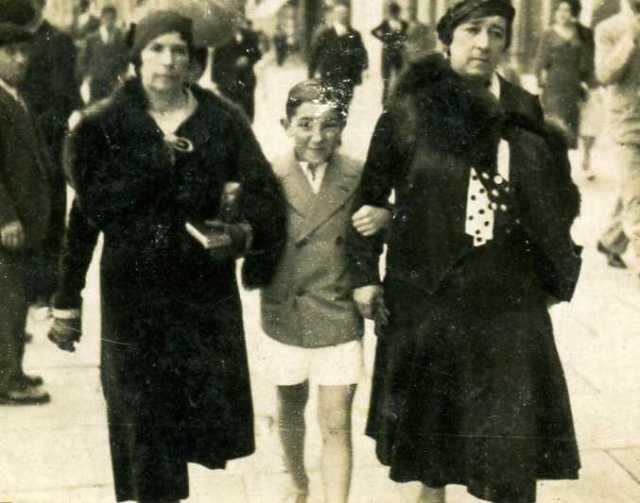
My grandfather in the 1930’s flanked by his mother (r) and her sister. All three died of cancer.

I immediately jumped back a further generation to try and find a link to any other cancer-related deaths on either side of their parents’ family. My great-grandmother’s mother, Dominga, died of a “diabetic coma” – in other words, not a cancer-related disease. My great-grandmother’s father, however, did die of cirrhosis of the liver, which apparently can be a linked to liver cancer (which as we have seen was the cause of death given for one of his ten daughters). This seemed to me like a possible lead, so I decided to research further researched how my great-great-grandfather’s ten brothers and sisters’ ended their days.

Again, I was compelled to discard two of his sisters who had died in infancy of unknown causes, as well as a third brother who had died of smallpox at the age of 13 months. Of the remaining two brothers, one died of what was diagnosed as chronic gastroenteritis, which in itself does not imply cancer, but the fact that it was recorded as “chronic” makes me wonder whether it may have been something else that brought on his demise?. The remaining brother apparently died of broncho-ataxia (a lung ailment) and pellagra (a deficiency disease). Thus, no immediate signs of cancer among the brothers… but what about the sisters?

My great-great-grandfather had a total of seven sisters; leaving out the two girls who had died in infancy, I had to find the cause of death of the remaining five. One remains elusive to this day, so I have no way of knowing yet when or how she passed away, but the other four offered further clues. The elder of the four, called Delfina, died at the age of 63 in 1918 due to a carcinomatose organic cachexia; her next sister, Carmen, had died eight years before at the age of 52 of a mamarian schirrus (or hard tumor). The next sister, Estrella, died at the age of 46 in 1912. Her youngest sister, Encarnación, had died four years previously of a reproduced mammarian carcinoma aged only 39. She left a widower and three infant children aged between five and one years of age – I later discovered that her younger daughter also succumbed to breast cancer aged 53.

I was obviously on the right track to discover from which branch my Mum had inherited the cancer gene, if indeed there was one, but my research got tougher as I moved back in time. Neither of my great-great-grandparents’ parents, Francisco and Rosa, appears to have died of a cancer-related illness, and in fact both reached a fairly advanced age. I thought then of turning to their respective siblings, but my great-great-great-grandfather Francisco only had one brother (who died, of unknown causes, at the age of 57) and the mother only had one brother who died young and one sister who, somewhat suspiciously, died of “rheumatism and flatus” (this again does not necessarily imply cancer, but who knows if rheumatic-type pain could have been caused by an internal tumour of some kind?).

Any additional research into the origins of cancer beyond this generation appears impossible, as the cause of death for my ancestors in the early 19th century was not recorded. One possible lead which I may never be able to provide comes via Rosa’s family. Her mother, Carmen, died at the age of 35 of “a natural death” – possibly a euphemism for cancer? Alas, I don’t think I will ever find out.

With such a medical history, my Mum’s oncologist took immediate action and sent her Mum to do some tests for BRCA1 and BRCA2, hereditary genes which are linked to specific types of cancer (breast, pancreatic, prostate and melanoma), most of which can be found in my recent family history. Unsurprisingly, my Mum tested positive for one of those mutations (BRCA2), as did one of her younger sisters and the latter’s daughter. Other members of the family have decided not to test or are currently waiting for their results. In the meantime, my Mum’s eldest sister lost her battle against pancreatic cancer. She had decided not to do the BRCA2 genetic test.
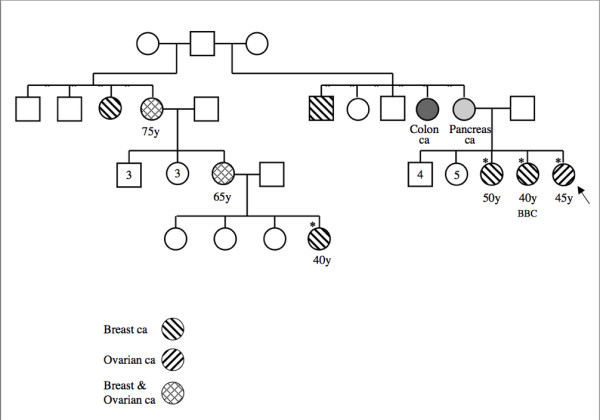
A family tree showing members of a family and the inheritance pattern of breast and ovarian cancer.

Unlike my aunt, and perhaps prompted by my natural curiosity as a genealogist to unravel family mysteries, I decided to test in order to find out if I too was a carrier of the BRCA2 gene, and thus if my chances of developing cancer were significantly higher than average. My brother also decided to test. Much to our relief, our results came out negative. Now, this does not mean that we will never have cancer, but our chances of developing the illness are just the same as anybody else’s who does not have a genetic mutation.

I cannot finish this article without a note of encouragement to all my readers: if you have the slightest suspicion that there may be a genetic disease in your family, please speak to your GP. Remember: early detection saves lives!

If you wish to learn more about the BRCA1 and BRCA2 mutations, please visit the following links:

https://www.cancer.gov/about-cancer/causes-prevention/genetics/brca-fact-sheet

http://www.breastcancer.org/symptoms/testing/genetic/pos_results

https://academic.oup.com/jnci/article/91/15/1310/2543764/Cancer-Risks-in-BRCA2-Mutation-Carriers
Posted in Genealogy, Illness, Spain, Women | 1 Comment

Who Do You Think You Are? Live 2017

Well, I’m back. Or should I say I survived? My calendar over the last four days has been filled with nothing but talks about genealogy, genomics, resources and (to quote someone I met at WDYTYA? Live 2017) “nerdgasms”. Yes, Who Do You Think You Are? Live 2017 is over, sadly, but I have to say that despite the pain in my feet, my headache and a swollen throat, I can honestly say it was well worth the short hop on a two-propeller plane and the three-night stay in a Birmingham airport hotel.

This was my second time attending WDYTYA? Live, but unlike last year’s one-day visit, I decided to prolong my stay by an extra day. Having arrived on Thursday afternoon, I made my way to the hotel, where I had arranged to meet two friends from Twitter (Sonia Sanchez and J. Carmen Smith, escorted as ever by her faithful Jim) with whom I have been in correspondence for a while. Over the past few months we have been helping each other out with each other’s research in Spain and the UK, so we couldn’t resist the temptation to meet up and exchange views and notes. I had a number of records to give to J. Carmen concerning her Spanish ancestors, which I’m sure have kept her busy since travelling back home! To compensate my lack of certificates for S. Sanchez, I gave her a packet of Belgian chocolate which I trust she will munch as she too reflects on what she has learnt, grasped and taken away from her two-day visit to Birmingham.

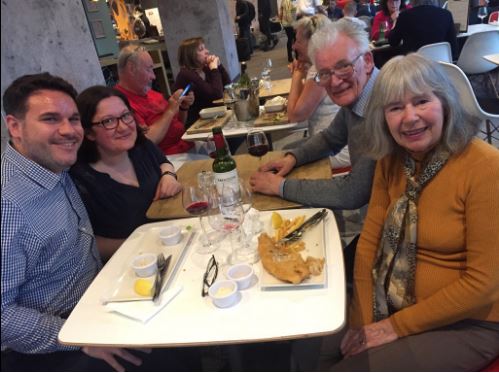
My absolutely highlight was meeting J. Carmen Smith (and Jim!) and Sonia Sanchez. A evening I shall always remember!

My first day at the show this year was marked by a slightly more planned approach to the stands I wanted to visit. It was difficult to avoid the Ancestry stand(s) as you came in, and even harder to avoid buying a few DNA kits for just 49GBP each (I won’t say how many I bought for fear of enraging my parents, who will probably read this entry). In any case, it was enough to make me momentarily a trending topic on Twitter and made me instantly recognisable even to Ancestry’s competitors. I also attended two workshops, one on Civil Registration: A Registrar’s View (which I found very interesting, if not a bit condensed for just 45 minutes) and one on High Definition AncestryDNA, given by the LivingDNA team. I confess the latter felt a bit like a sales pitch at first, but I was fascinated by the amount of information they were able to squeeze into a 45-minute presentation, not least because they showed the various ethnic groups within the UK (something which AncestryDNA has so far failed to break down).

Whoops, I did it again!

On Friday I also took the chance to speak to an expert at the FindMyPast booth, and was fortunate to speak to Audrey Collins (who some of you may know as the co-author of the Pen & Sword book on BMD registration. OK, so we weren’t able to bring down the brickwall, but we had a delightful chat and discussed other topics of less-genealogical consequence. It goes without saying I couldn’t resist buying a copy of her book and asking her to autograph it, as a reminder of our 20-minute conversation. Friday was also the day I was able to meet familiar faces from the world of Twitter. I confess I had been on the lookout for them, but the amount of people makes it quite difficult to just “bump into” anyone at WDYTYA? Live! At any rate, I did get to see Andrew, Steve and Jane, so it was nice to put a face to the Twitter handle!

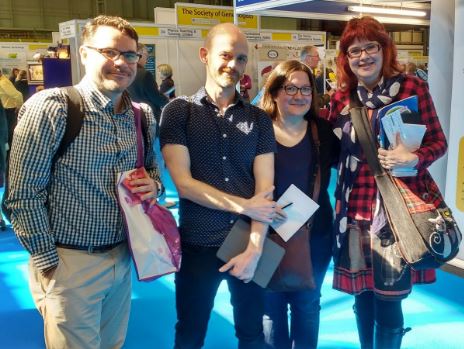
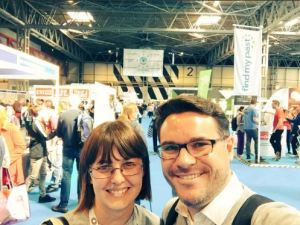
With Andrew, Sonia and Jane (courtesy of Steve, of Atcherley fame)

I should say at this point that my first day was spent in the company of Sonia, and I have to admit it was much more enjoyable than attending the show alone. It gave us a chance to look at stuff together, exchange views and keep each other company (it is amazing how easy it is to feel alone in a big crowd!). Upon returning to the hotel, Sonia and I decided to tackle my Mary Elizabeth Vickress brickwall, to no avail, although it was great fun. Next time I promise we’ll try to sort out some of her brickwalls instead!

With Carole (of The Surname Society fame)

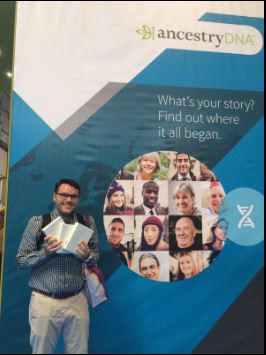
Saturday was my second (and last) day at the show. It was quite crowded, with a higher influx of families attending. As I was alone, I kept an eye open for other possible Twitter friends – my prayers were answered when Carole (of The Surname Society, whom I shall probably be joining very soon) recognised me thanks to my Converse shoes. Sometimes it pays to stand out! I also met Marie Cappart, the foremost genealogist in Belgium, who was busy attracting passers-by to hr stand. I was also recognised by another, unfamiliar face: passing by the LivingDNA stand to have a look at which ethnic regions they have managed to identify, a nice young lady approached me asking if I was interested in their product. She immediately confessed she had recognised me following my Tweet on the AncestryDNA kits, and very kindly offered me a complimentary kit – just like that! Well, how could I say no? I confess my interest in this new company is growing, and although I am still going to test a few more relatives with Ancestry, time will tell whether I shift my focus to a company which offers a more broken-down ethnicity result.

Swabbing and giving a grateful smile to LivingDNA at the same time is not easy, I can tell you!

My day was complete when I attended my last workshop on Ancient British DNA (given by Mark G. Thomas – highly interesting, if not a bit too technical and long-winded for my tired head by then). I couldn’t leave the show without passing by the FIBIS stand to see if a nice lady called Penny (whom I met last year, as you’ll remember) was there and see if she had found anything about her own Indian background. Penny remembered me and we spent a few minutes chatting about how DNA testing might help her to figure out her Indian-Burmese origins.To encourage her I gave her my last packet of Belgian chocolate, which I am told she will start enjoying soon “when Lent is over”.

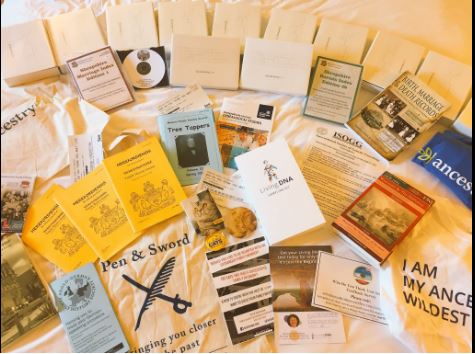
And so, my friends, WDYTYA? Live 2017 drew to a close, and I walked back to my hotel room with far too many DNA kits and too much merchandise to test even my own sturdy carry-on luggage. Alas, another year has gone by, but I can’t wait to go back next year!

Just as well I didn’t attend WDYTYA three days…


Posted in Birmingham, DNA, Galicia, Genealogy, Who Do You Think You Are? | 1 Comment

How to order a Spanish death certificate?

One of the most common questions I usually get when discussing genealogy is “how can I get my ancestor’s death certificate from Spain?”. The procedure is actually pretty straight-forward and it usually takes a few days – if you’re lucky!- to reach your doorstep. Oh, and most importantly, it’s free of charge, wherever you live!

Going on an official government’s website can be a bit confusing, not least because of the language barrier, which is why I have prepared a simple PDF manual that will hopefully help you to order a Spanish death certificate step by step.

Remember you can always contact me if you have additional questions or if anything remains unclear!

Posted in Civil Registration, Death, Galicia, Genealogy, Spain | 1 Comment

Understanding Spanish Surnames

In recent times family researchers in England, the USA and beyond  have asked me to clarify a matter which concerns their Spanish ancestry. It is, in fact, one of the most common questions I tend to get: how does the Spanish surname system work (and by that, I mean the system which regulates the inheritance of family names from one generation to another)?

Like in most cases in Western Europe, surname usage was introduced in Medieval times to differentiate citizens, mainly for tax purposes. Initially, surnames were not passed on systematically from a parent to his or her children; children often had the choice of which family name they wanted to be known by. In practice, this meant that a couple’s children could easily have different “surnames” and still be, legally and biologically, full siblings.

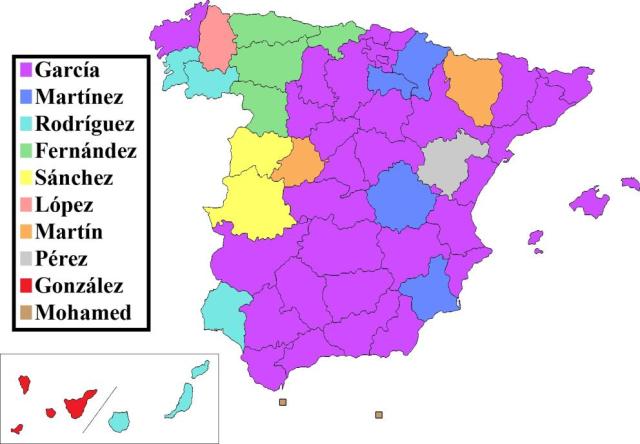
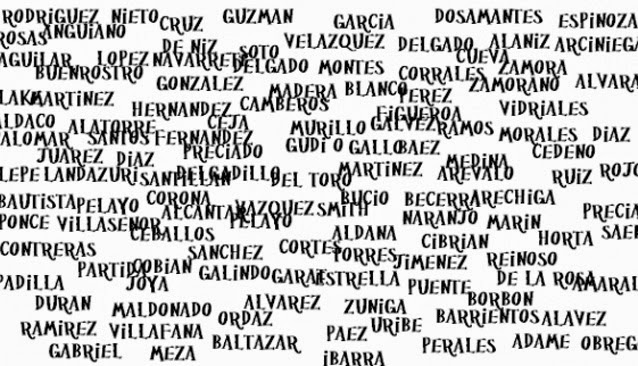
It was also during the medieval period that some of today’s most common Spanish surnames came into existence, developing from simple patronymic variations of first names. These are easily recognisable by their ending -ez (or the variant -es, which is predominant in Portuguese). This ending denotes “son of” or “of the family of”, and so the surname Fernández means “son of Fernando”, Pérez means “son of Pero/Pedro”, Rodríguez means “son of Rodrigo”, and so on. Most surnames which end in -oz  are usually derived from first names (like Muñoz, which means “son of Munio”); in this last instance, however, we should note that surnames like Galduroz, which also end in -oz, are not derived from first names; Galduroz is a toponymical surname, as it derives from a place name (Galduroz being a town in the Spanish province of Navarre). Nowadays, seven out of ten of the most common surnames in Spain end in -ez!

los-apellidos-mas-comunes-de-espana-wikicommons

However, the pattern in which a surname was inherited changed over time. Over the centuries, the system became more rigid, and thus left less space for individual choice. In fact, until the late 1700’s it was fairly common for men to use their father’s last name, while women would tended to use their mother’s surname. And so, we may still find cases as recently as the 1790’s where two siblings share both parents but do not make use of the same surname. This custom was discontinued by the 1800’s, although it is likely to come up in any Spanish family tree which stretches roughly seven or eight generations back.

But that is not all. You may have often wondered why Spaniards have such “long” names. This is due, partially, to giving children several Christian names (a tradition which is not as popular today as it was, for instance, one or two generations ago); this tradition often stemmed from the belief that being given several names implied Divine protection on behalf of the saint whose name the child bore – thus, the more names a child had, the larger the chances to lead a longer and healthier life. But going back to surnames, the fact that Spaniards have long names is partly explained by the fact that Spanish tradition allocates not one but two surnames to an individual (historically even to children born in Spain to foreign parents). To understand how this works I have created a simplified (fake) family tree:

TReeSurnames

As per the above, you can see that Pedro García López, who has two surnames (García and López) marries Catalina Galindo Fernández. Their son, Antonio García Galindo, therefore inherits his father’s first surname and, in the second place, his mother’s first surname. When Antonio marries Sara Rodríguez Pena, their children will have the surname García in first place, and the maternal surname Rodríguez in second place. Antonio’s sister Luisa, on the other hand, married a man called Eduardo Ortega Sánchez. Their children will bear Eduardo’s first surname followed by Luisa’s first surname, thus becoming Ortega García. This means that surnames in the paternal line tend to be perpetuated in future generations, while maternal surnames are usually lost in the next generation. Nowadays this is not necessarily so, as parents can choose the order of their children’s surnames, but the traditional practice of “father’s name first” continues to be the most usual.

After explaining the above, you may have noticed that the tree I created does not show women’s married names; this is because, quite simply, women in Spain never adopt their husband’s surname. In other words, women keep their maiden name throughout their lives.

Curiously, in some countries married women (particularly of  certain generation) used to attach their husband’s surname to their last name to denote that they were married; thus, María Cordero de Arias would seem to indicate that the woman’s husband was called Mr. Arias, and she wished to make the fact known to her interlocutor. This practice, however, is rarely used today and is not officially recognised.

During your Spanish family research, you may well encounter cases where a surname has a de/del/de la between words. It is often asserted that this “mark” denotes an ancestor who was of noble birth, and is therefore out gateway to fame and fortune. Unfortunately (no pun intended), this is very rarely the case. Surnames such as de la Iglesia or del Rey may well indicate illegitimacy somewhere in your family tree, while others like de la Plaza or de Orellana are generally considered to be toponymics, and may therefore be indicative of a place of origin (plaza meaning “square” or “meeting place” and Orellana may refer to any of the places in the Spanish-speaking world with that name).

That said, some surnames have, with the passing of time, become compounds, either by way of a hyphen (such as in Martínez-Bordiú) or by a particle which, in effect, turns two surnames into one fixed form (like García de la Concha). Just be sure, when researching your ancestors’ surnames, that you do not split surnames in the wrong place!

As you can see, there is no black or white when it comes to Spanish surnames. There are many variants, many exceptions and overall a lot of details which the researcher needs to bear in mind to avoid mistakes – but that’s what genealogy is all about, isn’t it?

A2historia


Posted in Genealogy, Spain | 2 Comments

Blind Expectations

Well, what a week this is proving to be what with one thing and another! It seems my Allen ancestors still have much to say about our family history, and now, thanks to the wills I had copied last week from Hereford Records Office, I have managed to make out new branches of the family I had not yet discovered.

A few days ago I received a copy of the will written by my great-great-great-great-grandfather Thomas Allen in 1842, only a few weeks before he passed away at the grand old age of 82. Thomas’s marriage to Sarah Jones had produced ten children, and although I had found the baptism entry for each and one of them, I had presumed their own story would be easy to tell – or at least, that I could track them down on the census. Wrong! Although this was indeed the case, son William is turning out to be a bit of a mystery. He isn’t mentioned in his father’s will in 1842, but he is recorded in the 1841 census – did he die during that narrow space of time, or was he disinherited? The former seems to be easier to prove than the latter, but as there is no shortage of William Allens who died in the right place during that period, it seems I will have to put off my “William Allen research” till another time.

The next mystery I had stumbled across was daughter Mary Ann, whose total absence from the censuses of 1841 and onward (at least under the surname of Allen) made me believe she may have died young. You will therefore understand my excitement when I discovered that she is listed on her father’s will, and not just that, but it also gives me the name of her husband: “my daughter Mary Ann, the wife of Richard Alford”.

alford

Reference on Thomas Allen’s 1842 will confirming his daughter Mary Ann was “the wife of Richard Alford (sic)”

A quick glance at the census typing in Mary Ann’s name, estimated year of birth and place of birth, together with her newly found husband’s surname, and voilà, I easily locate her in 1851 living with husband Richard and – surprise!- two children, Sarah Alford, who is a 9 year-old at the time, and a son called Charles Hide. Hang on… Hide? Surely he can’t be their son if his surname isn’t Alford or Allen, can he? Well, a quick search for a birth of a Charles Hide (or Hyde, which is a more conventional spelling) brings up few results, but as he would have been born around 1830 (in other words, before the introduction of civil registration) the relevant baptism record may not be available online.

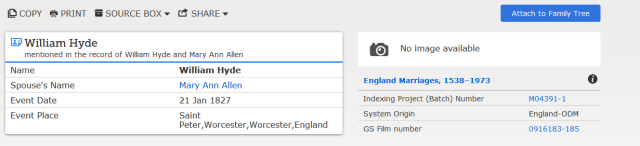
hyde

The 1827 marriage in Worcester between Mary Ann Allen and her first husband, William Hyde. The marriage is likely to have lasted about ten years or so.

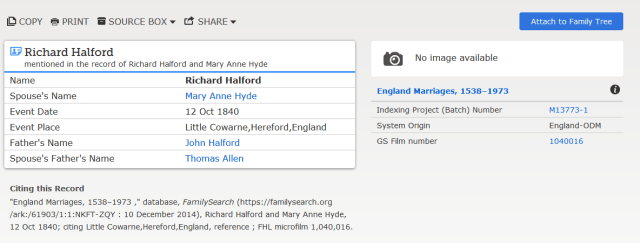
I then decide to go down another route: as daughter Sarah appears as being just under ten years of age, chances are Richard and Mary Ann married about ten years before the 1851 census was taken. I find no immediately obvious results on FamilySearch for a marriage between an Alford and an Allen, but by doing a wildcard search I stumble across an interesting marriage entry: not only do I find a marriage dated 1840 between a Richard Halford and a Mary Ann Hyde, but the marriage transcript also mentions her father as Thomas Allen! If I was ever in any doubt that I was on the right track, this certainly confirmed that I was!

halford

Entry of marriage between Mary Ann Hyde (née Allen) and her second husband, Richard Halford. The marriage lasted 15 years.

It therefore seemed increasingly likely that Mary Ann was married not once, but twice, and that she had a son by her first marriage, and a daughter by her second. It did not take me long to locate a marriage between a Mr Hyde and Mary Ann Allen – only one possible result showing a wedding that took place in 1827, when Mary Ann would have been just 19. I have yet to locate the death of her husband, whose name was William Hyde, but for now I have decided to focus on Mary Ann.

Following her marriage to Richard Halford/Alford, Mary Ann seems to have lived for a period in Little Cowarne, in Herefordshire, where she and her husband welcomed their daughter Sarah. By 1851 they were already living in Cradley, but a burial record for a Richard Halford in Colwall in 1855 suggests the marriage was short-lived, as indeed proven by the 1861 census, when Mary Ann is listed on the census as a widow. By then Mary Ann was forced to work as a housekeeper in order to survive, but I was relieved to find her living with her children (son Charles was a farm labourer, daughter Sarah a laundress). The family had by then made Colwall their permanent residence, and it was there that Mary Ann is likely to have died, as there is a death record for a Mary Ann Halford listed in 1884, showing the right age, in Ledbury registration district.

Sarah’s own story goes cold thereafter – I need to devote an hour or two to find out what happened to her after 1861- but Charles seems to have stayed close to his mother, and in 1868 he was married in Colwall to a woman called Martha Williams. The couple seems to have started a family early on, as confirmed by the baptism records available online: William (born 1869), twins Rosanna and Marianne (1872), Charles (1874), another Charles (1876), John (1878) and Herbert (who died in his first year of life in 1883).

The family is fairly easy to track down on the 1881 census, only this time I learn something new  about Charles himself: instead of having a profession, he is listed as “unable to work” – the first time I have ever come across such a note in my family’s research. The answer to the puzzle can be found a few columns over on the census record, as he is listed as “blind”. I quickly check previous census entries to see if I had overlooked such a heart-breaking fact, but there is no indication that before the 1880’s Charles had any eye problems.

The 1891 census offers no further clues – Charles is listed as “nearly blind” and continues to be without a profession, a situation which forced his wife as a “church caretaker and cleaner” – so Martha likely cleaned the church of Saint James, where all of my Allen ancestors were baptised for the last 300 years!

Ten years on the family is listed in the census complete for the last time, as Martha appears to have died in 1902, followed by Charles in 1906. I am however quite happy to see that living in the same household is a Alice Jane Sweatman, who shortly after married their son Charles – a nice revelation to end what had by then become a somewhat melancholy story of a very resilient and close-knit family!

1901

The 1901 census, showing Charles Hyde as being “blind” (last column on the right) with his family and daughter-in-law-to-be.

Posted in 1841 Census, 1851 Census, 1861 Census, 1871 Census, 1881 Census, 1891 Census, 1901 Census, Ancestry.com, Birth, Colwall, England, Family Search, Genealogy, Herefordshire, Marriage | Leave a comment

Where There’s a Will…

Most of you by now are aware of my ongoing interest in my Allen ancestors, from the parish of Colwall, on the Herefordshire side of the Malvern Hills. The fact that I live nowhere near the area makes onsite research – including a visit to the Hereford Records Office, where the parish records are currently kept- an impossible task! And so, you will understand why recently I leapt at the chance to have four copies of ancestors’ wills and testaments sent to me for the price of three!

I started off by doing a search on the Hereford Records Office website of available wills for the parish of Colwall. Choosing the documents I wanted copied was not too difficult – it seems not many of my ancestor left a will- but I could still have my pick among several possibilities. I already had a copy of the will left by my most remote Allen ancestor, the ‘husbandman’ Richard Allen, which was probated on 24th May 1716 – that’s a whopping three centuries ago. I remember finding the document very useful, as it not only confirmed the names of Richard’s four sons, but also gave me the name of an additional daughter, Mary, whose existence I had entirely overlooked.

In the same spirit, desirous to confirm and gather further information about my most distant ancestors, I went on to order the next will, chronologically speaking. I had been fortunate enough to find the will of the aforementioned Richard’s son William on Ancestry.co.uk, and as the latter died without issue, the document was doubly useful to identify nieces of nephews whose position in the family tree had been somewhat confusing up till then. Not only did he leave varying amounts of money to two of his surviving brothers, but also to several of his nieces and nephews and other relatives further removed, among whom we can count Elizabeth Pitt (widow of his nephew Richard), the young Margaret King (daughter of his late niece Elizabeth King, née Allen), the recently-married Hannah Wall (daughter of his late nephew Richard Allen), his Harwood cousins, the Blackways, and many others. I was rather happily surprised to see that he named his nephew and namesake, my ancestor William Allen, as his executor and the beneficiary of his will, once all other legacies to his remaining heirs had been paid. With such generous gifts as his last will in this earth, it is little wonder William Allen Sr. is described as a ‘gentleman’ on his gravestone.

And so, we come to the 1802 will of my own ancestor William Allen, nephew of the latter, grandson of the former, and only son of another Richard Allen – you will understand how confusing these repetitious names become after a couple of generations.  The will in itself is perhaps not as detailed as that of his uncle, as it only mentions the children who are alive at the time – which, luckily, matches my earlier research which confirms his son Joseph died at 15. It is also proof that two sons, William and John, whose date of death I had as yet not discovered, were alive at the time, and goes on to mention the youngest daughter by her married name – a new revelation and a prospective door to a new branch of relatives.

The third will I uncovered this past week is that of (yet another!) William Allen, a first cousin of the William Allen whose will we have just analysed. This new William Allen, a contemporary of my own ancestor, seems to have been widowed toward the end of his long life. His marriage to his late wife Anne produced at least ten children, of whom at least two died in infancy. His will is helpful, in that it mentions several of his surviving children by name, but perhaps the most exciting revelation was that he mentions leaving some money to his daughter Lucy, the wife of Henry Turner. Now, a long time ago I had tried to find a link between this Lucy Allen and my own family, as her descendants emigrated to America in the 1800’s and converted to Mormonism, as detailed in one of my older blog posts. The problem originally was that all sources I have found describe Lucy as being the daughter of “William and Mary” – however, William’s will confirms her to be his daughter, and knowing his wife was called Anne, I can safely assume the mother’s name on the baptism record is wrong (it wouldn’t be the first time such an error comes up in my research). One further point of interest is that old William Allen left some of his possessions to Philip, the illegitimate son of his daughter Lucy. I had not yet made a link between Philip Allen and my own family, but I now know that before marrying Henry Turner, Lucy had a son out of wedlock. What became of him is a mystery, but I can’t wait to unearth more information about him, and whether he went to America with his half-siblings too.

The final will which is of relevance to my Allen research is that of Thomas Allen, a son of the one of the William Allens listed above. Once again, the will is particularly useful not only because it gives us the names of his living sons at the time, but also because it goes on to confirm the married name of one of his daughters – one whose marriage I had completely overlooked! Also, interestingly, the document mentions Thomas’s wish to be buried next to the grave of his great-uncle William Allen (that generous man we analysed at the beginning of this article) – a wish I am happy to say was finally granted as the below photographs shows.

My overall conclusion after reading these different wills is that not only do you get an idea of a family’s fortunes over the course of time, but you also learn a lot about the people whose names you have discovered via parish records. You get a feeling of their relationships, of how close people were to their wider family, and naturally you discover new identities, married names and living relatives at the time the will was made. A goldmine of information if ever there was one!

img_0592

Me standing behind the graves of my 4x great-grandfather Thomas Allen (r), whose 1842 will reveals he wished to be buried next to the grave of his great-uncle William (l), who died in 1765 after leaving generous amounts of money to his extended family.

Posted in Genealogy | 2 Comments