
This is the story of my seven times great-grandmother, Mary Crowther. Very little is known about her – and yet, through a handful of records, it is still possible to reconstruct what must have been some of the most important milestones of her life.
Mary was probably born in the spring of 1707, as she was baptised on 6 May of that same year in the church of St Peter, in the hamlet of Diddlebury (Shropshire), about five miles north-east of Craven Arms. Her parents, John and Elizabeth Crowther, had probably married only a few years earlier, as the baptism of their eldest daughter, Elizabeth, was recorded in January 1705. In 1710 the couple welcomed their third child, Anne, who would be followed by twin daughters, Martha and Margery, baptised on 25 October 1713. Sadly, neither girl survived the perils of a double birth at a time of unsanitary obstetrics – they were both buried six days after their baptism.
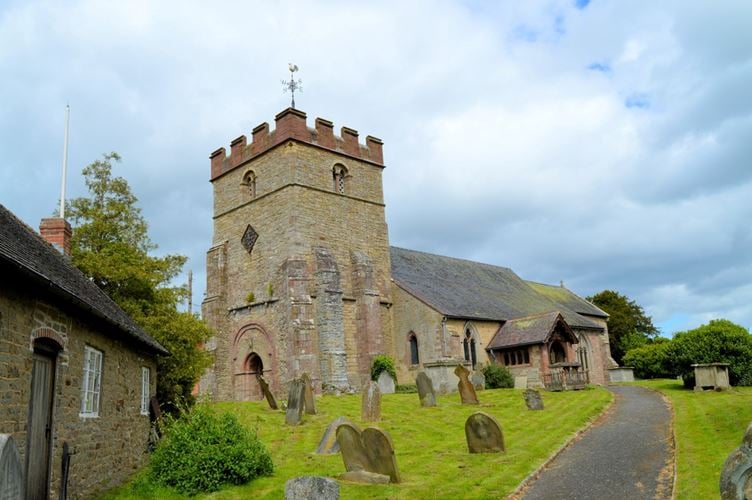
Tragedy would continue to haunt young Mary’s life for years to come. Although her mother Elizabeth had almost miraculously survived the twin girls’ birth and subsequent tragic loss, within ten months she herself would pass away – quite possibly as a result of yet another unsuccessful pregnancy.
The loss of his wife and at least two young children left John Crowther, a humble church warden, responsible for raising Mary and her two surviving sisters, Elizabeth and Anne. It is therefore unsurprising that he chose to marry a neighbour, Sarah Lealoe, the following year.
As the middle daughter in a family of orphaned children, Mary probably matured quicklier than most children of her age, though it is hoped that the arrival of a new stepmother would have alleviated some of the most arduous domestic duties. Her father’s second marriage produced three children in quick succession: Sarah (1716), John (who only lived a few weeks in 1718) and William (1720). These new arrivals were overshadowed by the sad loss of Mary’s eldest sister Elizabeth, who died at the age of 13 in September 1718.
In February 1725 Mary’s father John Crowther died, leaving his second wife a widow to care for his eldest surviving daughters Mary, Anne (from his first marriage) and Sarah (from his second). I do not know what became of his youngest son, William, who would have been five years old at the time.
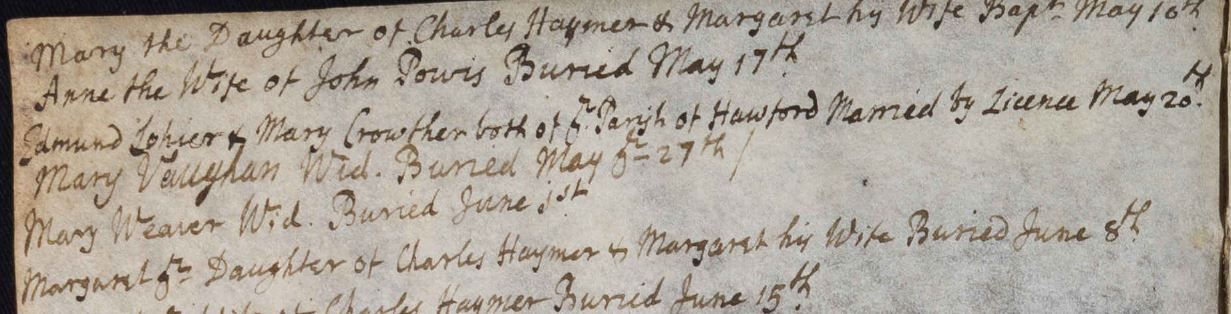
With few means to sustain her, Mary Crowther very likely looked for employment in Diddlebury or a nearby parish. On 20 May 1730 she married Edmund Lokier; both he and the bride were described as “of the parish of Hawford” (sic), which probably refers to the parish of Halford, barely five miles away from Diddlebury. The fact that her two sisters appear to have married in nearby Eaton-under-Heywood (Anne in 1732 to a John Pinches; and Sarah in 1744 to a Edward Harris) might suggest the sisters stuck together for several years.
Edmund and Mary Lokier settled in the neighbouring parish of Wistanstow and would go on to have two sons during their short-lived marriage: Edward, born in 1732, and John, who died within a few days of his birth in November 1734. About six months later, Mary was left a widow when Edmund himself passed away at what must have been a comparatively early age.
Despite her youth (she was still in her late twenties), Mary Lokier had gone through a string of devastating family losses: not only had she lost her mother and sisters as a child, but she also witnessed the death of her father, elder sister and younger half-brother by the time she was a teenager, and she now had to endure the loss of a new-born son and her husband. One can only suppose that having to care for her surviving son Edward, and perhaps through the support of her sisters Anne and Sarah, she eventually pulled through.
By January 1739 [N.S.] 32 year-old Mary was once again on the brink of matrimony – only this time her husband was a man who was not yet 19. Vincent Hammond, from the parish of Wistanstow, was thirteen years her junior, and although his family had owned several properties in that part of Shropshire, and boasted several connections to influential families, he seems to have gone into the employment as “huntsman” of one Edward Acton, of Acton Scott, to make ends meet.
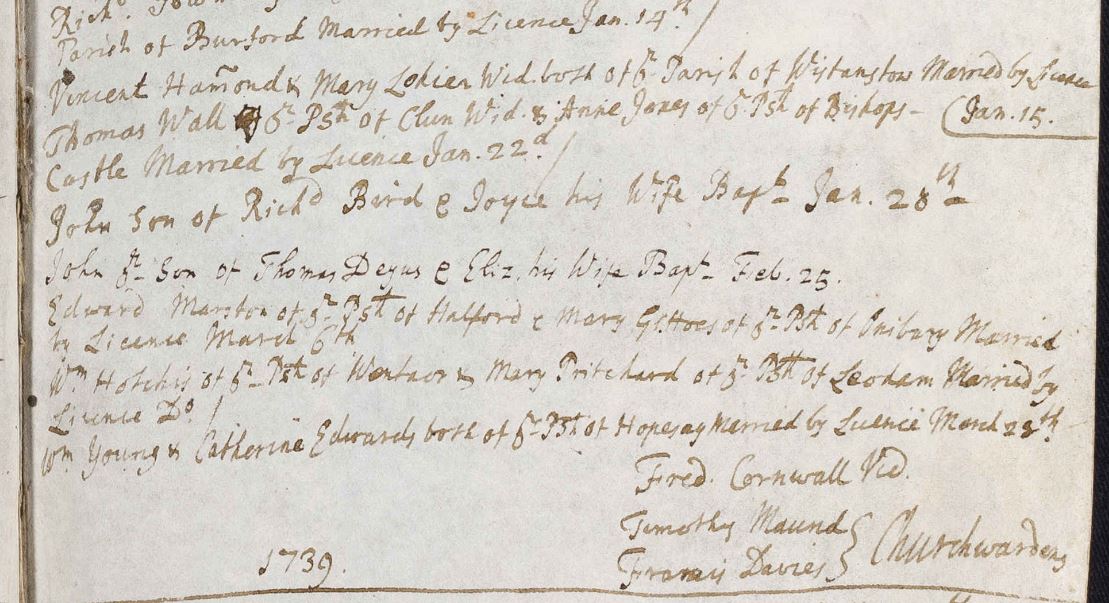
Whatever their financial circumstances, Mary’s choice of husband seems to have given her the stability she would have undoubtedly needed. She and Vincent only had one child, a daughter: my six times great-grandmother Eleanor Hammond.
It is difficult to pinpoint Mary’s date of death – there is no shortage of Mary Hammonds buried in Shropshire after 1739 – but I believe one probable candidate is the Mary Hammond who was buried in Eaton-under-Heywood in 1779. If it is so, she may have been buried there at her own behest in order to be laid to rest near her beloved sisters Anne (who was buried in Eaton on 10 November 1760) and Sarah (who was buried in the same parish on 5 December 1754). If Mary indeed lived until 1779, she would also have witnessed the arrival of four grandchildren through her son Edward Lokier, and a further six through her daughter Eleanor (who became Eleanor Crump upon marriage in 1760). An additional grandson, Lancelot Crump, who would go on to join the army as a soldier of the 58th Regiment of Foot and saw military action during the Napoleonic wars, was born less than two years after Mary’s death.
Mary Crowther, aka Mary Lokier, aka Mary Hammond, was my seven times great-grandmother. By the time she was a teenager she had known more adversity and tragedy than most of us go through in a lifetime. Even though her story can be reconstructed through a handful of records, her life is an example of stoicism, endurance and survival. I am immensely proud to have her blood flowing in my veins.


 The Genealogy Corner