
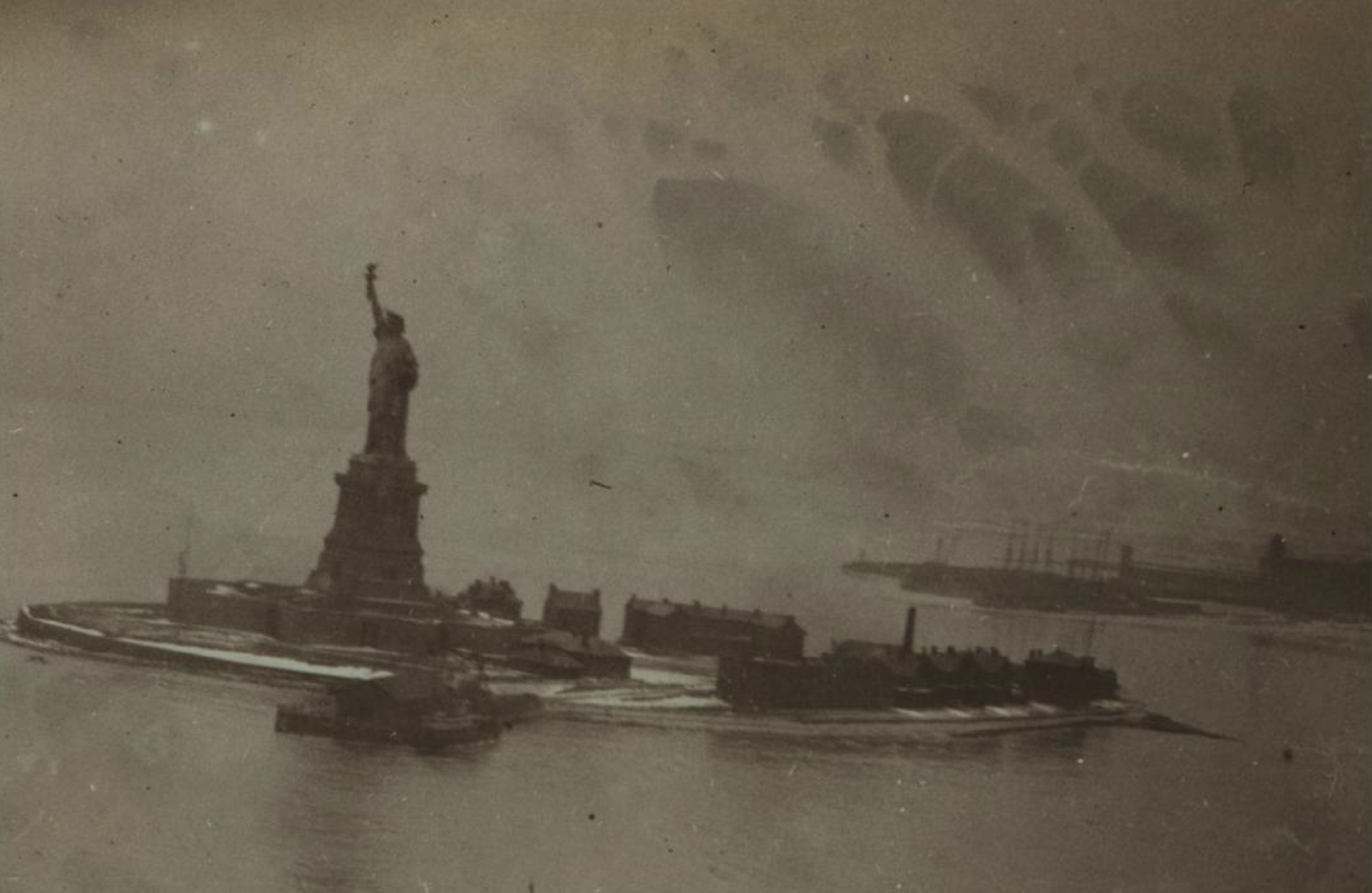
On 29 October 1912, my great-grandmother Giovanna Amerio sailed from the Italian port city of Genoa on the SS Duca di Genova, bound for New York. Crossing the chilly North Atlantic in late autumn would take a full two weeks, and Giovanna, who had turned 17 barely a week before leaving Italy, would never see her homeland again.
Upon docking in New York City, Giovanna was met by her beloved elder brother Giacomo, who had emigrated to America in 1909. It was through him that she would eventually meet her future husband, a fellow Italian immigrant also called Giacomo, whom she married in 1915. In 1916 the couple had their only child, my grandfather Peter – so christened not just in honour of Giovanna’s father Pietro, but also because he happened to be born on 29 June – St Peter’s Day. Sadly, Giovanna’s constitution was not strong, and in 1920 she succumbed to tuberculosis. She was only 24.
When Giovanna had boarded the Duca di Genova back in October 1912, she was not meant to be travelling alone. In fact she was supposed to be accompanied by Fiorenza Quaglia, a 15 year-old neighbour from her same village of San Marzano Oliveto – and, I recently discovered, a distant relation of hers: Fiorenza’s maternal grandmother, Lucia Amerio (1830-1899) was the half-cousin of Giovanna’s paternal grandfather Giacomo Amerio (1823-1887).

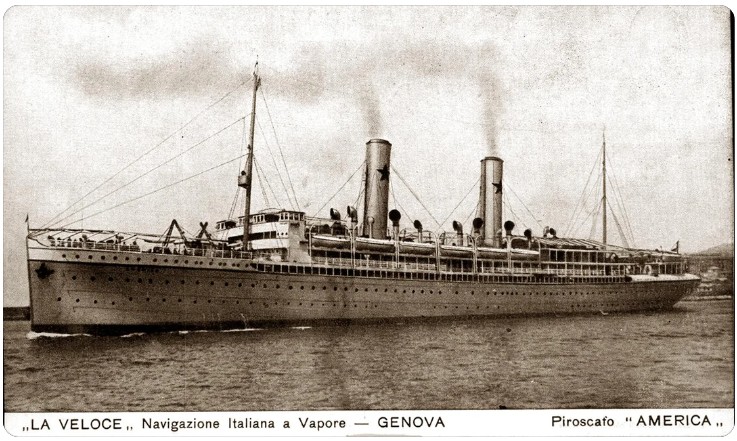
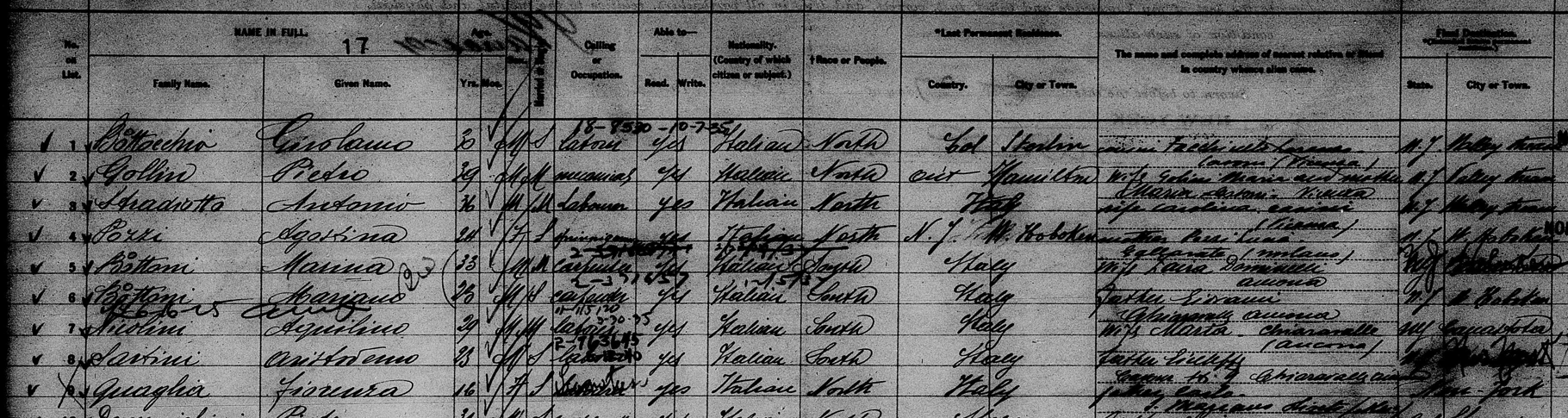
The inclusion of Giovanna and Fiorenza on the Duca di Genova‘s passenger manifest implies that both girls were originally meant to sail together in October 1912, but the line detailing Fiorenza’s personal information is crossed out (see above), meaning she was meant to be on that ship, but for whatever reason (illness, missing the ship or a sudden change of plans) she did not make it. Instead, two weeks later Fiorenza caught a different ship, the SS America of La Veloce di Navigazione steamship line (not to be confused with the Hamburg-Amerika liner SS Amerika, which was requisitioned by the United States from Imperial Germany at the outbreak of the First World War).
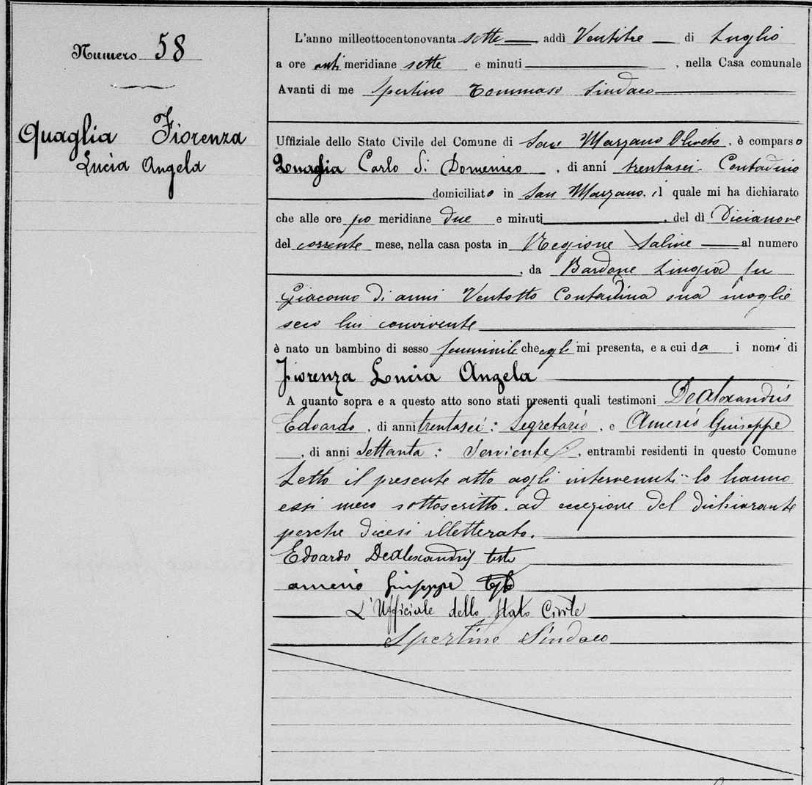
Young Fiorenza left behind her hometown of San Marzano Oliveto, which even today is a small village dominated by its baroque church and medieval castle, perched atop a rolling hill overlooking the Monferrato vineyards of Italy’s Piedmont region. She had been born there in July 1897, the fourth of her parents’ seven children. She was christened Fiorenza Lucia Angela in memory of her only sister, Angela Lucia Fiorentina, whom she never knew, as the latter died aged one in 1891. When our story’s protagonist left San Marzano Oliveto in late 1912, she also bade farewell to her parents Carlo Quaglia and Luigia Bardone, and her brothers Domenico, Giuseppe Giovanni, Francesco, Augusto Stefano and Giovanni, whose ages ranged from 4 to 25. To my knowledge, Fiorenza was the only one among her siblings to emigrate to America.
Fiorenza sailed on the SS America from Genoa on 12 November 1912 (the same day that her friend, neighbour and cousin Giovanna reached New York). After briefly stopping in Naples, the ship sailed west across the Mediterranean and into the Atlantic ocean – quite an experience for a lonely 15 year-old! What the crossing was like is anyone’s guess, though I’m sure the recent sinking of the RMS Titanic earlier that year cannot have been too far from everyone’s thoughts.
Luckily, Fiorenza made it safely to New York, docking on 26 November. Her name appears on a list of detained aliens on 27 November, perhaps because she had become physically sick during the voyage and needed medical attention. She was eventually released by the authorities, allowing her to meet up with friends or relatives, among whom I am sure was my great-grandmother Giovanna, still buzzing from her own Atlantic crossing.
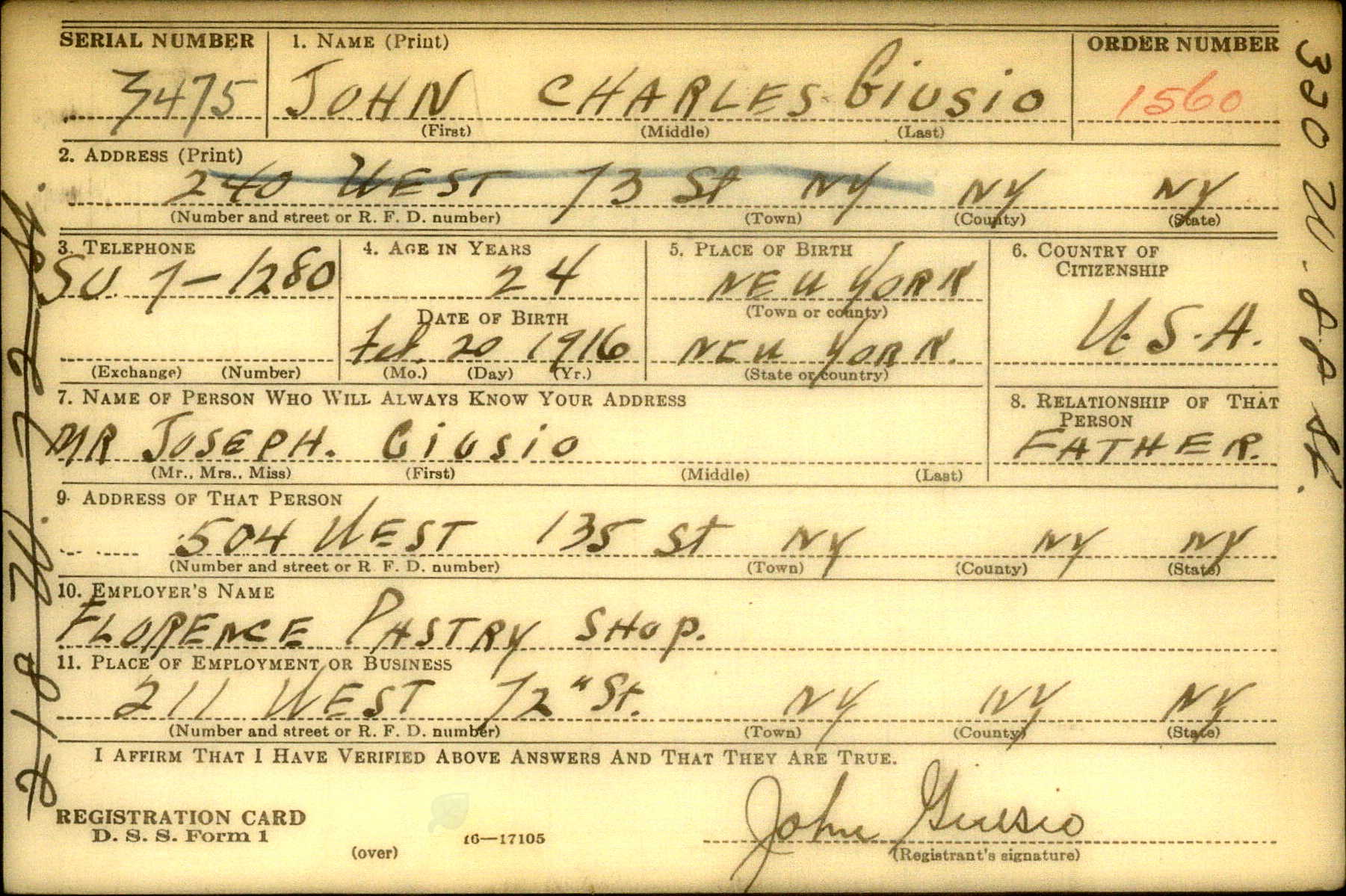
The next record where we find a reference to Fiorenza is dated 20 May 1915, when she married a fellow Italian immigrant called Giuseppe Vincenzo Giusio. Giuseppe, or Joseph as he became known in the United States, was a pastry cook who hailed from the village of Vinchio, very close to Fiorenza’s hometown of San Marzano Oliveto. It is even possible that the couple had known each other back in Italy, or more likely that they had many common acquaintances both in Italy and in New York much like my own great-grandparents, who were married later that same year.
From the moment of her marriage, Fiorenza’s name appears on records as either Fiorentina, which is how she was probably known within her family, or Florence. At some point after their marriage, the couple opened a pastry shop on 211 West 12th Street, Manhattan. The building is long gone, but the name of the establishment – Florence Pastry Shop – leaves me in no doubt as to whom it was named after. In 1925, Fiorenza signed a declaration of intention to become a naturalised citizen of the United States. The process was completed in 1928, when she relinquished her Italian nationality and her allegiance to the King of Italy.
Unlikely my great-grandmother Giovanna, whose early death meant she never got to become a US national, nor to see her parents or homeland again, Fiorenza and her family managed to travel back to Italy at least twice in her lifetime. At the age of 59, she died in New York City on 13 November 1956 – exactly 44 years and one day after sailing from Italy for the first time. She was survived by her husband Giuseppe, or Joseph, who passed away in 1975.
The couple only had one son, John Charles Giusio, who went on to live 91 years. Through his son, grandchildren and great-grandchildren, Fiorenza’s descendants continue to live in the United States to this day. I hope one day they will come across my blog post and discover their ancestor’s fascinating journey from San Marzano Oliveto to New York City.


 The Genealogy Corner
I took trip to my Northern Irish grandparents hometown two years ago and met many relatives. One even apologized for excluding my grandfather out of inheriting farm land to alternative of homesteading in Saskatchewan, Canada. His sister was treated poorly and moved to Winnipeg, Manitoba. I hope they find your blog but more of your own efforts will help.