
Today’s blog post is about resourcefulness and, above all, perseverance. For years, I have been obsessed with a particular line of my family tree (I know none of you has ever experienced this!).
It all started a couple of years ago when I was playing around with my dad’s DNA matches on Ancestry, filtering his results by searching for known family names in the surname search field, and colour-coding each individual match (I find colour-coding a very easy and accessible way of categorising and distinguishing DNA matches, particularly if you are not good at keeping track of how you are related to all your matches). I searched for the surname Terzano, which was not only my Italian great-great-grandmother’s maiden name, but also her mother-in-law’s maiden name. Yes, they came from a small place in northern Italy, and in all likelihood they were very distantly related to each other.
As the Terzano surname is relatively rare in Italy – but extremely common in my great-grandmother’s village of San Marzano Oliveto, in Piedmont – I figured that finding out my family link to this unexplored DNA match would prove relatively easy. Wasn’t I in for a surprise!
This DNA match, who must be a very distant relative of mine (roughly 5th cousin, if not more distant) had published on Ancestry a fairly basic family tree featuring his parents and grandparents. Despite the relatively sparse information, it did reveal that his mother’s maiden name was Terzano. Her parents, now deceased, had both been born in Detroit, Michigan but were probably first generation Americans with recent roots in Italy. In order to make the connection between this family and my own, I knew I had to rebuild my DNA match’s family tree and see where the paper trail would take me.
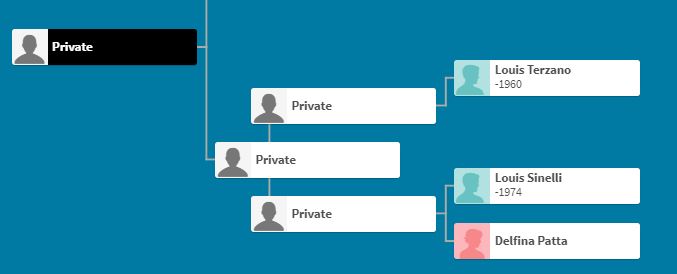
My relative’s great-grandfather was a man called Louis Terzano, and he seems to have emigrated to the United States in the early twentieth century. The first significant record I was able to find that mentioned him with any certainty was his marriage, which was registered in Detroit in July 1914. I knew this was correct because his wife’s surname matched that of my DNA match’s tree (which, although quite basic, was still accurate when it came to personal details such as dates of birth). My next step was to find Louis on the census, in the hope that I find retrieve further details about his family and place of birth.

The 1920 census records Louis, his wife and children living together in Detroit. This information is replicated in the 1930 and 1940 census, but two very useful details proved essential: Louis’ citizenship status (which changed from “alien” in 1920 to “submitted papers” in 1930, and then to “naturalised” in 1940) and the year in which he emigrated, which is given as 1909.

Finding Louis’ naturalisation papers on Ancestry actually proved difficult, though an index card did provide me with his exact date of birth: 19 October 1887. With this additional detail I decided to go off on a tangent and decided to look up the civil registry birth records for my great-grandmother’s home town, which are available (including images) on FamilySearch. I knew I was clutching at straws, since I had no proof as yet that Louis came from my great-grandmother’s hometown, but of course there was an outside change that they were from the same place. Sadly, no birth record matches Louis’ name or date of birth, at least in the village of San Marzano Oliveto. But as I was searching on FamilySearch, I decided to try my luck with a general search and see if there were further clues as to Louis’ origins.
To my delight, a few clicks later I was able to download his 1933 naturalisation papers which had eluded me on Ancestry. In this signed declaration, Louis (or Luigi, as he would have been officially known) stated that he had been born on 19 October 1887 in Casasco, Alessandrea (sic), in Italy. My knowledge of the area’s geography is relatively good, but even I had never heard of Casasco before, or even knew whether it was still within the province of Alessandria (the neighbouring province of Asti, where most of my ancestors came from, actually split from Alessandria in 1935). I checked the online birth records for Camerano Casasco (Asti), which are also available on FamilySearch, but drew a blank. But it turns out that there is indeed a town called Casasco in present-day Alessandria, so armed with his date of birth, I decided to give the local registry office a call in my somewhat mangled Italian. Unfortunately, a search for a birth record for Luigi, as well as a marriage record for his parents, drew a blank.
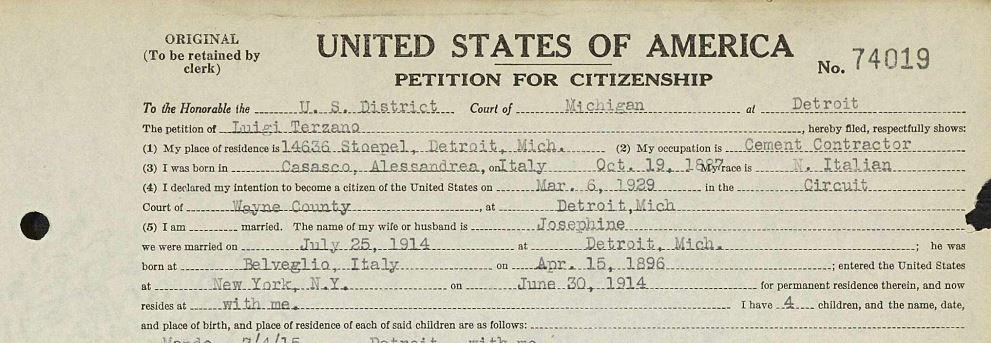
At this stage in my research, I started to become frustrated: here I was, with a consistent date of birth, a record that clearly gave me an exact place of birth, a name and surname, and yet there seemed to be no trace whatsoever of my presumed relative’s birth. I then decided to check a source I had not yet consulted before: passenger lists, which as you all know contain a wealth of information about our migrant ancestors.
In 1914, a few short weeks before his marriage in Detroit, Luigi seems to have entered the United States by ship – let’s remember that he had already emigrated in 1909. Unfortunately, he once again gave Casasco as his place of origin. I turned to Twitter for advice (and a bit of moral support), and I was fortunate enough to receive some very helpful tips that will definitely be useful to me in future: a contact of mine suggested that perhaps Luigi was from another town “near Casasco”. Another suggested that perhaps there’s another place with a similar spelling. It’s true that Casasco can be easily spelt incorrectly, and therefore mistranscribed: Casario, Cassano, Cassinasco, Calosso… All these places are relative close to Casasco, but how could I be sure I had the correct place without going on a wild goose chase?
I was on the verge of giving up my quest, when two things happened that made me realise the error of my ways: my dad, who I told about my ongoing genealogical conundrum, made a very pertinent remark when he asked me “Are you sure Casasco was where Luigi was born, and not simply his last place of residence before he emigrated to America?” Something clicked in my mind. What if Luigi had reported Casasco as his last place of residence, as opposed to his actual place of birth?
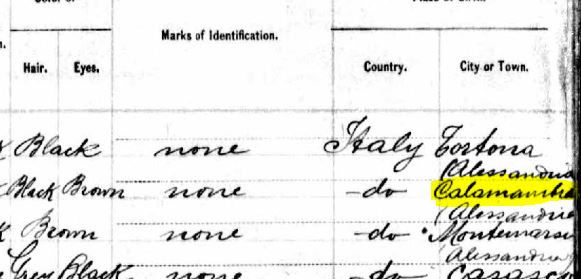
The other fact which I had stupidly overlooked was the information contained in the census relating to the year on which Luigi had emigrated to the United States. While I had located him on the 1914 passenger list, the 1920 census clearly gave his emigration year as 1909 (see screenshot above). But there was no 1909 passenger list to be found! At first, all I could find was the one for 1914, so I decided to try different spellings and wildcard searches to expand my search. At last, I found a passenger list featuring a Luigi Cerzano, born in or around 1887, who emigrated to America in 1909. While the first page of the manifest (again) mentioned Casasco as his last place of residence, the final column on the second page did actually ask where each passenger had been born: Luigi did not answer Casasco (contrary to what he declared both on the 1914 passenger list and his naturalisation papers in 1933) but Calamandrana. Now that is a familiar name, as it’s a small village literally next to my great-grandmother’s home-town! At long last, I seemed to be getting somewhere!
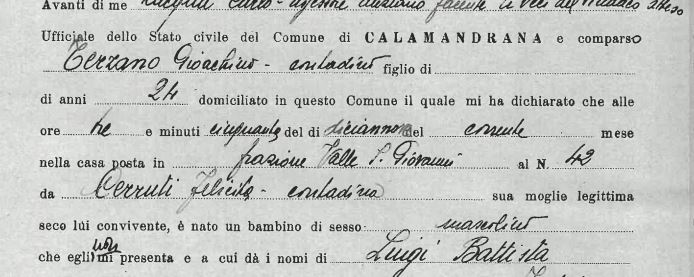
I couldn’t help myself, so I immediately telephoned the civil registry office in Calamandrana in the hope that they might be able to help. The lady at the other end of the line was extremely helpful, and told me I could make a request via e-mail, asking for an integral copy (basically a certified scan) of the birth certificate. Doing as instructed, I decided to try my luck and also requested a copy of Luigi’s parents’ marriage certificate (assuming they had married in Calamandrana, and of course assuming that their names would be mentioned on Luigi’s birth certificate). After a full week, I received Luigi’s birth certificate, stating that his parents were Gioacchino Terzano and Felicità Cerruti.
Now that I had two new names to play with, I decided to again cross-check the information I had about my own great-grandmother’s family. Looking through the family tree I have built over the years, for a moment I suspected that Gioacchino may have been the same Gioacchino Terzano born in 1855 who is a probable distant relative of my great-grandmother’s. Sadly, his age on Luigi’s birth certificate appears to be off by a number of years (he was more likely born in 1863, give or take). Things seemed a bit more promising for Luigi’s mother, Felicità Cerruti, as I happened to have a woman born in San Marzano Oliveto with that very name combination (and born, coincidentally, in 1863). Of course, this was not yet proof that the woman on my tree was Luigi’s mother. I knew I would have to locate Gioacchino and Felicità’s marriage certificate, or their respective death certificates, to prove these theories.
Sadly, the e-mail from Calamandrana registry office also contained a piece of bad news: there was no trace of a marriage recorded in the village between a Gioacchino Terzano and a Felicità Cerruti. Nothing. Not even close. So… what now? I truly felt like I was at a dead end once again.
My ongoing quest for Luigi’s parents marriage (or death) certificate in both Calamandrana and Casasco had drawn a blank, despite being the only two places where I knew for sure he had lived in at some point prior to emigrating in 1909. Any other place to search would be pure guesswork, and with so many options, I wasn’t prepared to start contacting dozens of registry offices across the provinces of Alessandria and Asti without hard proof. I then decided to think collaterally.
I asked my DNA match in Detroit if he knew whether Luigi/Louis had any known siblings. His reply proved useful, as he was able to enclose a newspaper clipping of his ancestor’s obituary. The clipping happened to mention two sisters, Mrs Caroline Ribero and Mrs Peter Bregni. So far I have been unable to locate any information on Caroline, but I did manage to find Maria and her husband Peter (or Pietro) Bregni on several American records. Peter’s naturalisation papers not only gave me his place of birth, but also included his precise date of marriage, which had taken place in his hometown of Volpedo, also in the province of Alessandria. The naturalisation file also mentioned his wife Maria Terzano’s date of birth, although her name is given as Clementina, and her place of birth is given as Belvilia… I first decided to try my luck and requested their marriage certificate from Volpedo registry office. And it turns out… there is no trace of such a marriage in Volpedo.
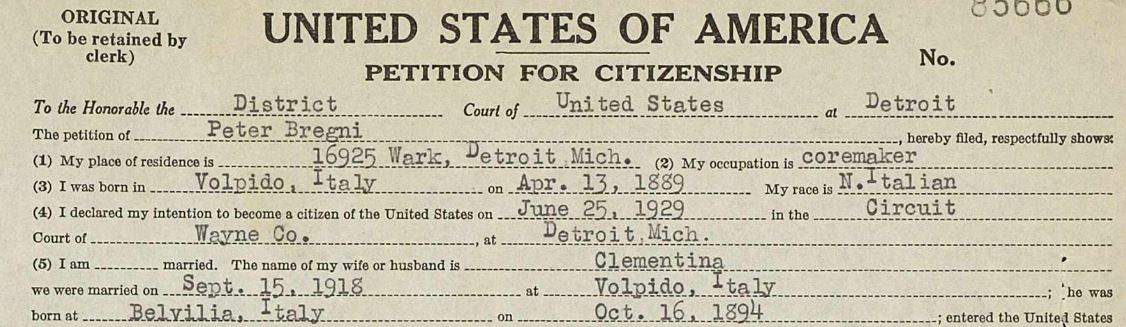
Having got to this point in the story, I wasn’t all that surprised when I looked through the records for Belveglio (or Belvilia, as it appears on Peter Bregni’s petition for citizenship record) and could not find either a marriage or a birth record for his wife Maria. But then I thought to myself: if Luigi was born in Calamandrana in 1887, perhaps his sister Maria, who was presumably born in 1894, was also born in the same village. I therefore asked my old friends at Calamandrana civil registry office for an extra favour, and you can imagine my delight when they replied with a copy of Maria’s birth certificate! In it I was able to glean a few extra clues about Maria and Luigi’s parents: their father’s name was now recorded as Rocco Gioacchino Terzano (again, with a birth year in around 1863/1864) and, even more helpfully, there were two marginal notes referring to Maria’s death (in Volpedo) and her marriage to Pietro Bregni, which took place in the nearby village of Sarezzano – so not in Volpedo as stated in her husband’s naturalisation papers! Yet another place I had not come across until now!
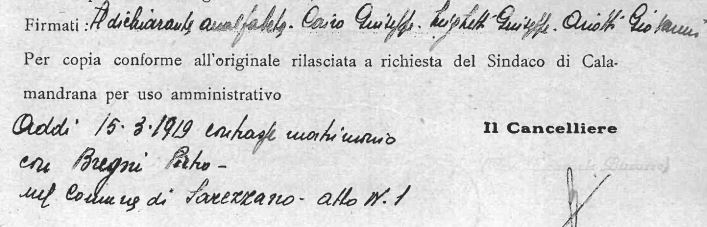
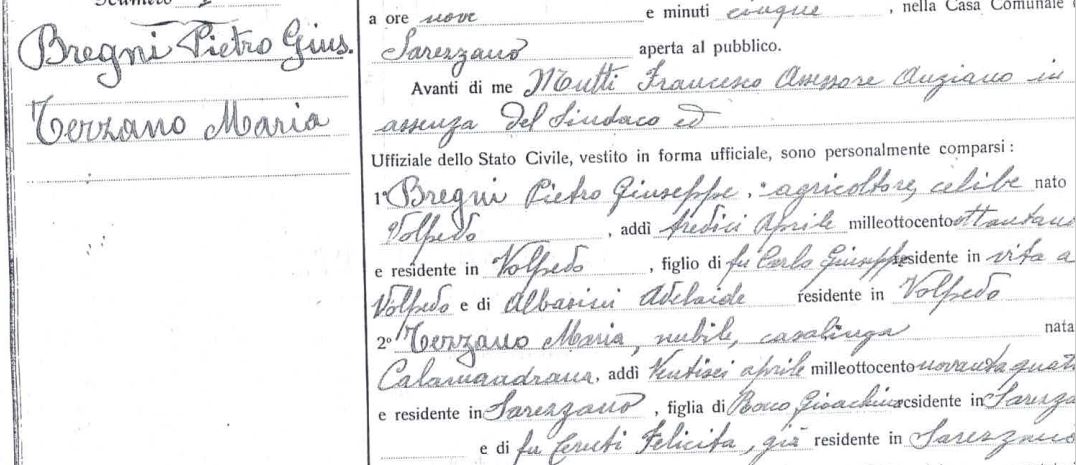
On I proceeded to call the registry office in Sarezzano, asking if I could get a copy of Pietro and Maria’s marriage certificate, a document that would hopefully provide me with information about Maria (and therefore Luigi’s) parents. At this stage, I was trying to move strategically: my plan was to figure out where Rocco Gioacchino Terzano and Felicità Cerruti were by the time of their daughter’s marriage in 1919, which would in turn allow me to locate their respective death certificates, and from then move back to heir baptisms and their own parentage – and discover once and for all how on earth I am related to these mysterious Terzanos!
The marriage certificate reached me only two days later, and it revealed two useful clues: one was that Maria and Luigi’s mother Felicità had already died by 1919, and that had previously been a resident of Sarezzano. Clue number one. Their father Rocco Gioacchino, on the other hand, was still alive at the time, and living in Sarezzano. Clue number three. I therefore contacted Sarezzano registry office again, politely asking them for an additional look up for their respective death certificates.
Unfortunately, the registry office in Sarezzano went silent at this point (I guess we genealogists can sometimes become as tiresome as we are enthusiastic…), but I was not going to give up so easily. I decided to contact the parish, and within days I managed to speak to the local priest in Sarezzano, to whom I explained my genealogical conundrum. He very kindly asked me to call him a few days later, by when he would have been able to search through the parish records.
My hopes were partially dashed when he told me that he had drawn a blank when it came to Rocco Gioacchino Terzano’s burial certificate. Not only was I having trouble locating his baptism in around 1863, but I had also failed to find his marriage to Felicità Cerruti, and now his death was eluding me too! Fortunately, the priest was luckier when it came to Felicità’s death, which was indeed recorded in Sarezzano. While I wasn’t able to get a copy of the record, he kindly told me the crucial pieces of information relating to her death, her place of birth and her parentage. Lo and behold, Felicità Cerruti was indeed from my great-grandmother’s village of San Marzano Oliveto, and she had been born in 1863 to Giovanni Cerruti and Maria Spertino.
Sadly, neither of Felicità’s parents seems to have been even remotely closely related to me, which still leaves me with the big question: how am I related to the Terzano family that ended in Detroit? My money is still on Rocco Gioacchino Terzano. I’ve certain that he holds the key to the mystery, and only by finding his baptism, marriage or death record will I be able to find our his parents’ names, and how he fits in my family tree. The mystery continues…


 The Genealogy Corner