
Today I’m going off-piste as I follow the line of descent through a collateral branch in my family tree. Harry Cartwright (1796-1842) was the only son, and the middle child, of Henry Cartwright and his wife Jane. Harry was also the first cousin of my great-great-great-great-grandmother Ann Morris (née Cartwright). Harry was born in the market town of Leominster, Herefordshire, and was baptised on 30 November 1796 according to the rites of the Anglican church – despite the fact that his grandfather, my great-great-great-great-great-great-grandfather William Cartwright (1723-1810) was a Quaker. Young Harry Cartwright seems to have spent all his life in Leominster, where his parents had relocated from nearby Kington shortly after the birth of his elder sister Amelia (b.1794). A younger sister, Catherine, would later be born in Leominster in 1799.
In 1818 Harry married Mary Lea; she was a few years older, and although the marriage lasted several years, it seems to have remained childless. Mary died in May 1831. Only a few months later, Harry married a second time, to Jane West, who was younger than him by about six years. They went on to have four children: Mary (1832), Henry (1834), George (1836) and Jane (1839), though sadly only George seems to have outlived his parents.
While the Cartwrights appear on the 1841 census, the record only includes Harry, his wife Jane and their two youngest children George and little Jane. An entry of burial for an infant called Mary Cartwright in Leominster in 1833 strongly suggests that Harry and Jane’s eldest child died in her first year. Their youngest child, Jane, would pass away two years after the census was taken. Unfortunately I have not yet been able to find further trace of their eldest son, Henry, though his absence from the census could well be indicative that he too had died young.
The 1841 census confirms that Harry Cartwright worked as a labourer. In fact this was the first and only time in which he would be recorded on the census. Just over a year later, in July 1842, he died at the age of 45; “waste” was given as the cause of death, which I take refers to some sort of slow, debilitating illness, probably consumption. His death was registered in Leominster by one Amelia Bottrell – quite probably his elder sister, who by then had presumably married a Mr Bottrell. Harry’s early death meant that he left behind a widow and two infant children, though little Jane, as already noted, would die the following year. Harry’s widow Jane seems to have managed to make ends meet by becoming a laundress, according to the 1851 and 1861 census. She died in 1869, in her late sixties. On the other hand, Jane and Harry’s third and only surviving son, George Cartwright, seems to have had slightly better innings than his father and siblings. Despite being left a fatherless orphan at an early age, his mother or perhaps some other relatives helped him become a shoemaker’s apprentice, according to the 1851 census.
But making and mending boots must not have been to George’s taste, since he appears to have become a “gas fitter” by the time the 1861 census was taken, when he was recorded as a visitor in the house of Mr and Mrs Frederick Horton on West Street, Bermondsey. Just what made George leave rural Herefordshire for bustling London is anyone’s guess, though the misery and death which had defined his earliest years in Leominster may well have played a part in his decision to start afresh far away from home. However, the move did not imply severing ties with Herefordshire entirely: in 1867 George married a local Leominsterian called Emma Peters, who was a certified schoolmistress. The couple soon settled in London, and by the time of the 1871 census, they were living on Ashburton Road, Fulham with their eldest children. The couple would go on to have seven children over a fifteen-year period: Harry (b.1868), who was obviously named after the father that George had lost all those years before; Fanny Mary (b.1871), Ada Louise (b.1872), Courtenay (b.1874), Percy (b.1875), Edith (1879) and Lily May (1883).
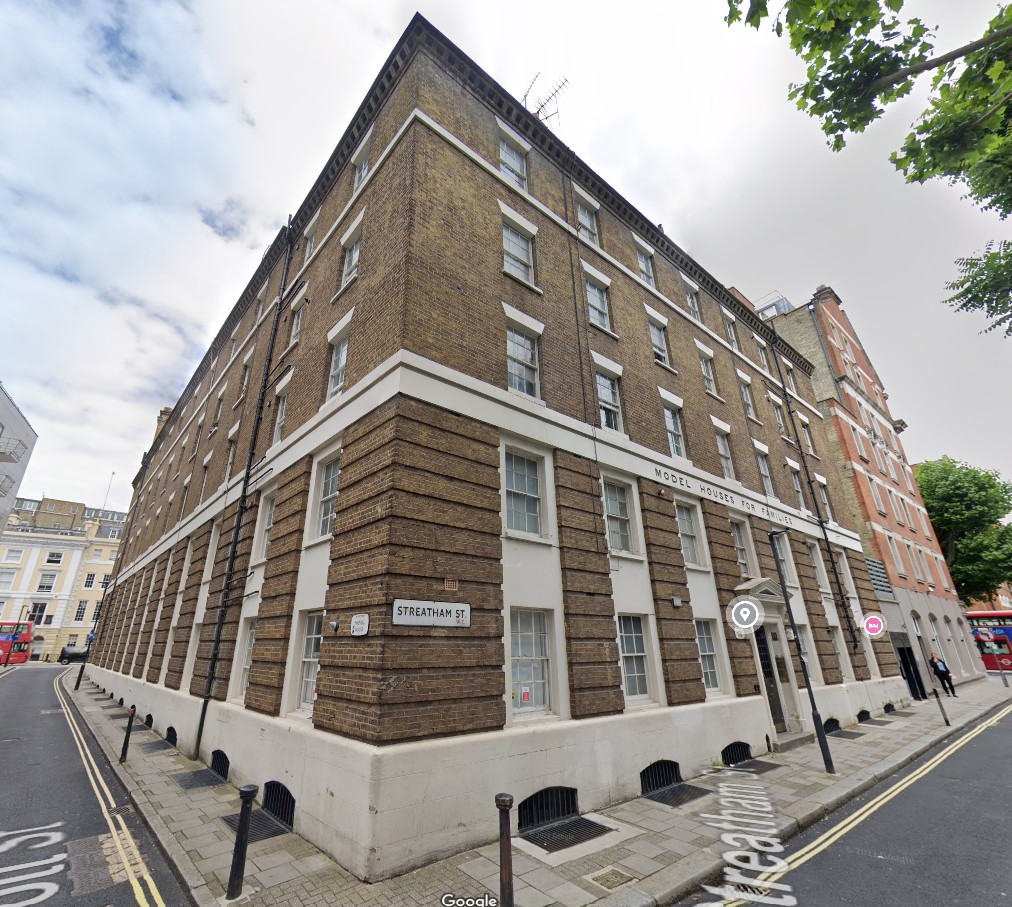
By the early 1870s the Cartwrights had moved from Fulham to 19 Model Houses, Streatham Street, Bloomsbury. A quick search online reveals that the building, designed by American-born English architect Henry Roberts, is still very much there, and in its time would have been something of an revolution in working-class social housing – the fact that the blocks had their own water-closets would have been quite innovative and forward-thinking. Sadly, conditions in the building were far from ideal, even with the addition of certain modern conveniences, and George Cartwright’s children paid a heavy price. In August 1873, little Fanny Mary died of pneumonia and rickets – a probable sign of dietary deficiency. The following year little Ada Louise died of inflammation of the lungs, a condition likely caused by bacteria, which could be indicative of her insalubrious surroundings. A year after that, George and Emma’s new-born baby, Percy, died of convulsions following his premature birth; there was just enough time to get him christened. In 1880 baby Edith died aged one year due to bronchopneumonia and convulsions. In all, four of George and Emma’s seven children died in infancy, a staggering proportion.
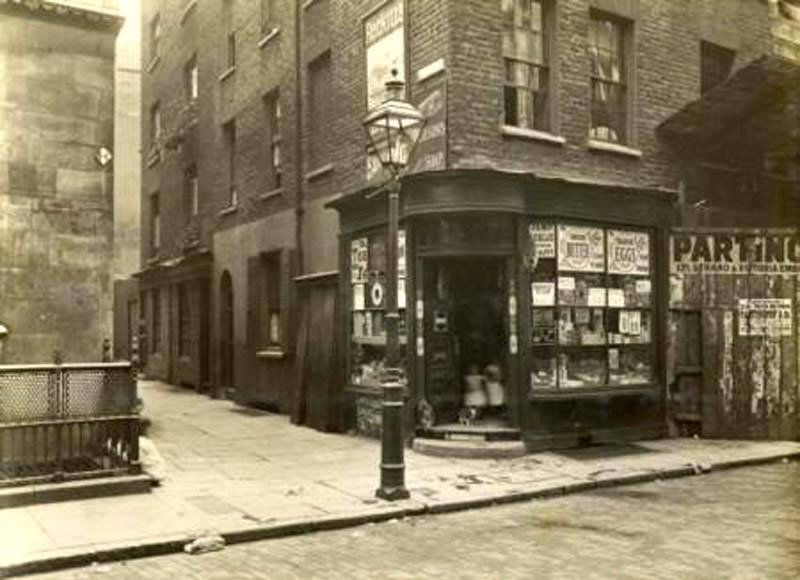
By the early 1880s, George Cartwright’s immediate family had been reduced to him, his wife Emma, their two surviving sons, Harry and Courtenay, and their youngest daughter, Lily May. The family moved a second time, this time to 3 New Inn Passage, just off the Strand – an area which was then characterised by its insalubrious conditions and the proliferation of its meat markets. The street had somehow escaped the Great Fire of London, but what once would have been a quaint reminder of old London was by the 19th century a congested, dirty, foul-smelling slum where cattle, food, and human and animal waste mingled without any concern for public sanitation measures. Much altered, the site is today occupied by the London School of Economics.
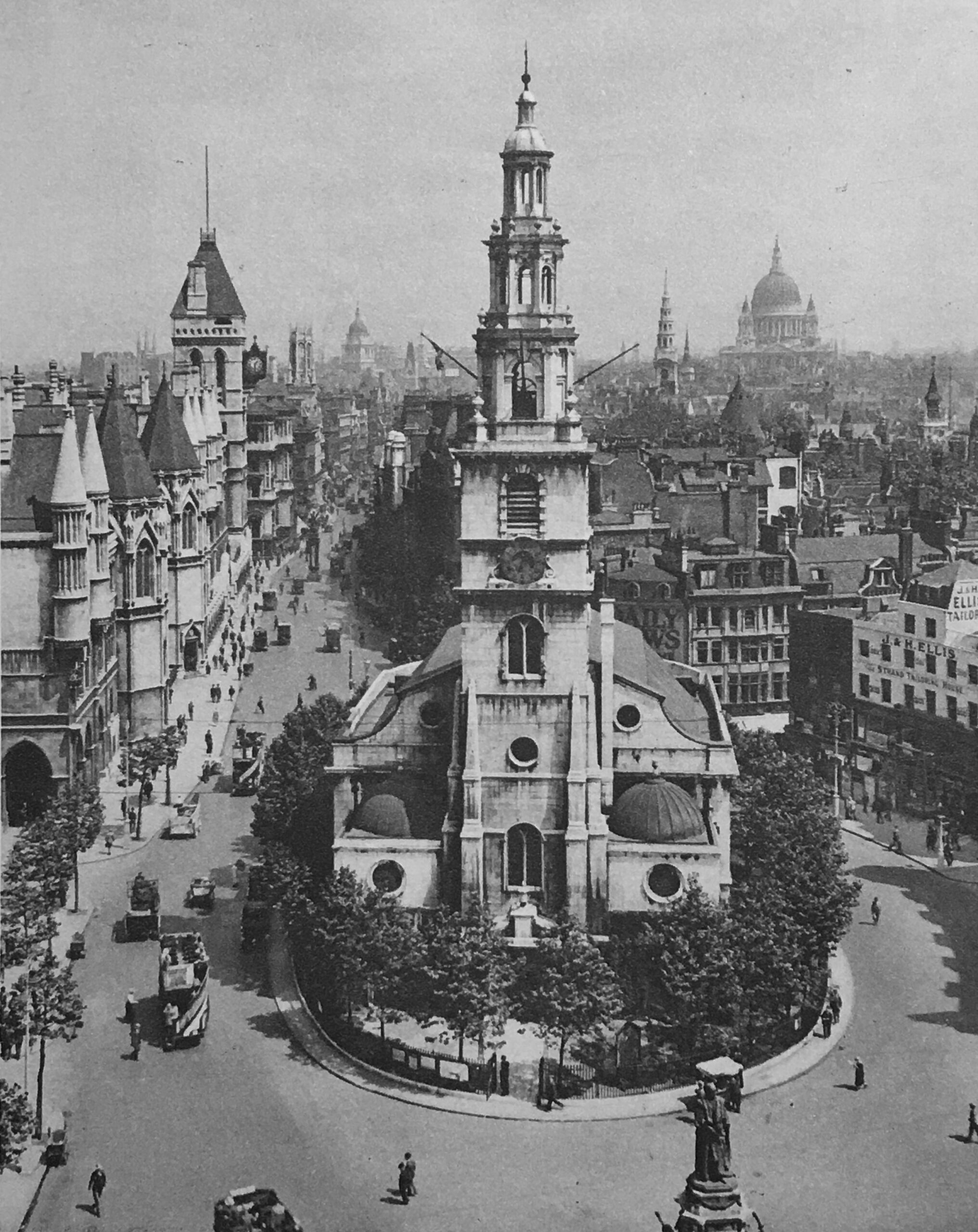
George Cartwright supported his family by working as a painter and interior decorator, but in addition he also seems to have taken a keen interest in religion, and he is noted on several records as the parish verger of St Clement Danes’ church, which was entirely gutted following a devastating fire in 1941, as a result of the Blitz, and later rebuilt. Although George’s wages as a decorator and as a verger would not have been great, for a time he did manage to employ a helping hand (possibly a domestic servant as much as an employee to assist him in the running of his business).
In September 1879 George’s eleven year-old son Harry was admitted to nearby St Clement Danes Grammar School on Houghton Street (the school was subsequently relocated to Hammersmith and later to Hertfordshire, where it still operates to this day). Sadly, Harry was removed from the school just three months later, his ill health being given as the reason for such a drastic move. Yet the boy must have been academically inclined – probably thanks to his mother’s efforts given her background as a former schoolmistress – and by the late 1880s young Harry was working as an assistant bookseller. Alas, his health slowly continued to deteriorate, and he died aged 22 in 1890 due to acute rheumatism and cardiac disease.
Harry’s death must have been a terrible blow to his parents, who on top of losing four children at a young age now had to endure the death of their eldest son. Perhaps to get away from their immediate surroundings, which would have been so familiar to poor unfortunate Harry, Emma took her surviving children Courtenay and Lily May to Prittlewell, near Southend-on-Sea, Essex, perhaps to visit friends or to spend some time recuperating and enjoying the sea air. George on the other hand stayed behind at 3 New Inn Passage, presumably as his work would not have allowed him to leave London for any extended period of time. But before long, his own health would also give in: George Cartwright, who we must remember was the only one of Harry Cartwright’s children to have survived childhood, and the one who had chosen to move from Leominster to London, died in August 1898 due to cardiac disease, cirrhosis of the liver and acute bronchopneumonia.
George and Emma’s now eldest and only-surviving son, Courtenay, who had earlier been listed on the census as working for Smith & Son (the predecessor of newsagent and bookseller W.H. Smith), decided to take over George’s position as parish verger of St Clement Danes’ church. It was in that very church that in early 1900 he married Rose Georgiana Pusey, the daughter of a stationer. The couple’s bliss was married by Courtenay’s failing health and, alas, the marriage was short-lived: Courtenay succumbed to exhaustion and phthisis pulmonum (tuberculosis) in November of that same year. His young widow, by then heavily pregnant, gave birth the following month to fraternal twins, Rosa Dorothy and Courtenay George.
Courtenay’s younger Lily May had meanwhile also attempted to start a family of her own. In 1907 she married William Jones, a labourer working for the Underground Electric Railways Company. Tragically, as if by some cruel twist of fate, this marriage was not only destined to be childless, but also short-lived: Lily May died of enteric fever (typhoid) in September 1910. Her death not only meant a tragic loss to her husband, but also to her mother Emma, who was still very much alive at the time. In the winter of her years, and approaching 70, Emma had to endure the death of her seventh and last surviving child. The sense of loss that she must have felt is inconceivable. She died in 1915, and I think it is fair to say that she died completely heartbroken.
Emma Cartwright’s death spared her of an additional, cruel loss which took place the following year, when her teenage granddaughter Rosa Dorothy Cartwright died of tuberculosis in Caversham, Oxfordshire (he widowed mother Rose Georgiana had remarried a man called Henry grey Rix and had a daughter, Enid Rix, by him). Rosa Dorothy’s death in 1916 meant that by the time the First World War ended, the only living descendant of Harry Cartwright (1796-1842) was his great-grandson Courtenay George Cartwright, Rosa Dorothy’s twin. He would later become a dispenser (chemist), and married Ethel Maud Slater in Brighton in 1926. The couple settled in the Battersea area, and it was there that their only son was born in 1931. For privacy reasons, I cannot disclose his name as there is a chance he might still be alive.
I do wonder if Courtenay George Cartwright’s son ever had children, and if any of them know that they are the sole living descendants of my distant great-uncle Harry Cartwright (1796-1842)? Do they know of their family’s link to Herefordshire? Indeed, do they know anything amount the insurmountable tragedies that marred their family history in the 19th and early 20th centuries? Alas, perhaps this article will help them to piece together some of their family history, and hopefully one day they will get in touch with me to tell me if any of the above was news to them.


 The Genealogy Corner