
My great-great-great-great-grandparents William and Elizabeth Vickress had twelve children, all of whom – remarkably – reached adulthood. Sadly, several of them succumbed to tuberculosis in their early twenties, depleting the number of family members considerably.
One of the daughters that did reach maturity, however, was their second daughter and fourth child, Elizabeth. Born in 1816 in Hope-under-Dinmore (Herefordshire), her movements are somewhat hazy in the early years when the census was taken. It is clear that by 1841 she had already left home, possibly to seek employment in service; in fact, I strongly suspect that she is the Elizabeth Vickress listed as a female servant in the nearby township of Wintercott, near Leominster. Her movements in 1851 are harder to trace.

By 1861 Elizabeth resurfaces on the census – only this time she had swapped the rural scenery of Herefordshire for the hustle and bustle of the West Midland town of Dudley, at the time in the grips of the Industrial Revolution. Working as a dressmaker, Elizabeth was living in a house large enough to accommodate lodgers. When the census was taken, there were three lodgers living under Elizabeth’s roof: Henry and Emily Budd who, aged 12 and 11, were presumably siblings, and an unmarried 49-year old carter called Benjamin Walker.
It is obvious that are relationship blossomed between Mr Walker and his landlady, for just over a year later, Benjamin Walker and Elizabeth Vickress were married in Rowley Regis, a town sandwiched between Dudley and Birmingham. Interestingly, Elizabeth may have passed herself off as a younger women (on the census she had claimed to be 38, when in fact she was closer to 45). Be that as it may, I like the fact that she was adventurous enough to move to a larger city by herself and entrepreneurial enough to take in lodgers – and it obviously paid off!
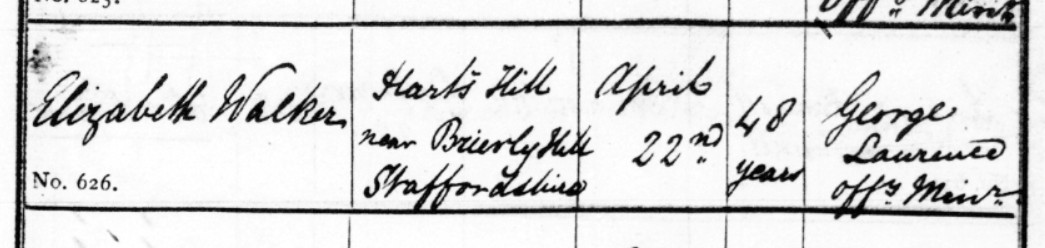
Sadly, whatever marital bliss Benjamin and Elizabeth may have experienced, it was to be short-lived. By 1864 Elizabeth was diagnosed with tuberculosis, a disease that had already killed three of her eleven siblings. The air in Dudley was probably considered to be too polluted for her own good, and so she went back to her native Hope-under-Dinmore, where the clean country air would help her recuperate. Alas, her untimely death came just nine months later, in April 1865 a few days short of her 49th birthday. Her residence is listed as “Harts Hill, near Brierley Hill, Staffordshire”.
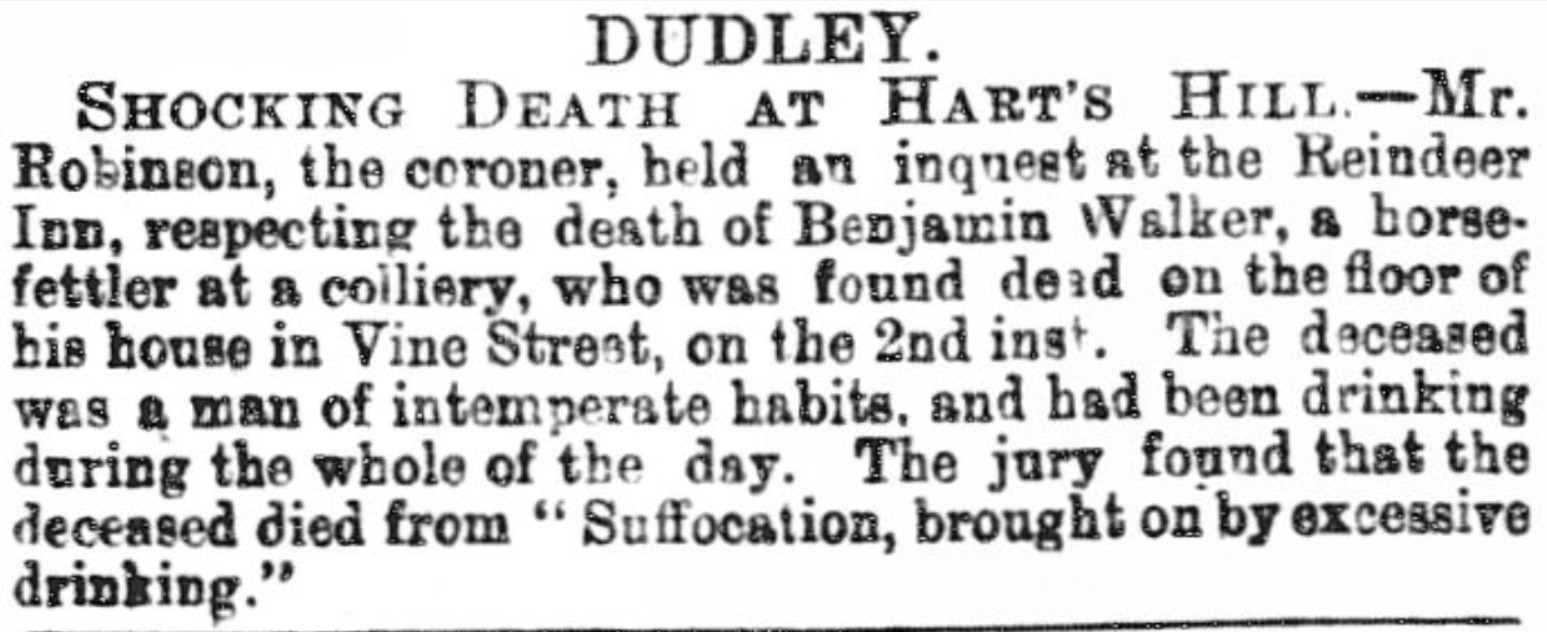
Alone, widowed and obviously childless, Benjamin Walker took to drinking heavily to drown his sorrows. Just six years after the loss of his wife, he too was to head to an early grave. His 1871 death certificate states that he died in Harts Hill (the same place as his late wife’s). The inquest that subsequently took place was held in the Reindeer Inn in Dudley, where the coroner concluded that Benjamin Walker had suffocated due to excessive drinking. He was “a man of intemperate habits”, had “been drinking during the whole of the day” and was “found dead on the floor of his house”.


 The Genealogy Corner