
My great-great-grandfather’s second cousin Ellen Tomkins was born on 2 May 1864 in Colwall, her family’s ancestral birthplace in Herefordshire. As one of no fewer than thirteen children, Ellen belonged to a tight-knit family whose branches stretched across the county borders of Worcestershire, Herefordshire, and beyond. So tightly-knit was her family, in fact, that marriage between distant relatives was not uncommon among her mother’s many cousins, the Rodways.
Ellen’s father, Henry Tomkins, worked as a mason and bricklayer, but his humble origins did not impede Ellen and her siblings from receiving a basic education; when the 1871 census was taken, the seven-year-old was recorded as a scholar. However, as soon as they reached their early teens, Ellen and her brothers and sisters were all put to work, presumably to support the family’s meagre income. By 1871, Ellen’s elder sisters were working either in service or as mantle makers, and one brother was described as a “wagoner’s boy”. By the time the next census was taken ten years later, Ellen herself had moved to Birmingham, where she had taken up work in the pen-making business (Birmingham having been described as the epicentre of pen-making). It was precisely in that city that in 1884 Ellen married a man called Edward Whitney. The couple, whose marriage would remain childless, began working together in the shoe-mending business, Edward as a boot riveter and Ellen as a boot patcher. Tracing the couple in subsequent decades through the census has been straightforward enough, but trying to discover more about Edward Whitney’s past proved a harder nut to crack, for I was unable to locate him in any records prior to his 1884 marriage to Ellen!
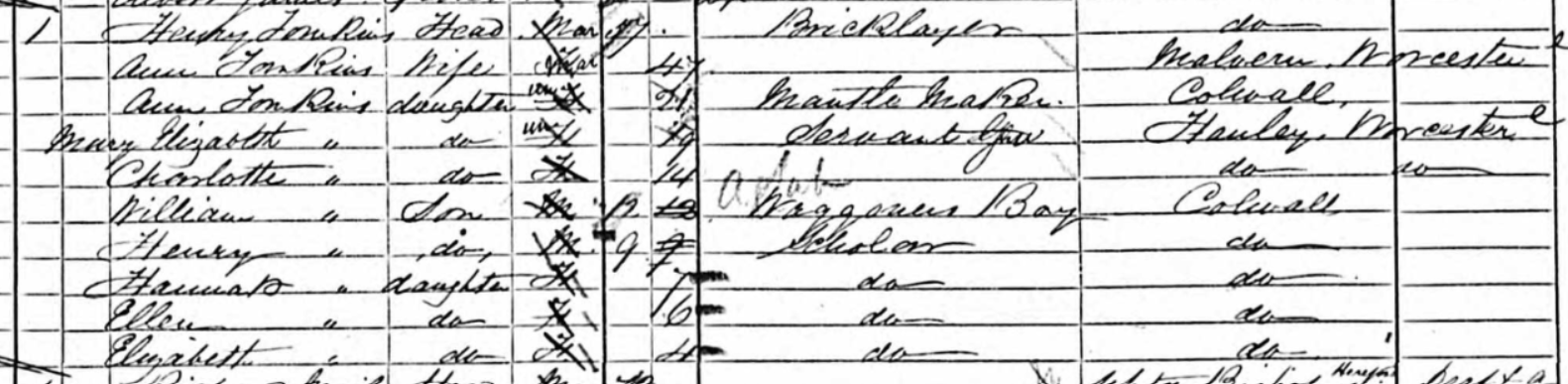
Edward Whitney was 37 years old in 1891 (the first census taken after his marriage to Ellen in 1884), which suggests a birth year of about 1854; he was therefore approximately ten years Ellen’s senior. Birmingham is mentioned on the census as Edward’s place of birth – and yet I was unable to trace a birth or baptism record for an Edward Whitney (and similar spelling variations). Ten years later, when the 1901 census was taken, Edward was listed as a shoemaker, and Birmingham was again given as his place of birth; the only significant discrepancy compared to earlier records is his age (43 – thus indicating a year of birth of about 1858). By this time, Edward’s wife Ellen was working as a washerwoman – a far cry from the pen-making business that occupied the first years of her professional career!
By 1911 the couple had moved back to Ellen’s native village of Colwall, where they were living with Ellen’s namesake niece and her illegitimate daughter Alice Tomkins. The record also confirms that Ellen and Edward’s marriage had produced no children.

It is clear that Edward and Ellen’s life has been well documented following their marriage in 1884, but his life beforehand initially remained a mystery. And then, a possible answer suddenly dawned on me. Edward’s last name, Whitney, rang a familiar bell. A quick search through my family tree database revealed that one of my relatives, Mary Wilkins (1821-1901) had married a Richard Whitney in about 1852 (though I have not found proof of a marriage record to-date). Rather remarkably, Mary Wilkins was Ellen Tomkins’ aunt! And even more remarkably, she and her husband lived in Birmingham, the very place where Edward Whitney is said to have been born.
Could Edward Whitney have been a son of Richard Whitney and his wife, the former Mary Wilkins – and consequently his future wife’s first cousin? My pet theory seemed to crumble in the face of the evidence I uncovered regarding Richard and Mary’s five known children, none of which were called Edward: these were George (b.1850), who married Harriet Pullinger; John (1853-1854); Frederick (b.1854); Mary (b.1859), who married John James Heath; and Richard (b.1862), who married Louisa Stephens.
Of these five siblings, Frederick Whitney was the only loose end. Tracking him down on the 1861 census was easy enough, as he was living at home with his parents. However, by the time the census was taken in 1871, 17-year-old Frederick was listed as an inmate at Stoke Prior Reformatory in Worcestershire! Thanks to the invaluable help of a fellow genealogist (to whom I am deeply indebted!) I was able to get my hands on a newspaper clipping from 1866 in which it Frederick Whitney, “a young incorregible lad”, was accused of stealing £2 from his own mother. For this, the 12-year-old, who was said to be “graduating in crime”, was to be put away “beyond the reach of bad company and bad advisers”. For his crime, Frederick was subsequently committed to five years in Stoke Prior Reformatory, after a spell of fourteen days in jail.
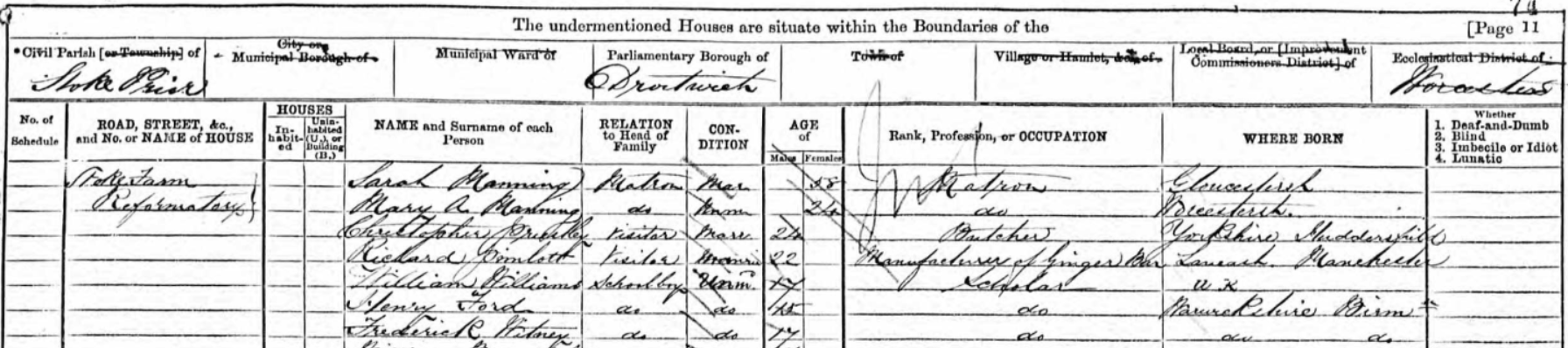
But after the 1871 census was taken, Frederick Whitney vanishes from all records.
And then, something “clicked” in my brain: not being able trace Edward Whitney prior to his marriage in 1884 shared a curious parallelism with Ellen’s cousin Frederick Whitney, whose story ended abruptly after the 1871 census was taken. Could Frederick Whitney and Edward Whitney be one and the same person? Could Fred, with a history of crime and prison, have turned into Ed in order to start afresh? Could Ellen’s mystery husband actually be none other than her own first cousin? Serendipity seemed to have played a curious joke on my family history research – if only I could find proof that my theory was right!
As is often the case, the answer can easily be unlocked if the right document can be located – and that is precisely why I ordered the marriage certificate for Edward Whitney and Ellen Tomkins. After waiting for many weeks for the proverbial brown envelope from the General Records Office, a few days ago I received a certified copy of Ellen’s marriage to Edward Whitney. The couple were married in July in Balsall Heath. The groom, whose profession is given as a press man, was a 27 year-old bachelor whose father was none other than a bricklayer called Richard Whitney – in other words, the man who married Ellen Tomkins’ aunt Mary Wilkins! As if this were not enough proof, the marriage was witnessed by George Whitney (Frederick/Edward’s elder brother) and Mary Heath (Frederick/Edward’s sister).
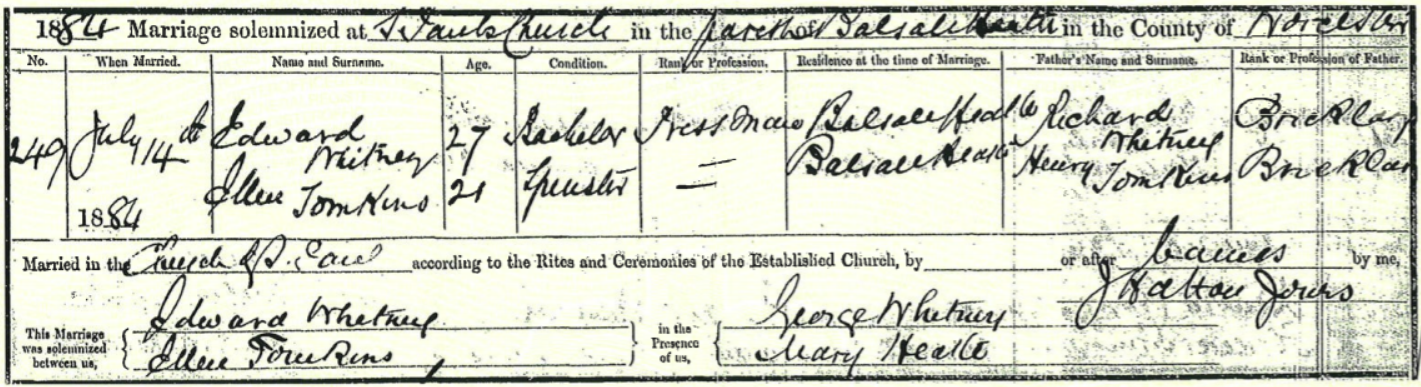
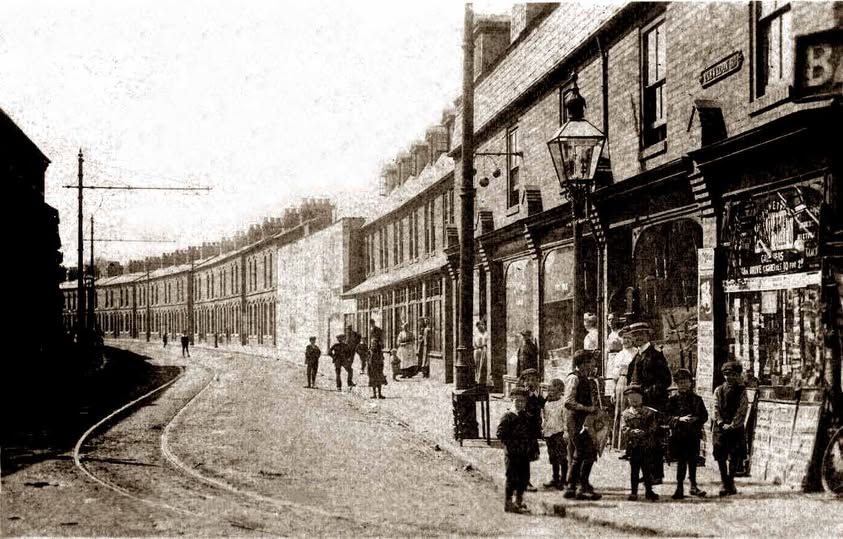
We will never know if Ellen decided to marry her cousin Edward/Frederick out of love, pity, necessity or even because of some sort of family pressure, but knowing that her mother’s family were keen on the idea of cousin-marriage, I am prepared to believe she would not have had any qualms about marrying a close relative like her first cousin. However, if by marrying Edward/Frederick she thought that his troubled days with the law were over, she was to be sorely disappointed: in February 1885, the Birmingham Daily Post reported that a boot-riveter called Edward Whitney, of 27 Clevedon Road, was summoned before the local magistrate for being drunk, for using obscene language, and for refusing to quit the Freemason’s Arms pub on Mary Street, in Balsall Heath. “Defendant was very violent, and knocked the officer down four times”, adds the article. Whitney was fined 10 shillings, and had to cover the costs, amounting to £1 and 6 shillings – a significant amount for a humble shoemaker.
As Ellen and her husband had a long marriage, I would like to think his violent temper and wayward personality did not surface often. I hope that when Edward/Frederick finally died in 1929, Ellen genuinely grieved not just a cousin, but also a loving husband. We will probably never know what she truly felt.


 The Genealogy Corner