
The Rodways of Castlemorton
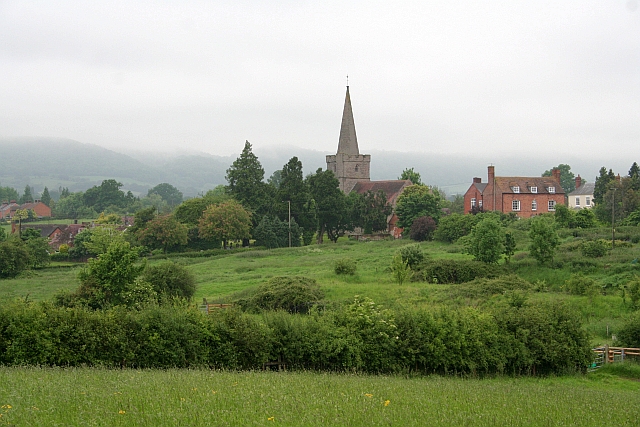
In 1853 my great-great-great-great-uncle John Rodway, a wheelwright by profession, died in the Worcestershire village of Castlemorton, where he had lived for most of his adult life. He was 60 years of age, a widower, and had recently experienced the loss of his fourth child, Thomas, who had passed away aged only 28. Sadly, within a year of John’s death, two of his three other surviving children would also go to an early grave – thus leaving his middle son, William Rodway, as the sole surviving member of the entire family.
Born in 1820, William Rodway would go on to become a greengrocer by trade; his first marriage to Harriot Hooper ended abruptly in 1849 with the passing of his wife, thus leaving him to raise their two small children, Joseph William and Angelina. William subsequently met Mary Ann Clee – I have no proof that they ever married – by whom he would have a further seven children. However, by the time their youngest was born, the family had moved away from the rural Worcestershire countryside and settled in the bustling East End of London. It was also there that William’s eldest son, Joseph William, would spend the remainder of his life.
Joseph William Rodway
Like his father and many of his relatives before him, Joseph William Rodway had been born in Castlemorton. The loss of his mother in 1849, when he was only four years old, must have made a devastating impression on the young boy. Fortunately, relatives were at hand: on the 1851 census he was listed living with his maternal grandparents, who also lived in Castlemorton. However, by the time the 1861 census was taken, he had left Worcestershire for the overcrowded streets of London. He continued to live with his father and the latter’s growing family for several years, and it was probably through his father’s training and influence that Joseph William also became a greengrocer.
In 1866 Joseph William married Catherine Ruthe, an East End engineer’s daughter who had grown up to the sound of Bow bells. The wedding took place in Stepney’s Trinity Church, which no longer exists as it was unfortunately destroyed during the Blitz. The couple initially set up house at 3 Burdett Road, Mile End Old Town, where they began a family of their own: Joseph William Jr (1869) and Catherine, known as Kate (1870), were both recorded on the 1871 census with their parents, as would be Florence (1872), Albert (1878) and Maurice (1880) ten years later. The couple’s last child, Jessie, would be born in late 1882, while another daughter called Adeline Elizabeth passed away in 1877 aged two.
If census records are anything to go by, there is nothing seemingly remarkable about the Rodways during the next few years, besides the fact that they changed address from time to time: in 1881 they were living at 59 Haggerstone Road, St Leonard’s Shoreditch, while ten years later they were recorded living at 312 Devons Road, Bromley-by-Bow. I can imagine that a greengrocer’s income would be insufficient to keep the family far above the poverty line, though thus far they seemed to have successfully avoided the dreaded workhouse.
A mysterious death?
And yet, not everything appears to have been well in the Rodway household, for 1891 would be the last census in which Joseph William would be recorded living with his wife and children. When his second daughter Florence married in 1894, her father was recorded as “dec[eased]” on the marriage certificate. On the other hand, while the marriage certificate of his elder daughter Kate in 1896 does not say as much, the 1901 census clearly states that his wife Catherine – by then living back in Mile End Old Town with her children Joseph William, Maurice and Jessie – was a widow. All these facts would therefore suggest that Joseph William had died sometime between 1891 and 1901, when the respective decennial censuses were taken, and more probably before 1894, when his daughter Florence got married. And yet, despite trying various spelling alternatives, there is not a single trace of a burial nor an entry of death that fits the fill, either on FreeBMD or on the GRO index, nor on any of the major genealogical websites. What happened to Joseph William Rodway?

Almost by chance, I came across an entry of death, registered in Shoreditch in 1883, for a 35-year-old man called Joseph Rodway. Except for the absence of a middle name, the place, age and name all matched with the information I had about my relative – were it not or the fact that in 1891 he was supposedly still alive! But we must remember that Joseph William and Catherine’s last child had been born in Shoreditch in 1882, and Joseph William himself declared he was in his mid-30s when the 1881 census was taken. I began to wonder: could he have truly died in 1883 and been recorded on the 1891 census by mistake, perhaps by a grieving widow who thought she had to declare who her husband had been? Did the census enumerator make a mistake? Believing there was a good chance that this may have been my distant cousin, I decided to order a digital copy of the 1883 death certificate from the GRO website, and dispel the mystery once and for all.
Unfortunately, my imagination had got the better of me. The Joseph Rodway who died in Shoreditch in late 1883 was a “fancy case maker”, not a greengrocer, as my Joseph William Rodway had been consistently recorded on all census records. He lived on Canal Road (not an address, as far as I know, associated in any way with my relatives), and had been admitted into the Shoreditch Infirmary, where he eventually died. This led me to conclude that I had the death record for the wrong man – but more importantly, it left one key question unanswered: what happened to Joseph William Rodway after 1891?
A broken-down marriage
I briefly considered the possibility that Joseph William may have abandoned his family and emigrated, as so many people did back then… but I did not have to go far to discover that he needn’t have boarded a steamer to elude my research efforts. There it was, hiding almost in plain sight: a 1901 census entry for Joseph William Rodway, a married 54 year-old greengrocer from Worcestershire, living by himself at 158 Boleyn Road, Stoke Newington, Hackney. This could not be a simple coincidence – this had to be my Joseph William Rodway! But before jumping to conclusions again, I had to ask myself the question: could there have been a second Joseph William Rodway from Worcestershire, born around the same period, who worked as a greengrocer in London at the same time as my relative? A quick check for a birth in Worcestershire for a possible second Joseph William Rodway brought up only one single candidate – my distant relative himself. This could only mean that the Joseph William Rodway living in Stoke Newington in 1901 was indeed my distant cousin!
It was obvious by this stage that Joseph William and his wife Catherine had parted ways at some point during the 1880s – whether the separation was mutually agreed to, or he led his family to believe that he was dead, I could not say. Perhaps the fact that Florence’s entry of marriage as the daughter of a man who was supposedly dead, and Catherine’s own declaration on the 1901 census that she was a widow, may well have been an effort to conceal the fact that the marriage had broken down irreparably, and Joseph William had consequently agreed to move out of the family home. In addition, the fact that all of his children remained close to their mother – and to each other, since they witnessed each other’s marriages as they found partners of their own – suggests to me that they all sided with Catherine following the separation. It is impossible to even guess what the reason for the separation was.
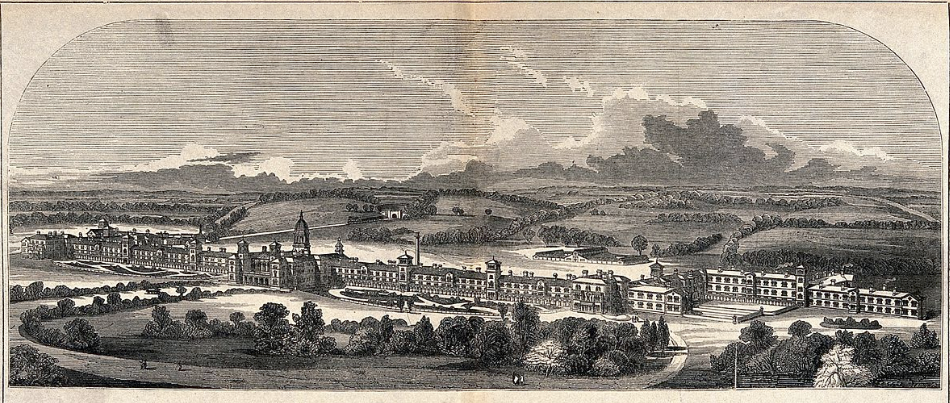
At some point between 1901 and 1903, Catherine and Joseph William’s youngest son, Maurice – then a young man of 23 – was admitted into the Mile End Old Town workhouse on Bancroft Road. He was eventually released on 21 April 1903, only to be sent to Colney Hatch Lunatic Asylum in Barnet. The Asylum had only recently been partially devastated by a fire which had claimed the lives of over 50 female inmates. Remains of the distressing event must have been evident by the time Maurice arrived there 120 years ago. Alas, it was to remain his permanent residence for the remainder of his life: he died there of pulmonary and intestinal tuberculosis in February 1915.
1911 would be the last time that Joseph William Rodway would be recorded on a national census. At the time, he was living at 173 Garratt Lane, Wandsworth. Living with my 65-year-old relative were a servant (a widow called Kate Taylor, of Monmouth) and two boarders (Henry and Emma Carter, of Chelsea). Despite his advanced years and personal circumstances – or perhaps because of them – Joseph William was still working as a greengrocer. Things likely took a turn for the worse shortly thereafter, and by late July he was taken to the recently-opened St James Infirmary, in Balham, where he finally succumbed to mitral valve disease. Touchingly, his estranged wife Catherine was present, and it was she who registered the death the same day of his passing in the local registry office. It seems that by the end at least, Joseph William and Catherine and made peace with each other.
A tragic epilogue
The final, tragic chapter of the family’s story took place three decades later, at the height of the Blitz. Joseph William and Catherine’s eldest son (confusingly also called Joseph William) had gone into the greengrocery business like his father and grandfather before him. His marriage to Ida Ethel Clapp had lasted almost forty years, but the couple remained childless.
By 1939, Joseph William Jr had gone blind, forcing him into early retirement. According to a later statement by his wife, he began to act “childishly” – perhaps a sign that he was suffering from mental illness, possibly brought on by syphilis (which is known to cause blindness, impotence and eventually dementia). Be it as it may, Ida Ethel Rodway had to give up her own job in a local shoe factory to nurse her husband. Then, with the onset of war, their home on 11 Martello Road was bombed and badly damaged. Fortunately the couple survived with only superficial injuries, and after a brief spell in hospital, went to stay with Ida Ethel’s sister at 39 Kingshold Road in Hackney. The sudden change of environment was very trying for Joseph William Jr, who became restless in his new surroundings. Ida Ethel also became concerned about their limited income (Joseph William’s old age pension was coming to an end, it seems), and was worried that their old home would have to be pulled down entirely.
As usual, on the morning of 1 October 1940 Ida Ethel made tea for her husband, but just as her sister left for work, she picked up an axe and a kitchen knife, and went to the room upstairs where her husband was resting. Distressed at their pitiful situation, and in a desperate effort to put an end to his miserable existence, she bludgeoned Joseph William Jr on the neck, killing him almost instantly. Offering no resistance, Ida Ethel was arrested and later tried for her husband’s murder, but was spared the death penalty when she was declared insane and unfit to plead. She died at Broadmoor Asylum in 1946, a year after the end of the war.


 The Genealogy Corner